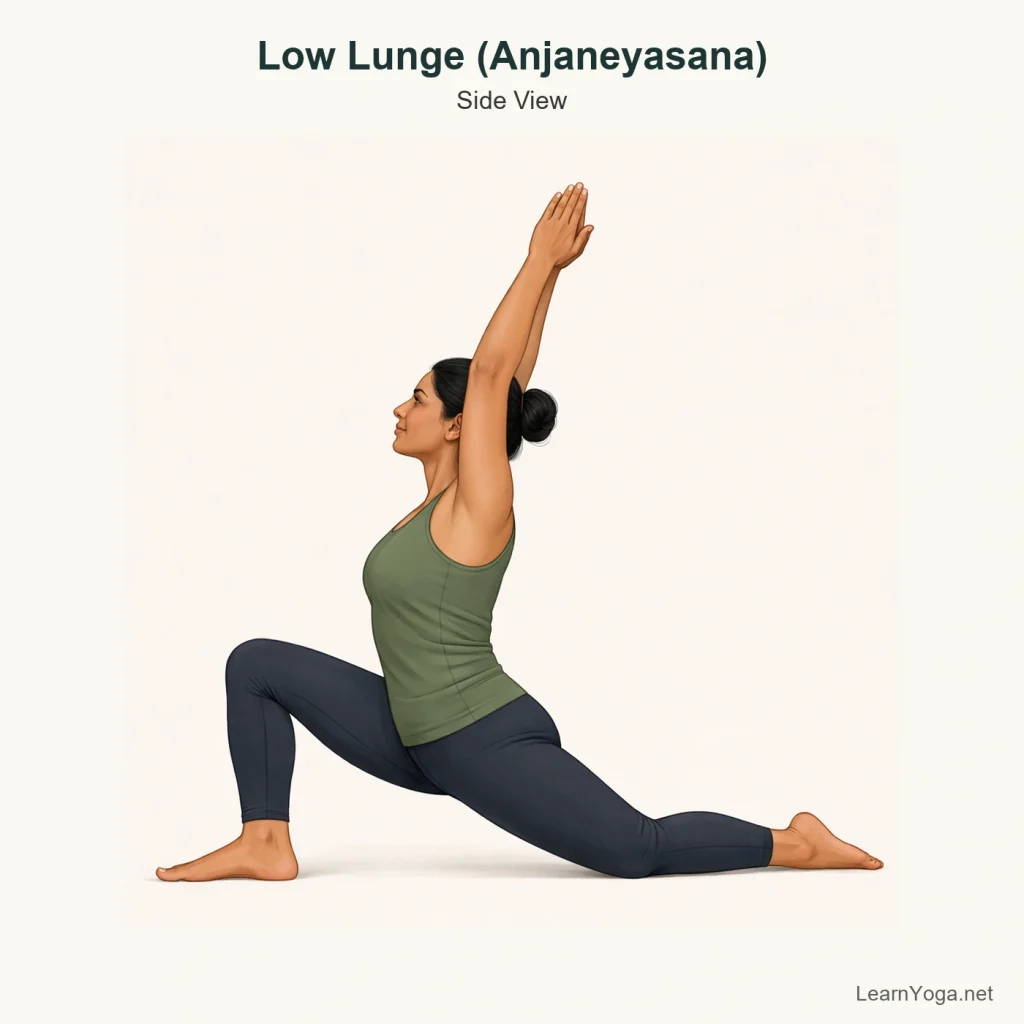
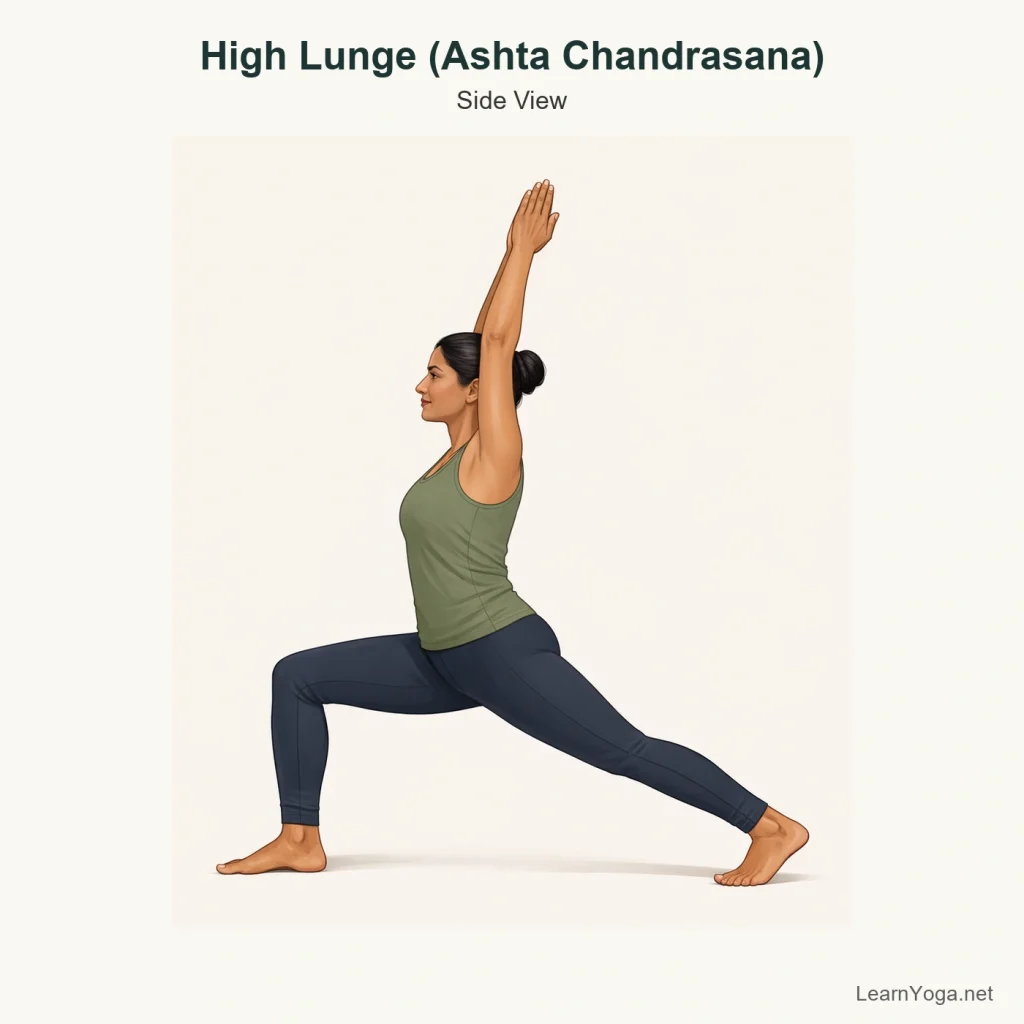
Low Lunge is a simple kneeling lunge that opens the front of the back hip while asking the front leg to steady the shape. It is often used to prepare for standing poses, lunges and backbends.
This lunge gives many people a clear stretch through the front of the back thigh and hip, but it does not need to be deep to be useful. A shorter stance often makes it easier to balance, breathe and keep pressure out of the front knee. You can keep your hands on the floor, on blocks, or lift the torso if that feels steady.
How to do Low Lunge
Start in a kneeling position and step your right foot forward so the knee is roughly above the ankle.
Slide your left knee back until you feel a workable stretch at the front of the left hip or thigh, then untuck or keep the back toes tucked depending on what feels steadier.
Press the front foot down evenly and let the front shin stay close to vertical rather than pushing far past the toes.
Place your fingertips on the floor or on blocks beside the front foot and lengthen the spine forward and up on an inhale.
As you exhale, allow the pelvis to move slightly forward without collapsing into the lower back.
If comfortable, bring your hands to your front thigh or lift the arms overhead while keeping the ribs soft and the neck easy.
Stay for 3 to 6 breaths, then lower the hands, shift the hips back slightly and come out carefully before changing sides.
Yogita's tip
If the stretch disappears as soon as you lift your chest, draw the front ribs in a little and think of the back thigh reaching behind you. That usually brings the work back into the front of the back hip instead of the lower back.
Benefits
Lengthens the front of the back hip and thigh.
Builds awareness of knee-over-ankle alignment in lunging shapes.
Gently strengthens the legs and glutes while the torso stays lifted.
Prepares the body for standing poses, stronger lunges and mild backbends.
Can help you practise balancing effort in the legs with ease in the breath.
Common mistakes
Letting the front knee drift far forward or collapse inward.
Taking the stance so long that the lower back compresses or balance becomes shaky.
Dropping heavily into the back knee without padding.
Lifting the chest by flaring the ribs instead of lengthening through the spine.
Forcing the hips low rather than stopping at a manageable range.
Make it work for you
Back knee blanket
Place a folded blanket or doubled mat under the back knee to reduce pressure on the kneeling leg.
Hands on blocks
Put one block on each side of the front foot and rest your hands there to make more space for the chest and hamstrings.
Shorter stance
Move the front foot a little closer to the back knee so you can keep the pelvis more neutral and the front knee better stacked.
Alternatives
Half Splits Pose
Shift the hips back over the kneeling knee and straighten the front leg partway, keeping the hands on the floor or blocks.
Use this if a deep bend in the front knee is uncomfortable and you want a milder option for the hips and hamstrings.
Constructive Rest Pose
Lie on your back with knees bent and feet on the floor, letting the pelvis and lower back settle.
Use this if getting down into a lunge feels like too much today or you need a floor-based reset.
Kneeling Crescent Pose
Keep the same base as Low Lunge but stay more upright with hands on the front thigh for support.
Use this if you want a similar shape with less demand on the hands and a clearer lift through the torso.
Common variations
Low Lunge with arms overhead
From the basic shape, lift the torso and raise both arms up while keeping the front ribs from pushing forward.
Low Lunge with back toes tucked
Keep the back toes tucked under to add steadiness and make it easier to lift the back knee if you are moving in and out of the pose.
Prayer twist variation
From Low Lunge, bring hands to prayer and rotate toward the front leg if the hips and spine are already warm.
Safety and contraindications
When to avoid or get individual guidance
Recent flare-up of knee pain, especially on the kneeling side.
Hip flexor or quadriceps strain that worsens when the back leg extends.
Balance difficulties that make stepping into or out of the lunge unsafe without support.
Pad the back knee if you feel pressure there.
Keep the front knee tracking in line with the foot rather than rolling inward.
Do not force the pelvis forward to chase a deeper stretch in the hip flexors.
If your lower back feels pinched, shorten the stance and keep your hands lower.
Step out of low lunge and ease the depth or add support if sharp pain shows up in the front knee, back knee, groin, or low back. Repeated pain here is a good reason to pause and get individual guidance before continuing.
Accessibility and limited mobility
If kneeling is uncomfortable, use extra padding under the back knee or choose a higher setup with hands on blocks.
For older adults or anyone who finds getting up and down difficult, practise near a wall or sturdy chair for help with transitions.
A shorter stance usually feels more manageable for limited hip range of motion and helps keep the pose from turning into a backbend.
If balance is uncertain, keep fingertips on the floor or blocks rather than lifting the arms.
Easier options
Use these related poses when you want a more accessible way to practise a similar movement or prepare for this pose.
Only far enough that you feel a clear stretch at the front of the back hip or thigh without losing your breath or crunching the lower back. For many people, the shape works better when it stays a little higher than expected.
What can I do if my back knee hurts?
Add more padding under the knee first. You can also shorten the stance and keep some weight in your hands on blocks. If kneeling still feels sharp or bruised, choose a different shape for now.
Do I need to lift my arms overhead?
No. Hands on the floor, blocks or the front thigh are all valid. Lifting the arms adds more balance and a bigger demand through the torso, but it is not necessary for the pose to be useful.
Why do I feel this in my lower back instead of my hip?
That usually happens when the pelvis tips forward a lot and the ribs push out. Try shortening the stance, keeping your hands lower, and gently drawing the front ribs in as the back thigh reaches away.
Is it better to keep the back toes tucked or untucked?
Either can work. Tucked toes often give more stability and make transitions easier. Untucked toes can feel softer on the foot if the top of the ankle is comfortable on the mat. Choose the version that helps you balance and breathe.
Reviewed for yoga instruction
Yogita
Certified Yoga Instructor with 5+ years of Teaching and Consistent Practice