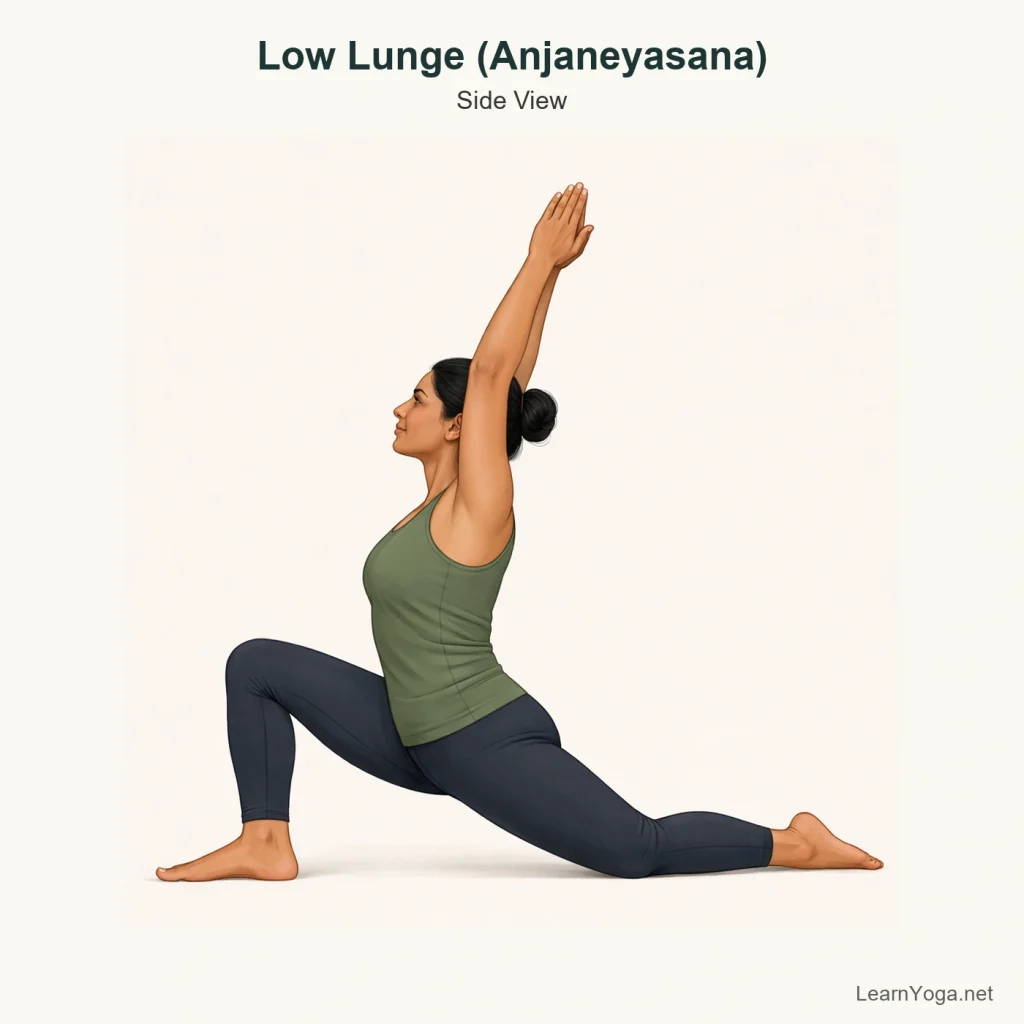
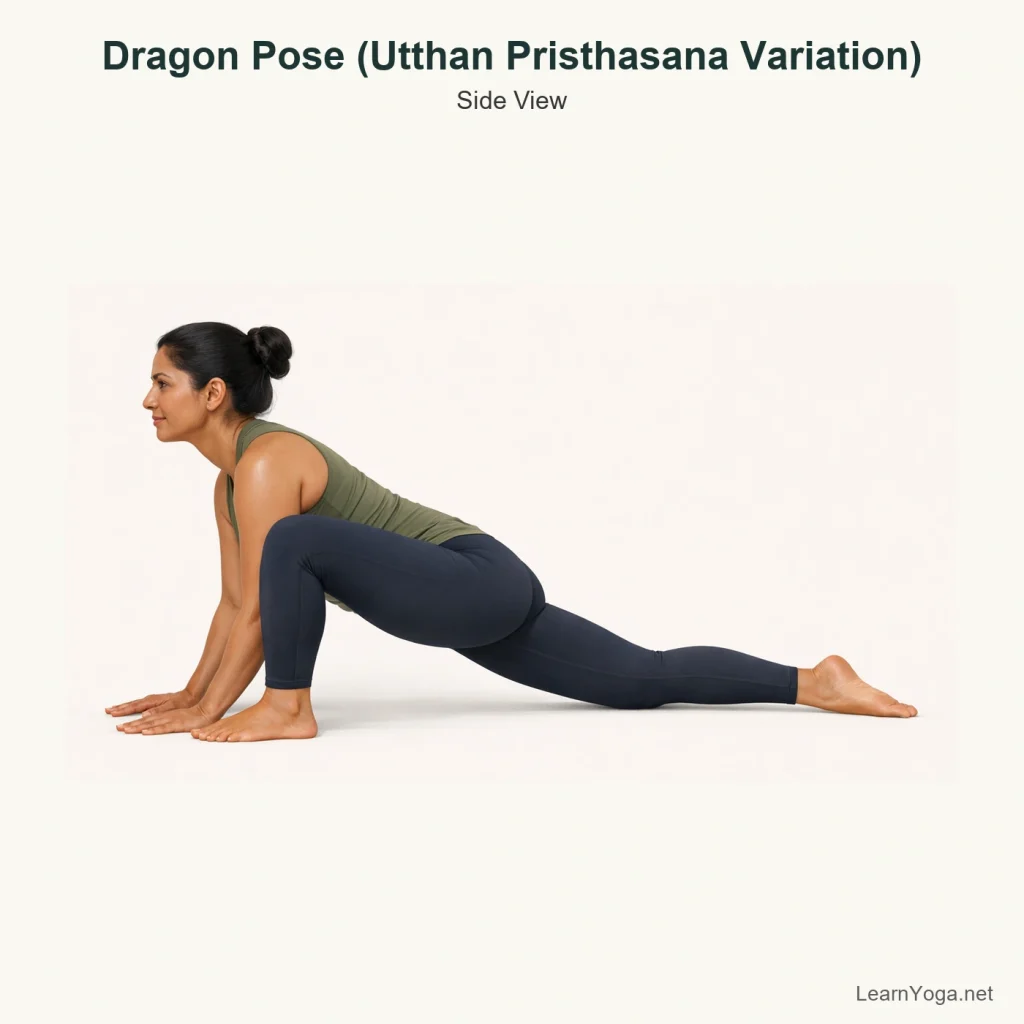
Lizard Pose is a deep low lunge variation that opens the front of the hip on the back leg while asking the front hip to fold more deeply. It can be practised upright on the hands or lowered to the forearms, depending on what feels steady and clear in your body.
Lizard Pose brings together hip flexion, hip extension and a fair amount of weight through the arms if you take it on the floor. For some bodies it feels spacious quite quickly. For others, the floor is simply too far away, and that is completely normal. Treat it as a low lunge with options rather than a shape you must reach.
How to do Lizard Pose
Start in Downward-Facing Dog or from a low lunge. Step your right foot to the outside of your right hand.
Lower your back knee to the floor if you want a steadier base, or keep the back leg active with the knee lifted.
Place both hands inside the front foot. Spread your fingers and press the floor away so the chest stays broad.
Draw the right hip slightly back and lengthen the breastbone forward rather than collapsing down between the shoulders.
If there is room, stay on your hands or lower one forearm at a time to a block or to the floor. Only go lower if your breath stays easy.
Keep the front knee tracking in the same direction as the toes. Let the back leg reach long through the heel.
Stay for 3 to 5 breaths. Use each inhale to create a little more length, and each exhale to soften unnecessary gripping in the hips and jaw.
Press back up to your hands if needed, step the front foot back, and repeat on the second side.
Yogita's tip
If the front knee keeps drifting outward and the inner foot starts to lift, press the big-toe side of the front foot down. That usually makes the leg feel more supported and stops the pose from dumping into the outer hip.
Benefits
Opens the front of the back hip and deepens the fold in the front hip.
Builds familiarity with low lunge positions used in many flowing sequences.
Can improve awareness of how the front knee, foot and hip line up under load.
Gives a stronger stretch sensation through the groins and inner hips than a standard low lunge.
Encourages spinal length and arm support when practised with steady hands.
Common mistakes
Forcing the body lower before the hips and breath are ready.
Letting the chest collapse so the shoulders crowd up around the ears.
Rolling onto the outer edge of the front foot instead of keeping the foot grounded.
Allowing the front knee to twist away from the direction of the toes.
Dropping heavily into the wrists when blocks or forearms would be more suitable.
Make it work for you
Hands on blocks
Place a block under each hand to bring the floor closer. This helps if your chest rounds or your hands do not comfortably reach the floor.
Back knee down
Lower the back knee and place a folded blanket under it if needed. This reduces load and lets you focus on the hip opening rather than balance and leg strength.
Stay upright
Keep straight arms and stay on your hands instead of lowering to the forearms. This is often the better choice if the hips already feel strong sensation.
Alternatives
Low Lunge
Keep the front foot between the hands rather than stepping it outside the hand. Stay lifted through the chest.
Use this if Lizard feels too deep in the hips or difficult on the wrists.
Half Splits Pose
Shift the hips back and straighten the front leg partway, with hands on blocks if needed.
Use this if you want less deep front-hip compression and more focus on the hamstrings.
Supported Child's Pose
Rest the torso over a bolster or stacked pillows with the knees comfortably apart.
Use this if getting low to the floor or bearing weight through the hands is not comfortable today.
Common variations
Forearm Lizard
From the basic shape, lower one forearm and then the other toward the floor or onto blocks while keeping the chest long.
Knee-Down Lizard
Keep the back knee on the floor for a steadier, less demanding version.
Twisting Lizard
From Lizard, rotate the chest toward the front leg side and place one hand to the thigh or reach the arm up if balance allows.
Safety and contraindications
When to avoid or get individual guidance
Recent or irritated knee, groin, hip or wrist pain may make this pose unsuitable today.
Skip the deeper forearm version if it creates pinching at the front of the hip or sharp pressure in the knee.
This pose can be strong on the hips, groins and the back knee if the knee is down. Use padding under the knee if needed.
Keep the front knee and toes generally pointing the same way rather than letting the knee twist.
If your wrists are sensitive, stay higher on blocks or choose Low Lunge instead.
Come out of Lizard Pose and avoid going deeper when sharp knee, groin, hip, or wrist pain shows up, or when soreness hangs around after you release. Choose a higher version on the hands or blocks, and get individual guidance before repeating strong lunge work.
Accessibility and limited mobility
Blocks under the hands can make a big difference if the floor feels far away or if rounding the back makes the pose uncomfortable.
A folded blanket under the back knee can help if kneeling pressure is the main issue.
If getting down to the floor is difficult, practise Low Lunge instead and keep the torso more upright.
Older adults or anyone with reduced hip range may find a shorter stance easier to manage without strain.
Easier options
Use these related poses when you want a more accessible way to practise a similar movement or prepare for this pose.
Do I need to lower onto my forearms in Lizard Pose?
No. Staying on your hands is a complete version of the pose. Lowering to the forearms makes the shape deeper and is only useful if you can do it without collapsing the chest or straining the hips.
Why does Lizard Pose feel so different from side to side?
Many people notice one hip is tighter, one ankle bends differently, or one side feels less stable. That difference is common. It is usually more useful to adjust the stance or use blocks than to force both sides to look the same.
What should I do if my back knee hurts on the floor?
Place a folded blanket under the knee, shorten the stance slightly, or choose Low Lunge instead. Knee discomfort in this pose is often from pressure on the kneecap or from trying to push too far forward.
Should my front foot stay flat?
Yes, or as close to flat as your range allows. Try to keep weight through the big-toe side as well as the outer heel. If the foot keeps rolling out, come a little higher so the leg can organise better.
Where should I feel Lizard Pose most?
Most people feel it in the front of the back hip, the inner hip of the front leg, or both. A strong stretch can be normal, but sharp pain in the knee, groin or front of the hip is a sign to ease out or modify.
Reviewed for yoga instruction
Yogita
Certified Yoga Instructor with 5+ years of Teaching and Consistent Practice