Splits Pose is a deep front-to-back leg position that asks for length through the front hamstring and the back hip flexors and quadriceps. It usually works best with props, patience and a smaller range than people expect.
This is a strong range-of-motion pose rather than a shape to force. For many bodies, a useful version of Hanumanasana happens well above the floor with blocks under the hands or support under the pelvis. A square, steady setup matters more than getting all the way down.
How to do Splits Pose
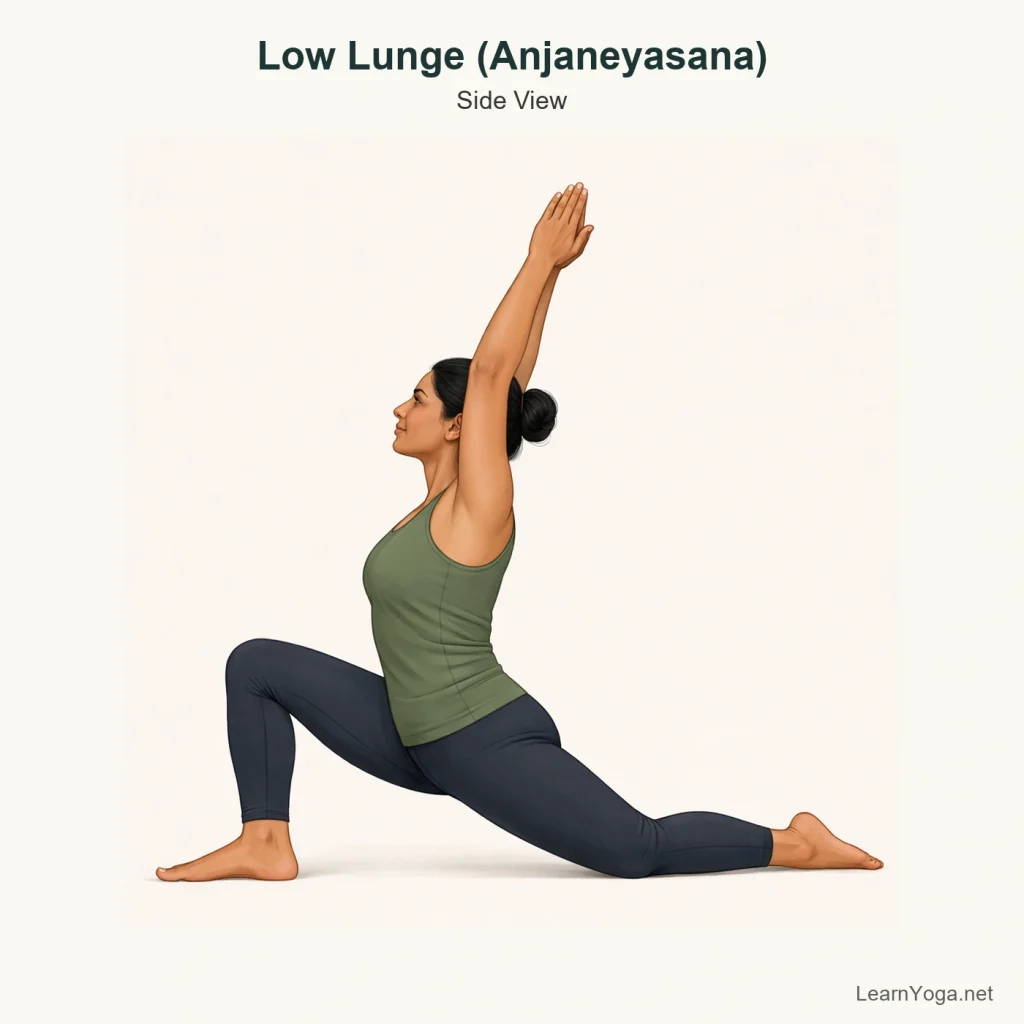
Begin in Low Lunge with your right foot forward and your hands on blocks on either side of the front leg.
Shift your hips back slightly and start to straighten the front leg as the back knee moves farther behind you.
Keep the front heel rooting down and the front toes pointing up or slightly forward, depending on what your knee feels best with.
Let the back thigh reach back as you lower, but keep some lift through the lower belly so you do not collapse into the front of the pelvis.
Pause as soon as you feel you are losing support, twisting to one side, or straining behind the front knee.
Stay with your hands on blocks, or place a folded blanket or bolster under the pelvis so some weight is supported.
Take 3 to 5 even breaths. On each inhale, lengthen the spine. On each exhale, soften only where the body allows without forcing.
To come out, press into your hands, bend the front knee, and carefully draw yourself back to Low Lunge before changing sides.
Yogita's tip
If the front leg keeps turning out and the back hip drifts open, place your hands firmly on blocks and draw the front outer hip back a little. That usually makes the stretch feel more even instead of all landing in one spot.
Benefits
Builds range through the hamstrings of the front leg and the hip flexors and quadriceps of the back leg.
Improves awareness of pelvic alignment and how each leg is working differently.
Encourages steady breath and focus in a demanding shape.
Can help you prepare for other deep lunge and hamstring-focused poses.
Common mistakes
Dropping quickly toward the floor instead of entering in stages.
Forcing the front knee straight and feeling pressure behind the knee rather than in the belly of the hamstring.
Letting the pelvis twist strongly to one side to create the appearance of a deeper split.
Sinking into the lower back without support from the hands or trunk.
Trying to hold the full expression without props when the body is not ready for it.
Make it work for you
Blocks under the hands
Place one block under each hand at a height that lets your spine stay long and your weight stay partly supported.
Support under the pelvis
Slide a bolster, firm cushion or folded blankets under the pelvis so you can pause before the floor and relax less aggressively into the joints.
Micro-bend in the front knee
If the back of the front knee feels sharp or pinchy, keep a small bend in that knee and shorten the stance a little.
Alternatives
Half Splits Pose
From a low lunge, shift the hips back and straighten the front leg only partway while keeping the back knee down.
Use this if full front-to-back split range is too strong or you want a clearer hamstring-focused version.
Low Lunge
Stay upright in a kneeling lunge with the front knee bent and the back knee padded.
Use this if the back thigh or hip flexors are the main limiting area.
Reclining Hand-to-Big-Toe Pose
Lie on your back and work one leg at a time with a strap, keeping the pelvis supported by the floor.
Use this if getting down into or out of a floor split is not practical, or if balance and body weight make the stretch too intense.
Common variations
Supported Splits Pose
The pelvis rests on a bolster or folded blankets while the hands stay on blocks. This is often the most workable version for practice.
Active Splits Pose
Instead of relaxing downward, the legs draw toward each other isometrically, with the front heel pulling back and the back knee dragging forward without moving.
Upright Splits Pose
The torso lifts more upright once the base is steady. This increases the demand on balance and the front of the back hip.
Safety and contraindications
When to avoid or get individual guidance
Recent hamstring strain or tear
Current hip flexor or groin strain
Painful kneeling knee
Any situation where deep split range is not currently tolerated
This pose places strong demand on the front hamstring and the back hip flexors and quadriceps.
Use blocks and, if needed, support under the pelvis so you do not drop into end range without control.
If you feel sharp pulling at the hamstring attachment, strain behind the front knee, or pain in the kneeling knee, come out and choose a smaller version.
Keep the descent gradual. A slightly higher split with steady breath is usually safer and more useful than the deepest possible shape.
Sharp pain high at the front hamstring, strong pulling in the groin, or pain in the kneeling knee that does not ease with props and a shallower split are signs to pause Hanumanasana and choose a smaller version. Get individual guidance before trying full depth again.
Accessibility and limited mobility
This pose can be difficult for anyone with limited hamstring or hip-flexor range, and many practitioners will be better served by Half Splits or Low Lunge.
If kneeling on the back knee is uncomfortable, use a thick folded blanket under the knee or choose a supine option such as Reclining Hand-to-Big-Toe Pose.
Older adults or anyone who finds getting down to the floor awkward may prefer supported lunge and supine variations rather than working toward the full shape.
Easier options
Use these related poses when you want a more accessible way to practise a similar movement or prepare for this pose.
Do I need to reach the floor for this pose to count?
No. For many people, the most useful version is quite a bit higher. If you can keep the pelvis more even, the legs active and the breath steady with support, that is usually a better practice than forcing the floor.
Where should I feel the work most clearly?
Usually in the front hamstring of the front leg and the front of the back hip and thigh. If the main sensation is sharp behind the front knee, in the groin, or directly in the kneeling kneecap, come out and adjust.
Should my hips stay perfectly square?
Perfectly square is not realistic for every body, but some levelness helps keep the stretch more balanced. If one hip swings far open, make the pose higher and organise the pelvis before lowering more.
Is it better to hold the pose or move in and out of it?
Either can work. If you tense up in long holds, try entering halfway, pausing for 1 to 2 breaths, then backing out and repeating a few times. If you can stay calm and supported, a short hold of 3 to 5 breaths is enough.
What if my back knee is the problem rather than my hamstrings?
Pad the knee well and shorten the distance between the legs. You can also stay in Low Lunge or work on a supine hamstring stretch instead. If kneeling itself is the issue, the full pose is probably not the best choice that day.
Reviewed for yoga instruction
Yogita
Certified Yoga Instructor with 5+ years of Teaching and Consistent Practice