Extended Puppy Pose blends the shape of hands-and-knees with the feeling of a gentle heart-opening stretch. It can create space across the chest, shoulders and upper back while keeping the hips stacked over the knees.
Puppy Pose is often more manageable than a full backbend because the knees and shins support you while the arms reach forward. The main work is not pushing lower, but keeping a clear line from hips to hands so the chest can soften between the arms. Some bodies will rest the forehead on the floor, others the chin, and many will hover somewhere in between. All of those can be workable.
How to do Extended Puppy Pose
Begin on hands and knees with your knees about hip-width apart and your hands under your shoulders.
Walk your hands forward several inches, then a little more, while keeping your hips roughly above your knees.
Spread your fingers and press lightly through the palms so the arms stay awake rather than collapsing.
Let your chest move down toward the floor between the upper arms. Rest your forehead on the mat if it reaches comfortably.
If your forehead does not reach, place a block or folded blanket under it so your neck can relax.
Keep a small tone in the lower belly so the ribs do not spill heavily toward the floor.
Stay for 3 to 8 breaths. On each inhale, lengthen from hips through fingertips. On each exhale, let the armpits and chest soften.
To come out, press into your hands and walk them back until you return to hands and knees.
Yogita's tip
If the stretch disappears and the pose just feels like your lower back dropping, shift your hands a touch wider and draw the front ribs very slightly in. That often brings the sensation back into the chest and underarms.
Benefits
Gently opens across the chest, shoulders and underarms.
Can help you explore upper-back extension without a strong load on the legs.
Offers a clear way to practise keeping the hips steady while the arms lengthen forward.
May feel settling when used as a short pause between stronger poses.
Common mistakes
Walking the hands so far forward that the shoulders feel jammed or the lower back takes over.
Letting the hips drift back toward the heels, which turns the pose closer to Child's Pose.
Dropping the chest down without any support through the hands and arms.
Forcing the chin to the floor even when the neck feels compressed.
Make it work for you
Forehead on a block
Place a yoga block, stacked fists or a folded blanket under your forehead if the floor feels too far away. This usually makes the pose calmer and helps the neck soften.
Blanket under the knees
Add a folded blanket under your knees or shins if kneeling pressure is distracting.
Less depth
Keep your hands a little closer to your knees and take a smaller version of the shape if your shoulders feel tight or the chest cannot drop comfortably.
Alternatives
Child's Pose
Take your hips back toward your heels and let your arms reach forward or rest by your sides.
Use this if kneeling is fine but the shoulder stretch in Puppy Pose feels too strong.
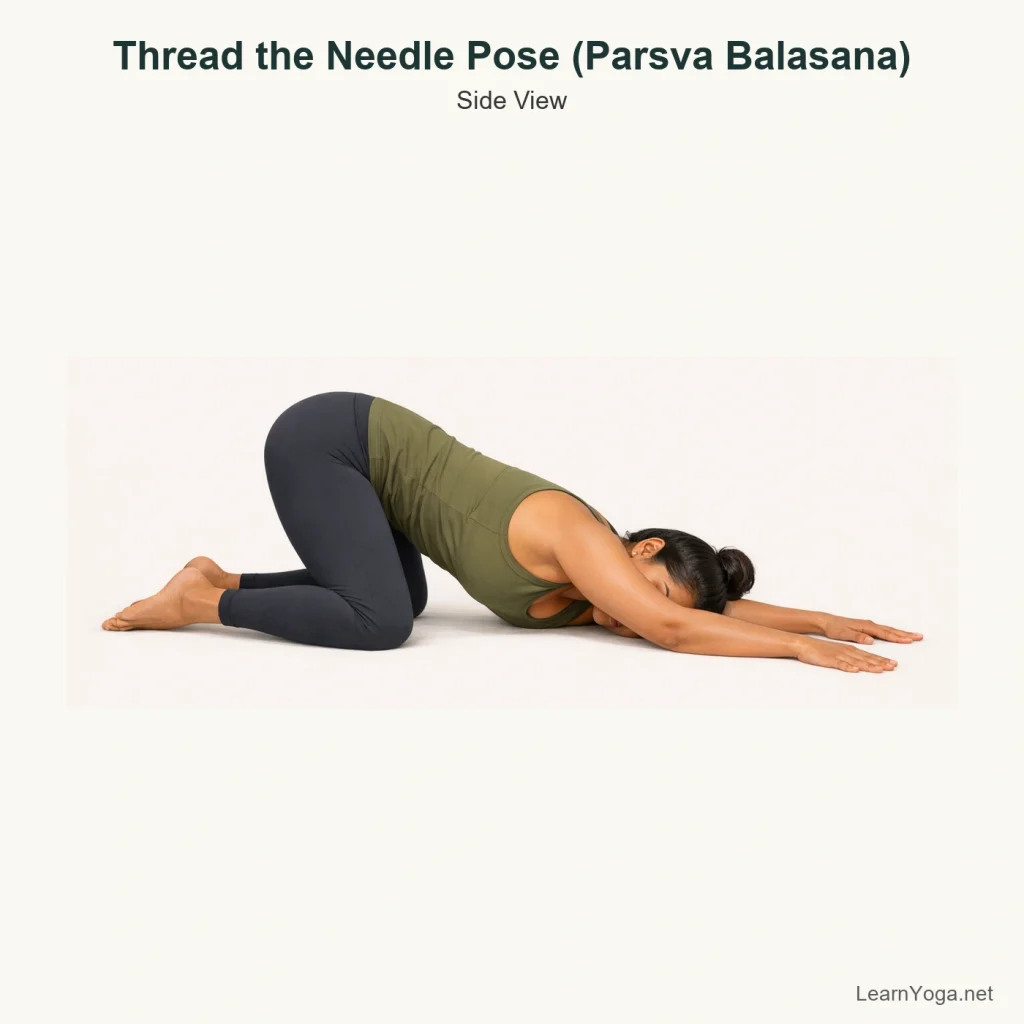
Thread the Needle Pose
From hands and knees, slide one arm under the other and rest on the shoulder and side of the head, then switch sides.
Use this if you want a gentler upper-back and shoulder opening with less chest drop.
Supported Child's Pose
Rest your torso on a bolster or stacked cushions with your knees bent comfortably.
Use this if getting low to the floor is tiring or you want a more supported resting option.
Common variations
Forehead-supported Puppy Pose
The forehead rests on a block or folded blanket to reduce effort in the neck and make the stretch steadier across the shoulders.
Chin-to-floor Puppy Pose
A deeper variation where the chin moves toward the mat and the throat opens more. Only useful if the neck stays long and uncompressed.
Wide-knee Puppy Pose
The knees move a little wider apart, which can give the belly and chest more room and change the sensation through the front body.
Safety and contraindications
When to avoid or get individual guidance
Recent or aggravated knee pain may make the kneeling position uncomfortable.
Reduce the depth or skip the pose if shoulder flexion overhead is currently painful.
Avoid dropping the chin down if that bothers your neck.
Keep the pose mild if your shoulders feel pinchy. Bringing the hands slightly wider or less far forward usually helps.
Support the head if it does not comfortably reach the floor so the neck does not hang.
If kneeling is uncomfortable, add padding or choose a non-kneeling alternative.
Come out of Extended Puppy Pose and ease the depth when shoulder, knee, or neck pain feels sharp, or when tingling in the arms does not settle after you release. Choose a gentler version or get individual guidance before trying it again.
Accessibility and limited mobility
If getting onto the floor is difficult, this pose may be less practical than a supported chest-opening shape done at a bed, sofa or chair.
Extra padding under the knees can make a big difference for older adults or anyone sensitive to kneeling.
A block under the forehead is often helpful when shoulder range is limited, because it reduces the amount of reaching needed.
Easier options
Use these related poses when you want a more accessible way to practise a similar movement or prepare for this pose.
For most people, forehead down is the steadier starting version. It keeps the neck quieter and lets you focus on length through the arms and chest. Chin down is deeper and is not necessary if it feels compressed.
Why does this feel more in my lower back than my shoulders?
That usually means the ribs are dropping too heavily or the hands have walked too far forward. Try bringing the hands slightly back, keeping the hips over the knees, and lightly drawing the front ribs in.
How far apart should my knees be?
Hip-width is a useful default, but it does not have to be exact. If your belly or chest feels crowded, a slightly wider stance may be more comfortable. If your lower back feels unstable, bringing the knees a little closer can help.
Can I stay here for a long hold?
You can, but it does not need to be long to be useful. Three to eight breaths is enough for many people. If you hold longer, keep checking that your shoulders are not becoming dull or compressed.
What if my head does not reach the mat?
Place a block, cushion or folded blanket under the forehead. That support often makes the pose feel clearer, because you can relax the neck instead of hovering and straining to reach down.
Reviewed for yoga instruction
Yogita
Certified Yoga Instructor with 5+ years of Teaching and Consistent Practice