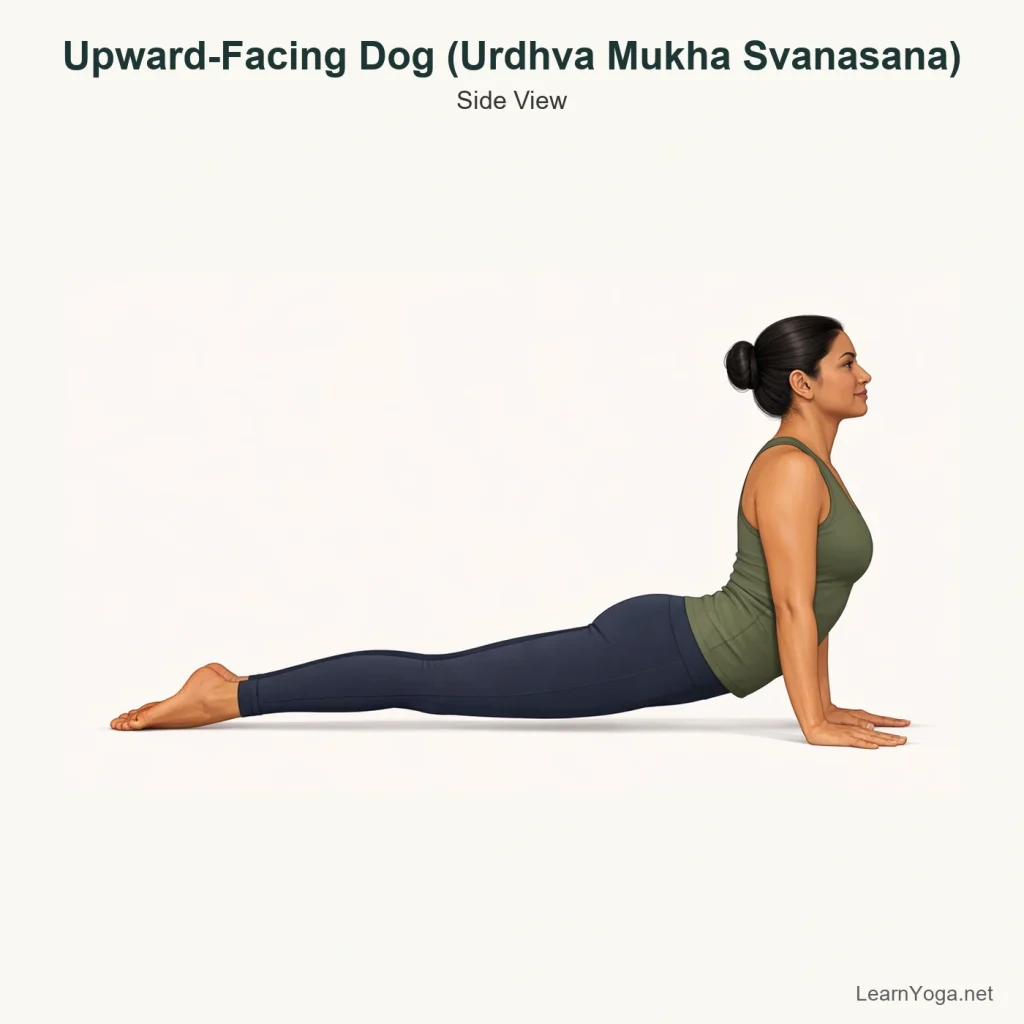
Cobra Pose is a gentle prone backbend that helps you practice lifting the chest with support from the back muscles, while keeping some weight light in the hands.
Cobra is often clearer when you think of it as a chest-opening action rather than a push-up. The hands do help, but the main work is usually in the back body. A small Cobra is often more useful than trying to lift very high. Comfortable range differs from body to body, so let the height be modest if that keeps the lower back and neck feeling easy.
How to do Cobra Pose
Lie on your belly with your legs stretched back and the tops of the feet on the mat. Let the legs rest hip-width apart or a little wider if that feels easier on your lower back.
Place your palms beside the lower ribs or chest, with elbows bent and pointing back rather than out wide.
Press the tops of the feet and the front of the pelvis down lightly, and lengthen the tailbone toward the heels.
On an inhale, begin to lift your head and chest by drawing the chest forward and slightly up. Use your back muscles first, then add a small amount of pressure into the hands if you need it.
Keep the elbows softly bent and close enough to the body that the shoulders do not roll forward. Let the collarbones broaden.
Lift only to a height where the lower belly can stay heavy and the lower back does not feel pinched. Your pubic bone and usually at least part of the lower ribs stay on the floor.
Keep the back of the neck long. Look slightly forward or down, rather than throwing the chin up.
Stay for 2 to 5 breaths, or lower down on an exhale and repeat a few smaller rounds.
Yogita's tip
If Cobra keeps landing in your hands, try briefly hovering the palms for a tiny Baby Cobra first. That usually shows you how much lift can come from the upper back rather than from pushing the floor away.
Benefits
Builds awareness of how to extend the spine without forcing a big range.
Strengthens the muscles along the upper and mid-back that help support an upright posture.
Opens the front of the chest and shoulders after time spent rounded forward.
Can prepare the body for larger backbends by teaching a smaller, more controlled lift.
Common mistakes
Pushing strongly with the hands and skipping the work of the back muscles.
Lifting so high that the lower back feels compressed.
Letting the shoulders creep up toward the ears.
Throwing the head back instead of keeping the neck long.
Letting the elbows wing out wide.
Make it work for you
Baby Cobra
Keep your hands light or lift them slightly off the mat, then raise the chest only a little. This reduces pressure in the lower back and helps you feel the back muscles working.
Folded blanket under ribs
Place a thin folded blanket under the lower ribs if the front body feels tender on the floor. Keep the lift small and steady.
Wider legs
Take the feet and legs a bit wider apart if your lower back feels crowded. Then lift less and focus on length through the front of the body.
Alternatives
Sphinx Pose
Come onto your forearms with elbows under or slightly in front of the shoulders, and lift the chest gently.
Use this if straightening the arms or placing the palms near the ribs feels uncomfortable, or if you want a steadier, lower backbend.
Baby Cobra
Lift the chest only an inch or two with very little hand pressure, then lower back down.
Use this if a fuller Cobra feels jammed in the lower back or heavy in the shoulders.
Supported Fish Pose
Lie back over a bolster or folded blankets under the upper back and let the chest open without bearing weight through the arms.
Use this if lying prone is not comfortable or getting pressure through the hands is not suitable.
Common variations
Baby Cobra
A lower version with little or no weight in the hands, useful for learning the spinal action.
Higher Cobra
A deeper lift with more arm assistance, done only if the chest can stay broad and the lower back remains comfortable.
Safety and contraindications
When to avoid or get individual guidance
Recent or aggravated wrist pain may make the hand position uncomfortable.
If prone backbending currently irritates your lower back, stay with Baby Cobra or Sphinx Pose.
During pregnancy, lying on the belly is often not comfortable or appropriate; choose a non-prone chest opener instead.
Keep the backbend mostly in a comfortable range, especially through the lower back.
If your wrists feel strained, reduce the pressure in the hands or switch to Sphinx Pose.
If your neck feels compressed, lower your gaze and make the lift smaller.
Sharp pain in the lower back, tingling, or pain that starts to travel into the arms during Cobra—even after lowering the lift or switching to Sphinx or Baby Cobra—means it’s best to pause backbends and get individual guidance before continuing.
Accessibility and limited mobility
If getting down to the floor is difficult, Supported Fish Pose may give a similar chest-opening shape more accessibly.
A small Cobra is often more manageable than trying to straighten the arms. Height is not the goal here.
If pressure on the front of the pelvis feels uncomfortable, place a thin blanket under the hips or choose Sphinx Pose instead.
Easier options
Use these related poses when you want a more accessible way to practise a similar movement or prepare for this pose.
Only lift to the point where your chest feels open and your lower back still feels spacious. For many people that is quite low. A smaller Cobra done clearly is usually more useful than a high one pushed from the hands.
Why do my elbows keep splaying out?
This often happens when you try to push up before the chest moves forward. Set the hands a little farther back beside the ribs, hug the elbows in, and think of sliding the breastbone forward first. The lift usually becomes steadier.
Should I straighten my arms in this pose?
Not necessarily. In many versions of Cobra, the elbows stay bent. Straight arms can work for some bodies, but only if the shoulders stay broad and the lower back remains comfortable. Bent elbows are completely fine.
What if Cobra bothers my wrists?
Try using much less hand pressure, or practice Baby Cobra with the palms light. Sphinx Pose is another good option because it changes the wrist angle and often feels steadier.
Is it better to hold Cobra or repeat it several times?
Either can work. If you are learning the shape, 3 to 5 gentle lifts with the breath often feel clearer than one long hold. If the pose feels easy and even, staying for 2 to 5 breaths can help you settle into the back-body work.
Reviewed for yoga instruction
Yogita
Certified Yoga Instructor with 5+ years of Teaching and Consistent Practice