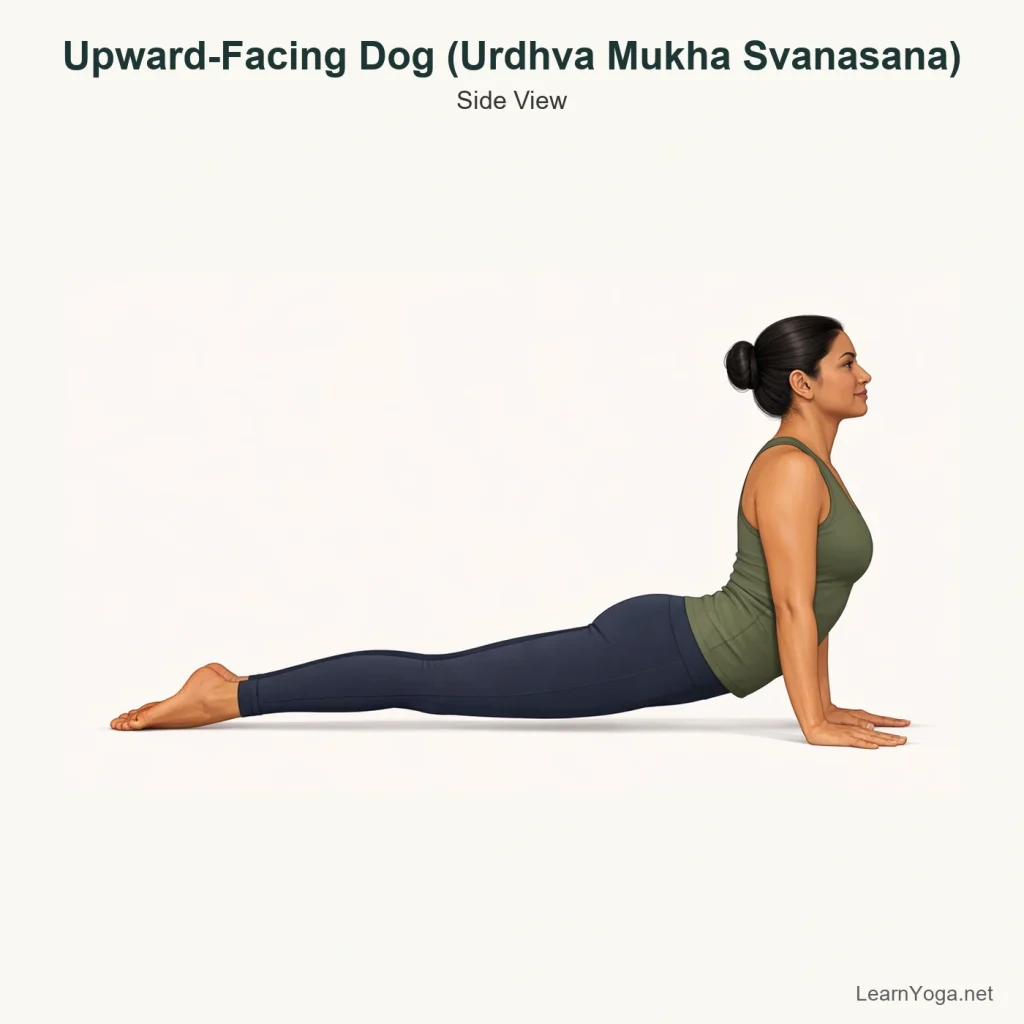
Baby Cobra is a small prone backbend that helps you practise lifting the chest from the upper back rather than pushing hard with the hands. It is often a more manageable starting point than a higher Cobra shape.
The lift in Baby Cobra is modest, but there is still plenty to organise. The front body lengthens, the shoulders draw away from the ears, and the upper back starts the action. It can be useful early in practice, especially if a bigger backbend tends to feel compressed or rushed. Comfortable height differs from body to body, so a very low lift is still the pose.
How to do Baby Cobra
Lie on your belly with your legs reaching back and the tops of the feet on the mat. Let your forehead or chin rest lightly down to begin.
Place your hands beside the lower ribs or a little forward of them, with elbows bent and close to your body.
Press the tops of the feet and the front of the pelvis gently into the floor so the lower body feels anchored without gripping hard.
On an inhale, draw your chest forward first, as if you are sliding the breastbone ahead. Then lift the head and chest a small amount.
Keep some weight light in the hands, or briefly hover them to check that the back muscles are doing the work.
Broaden across the collarbones and let the shoulder blades move gently toward the back ribs without pinching together sharply.
Stay low enough that the lower ribs remain close to the floor and the back of the neck stays long.
Take 2 to 5 steady breaths, or exhale to lower and repeat for several rounds.
Yogita's tip
If the lift feels crowded in your neck, lower your gaze slightly and think of the chest moving forward along the floor before it moves up. That usually spreads the curve into the upper back instead of bunching it at the throat.
Benefits
Builds awareness of how to create a backbend from the upper back rather than from the hands alone.
Gently strengthens the muscles along the back body.
Opens the front of the chest in a small, manageable range.
Can prepare the body for Cobra, Sphinx or Upward-Facing Dog later in practice.
Helps you practise coordinating breath with a controlled lift and lower.
Common mistakes
Pushing strongly through the hands and lifting higher than the back can comfortably support.
Throwing the head back instead of keeping the back of the neck long.
Letting the shoulders creep up toward the ears.
Pinching the lower back by trying to force height.
Squeezing the buttocks as hard as possible, which can make the back feel more compressed.
Make it work for you
Hands slightly forward
Move the hands a few centimetres in front of the shoulders. This usually reduces the steepness of the backbend and can make it easier to keep the chest reaching forward.
Very low hover
Lift only the head and upper chest a little, keeping the lower ribs grounded. Think of length first and height second.
Blanket under ribs or pelvis
Place a folded blanket under the low ribs or front hip bones if the floor feels too hard. This can make the pose more comfortable without changing the basic shape much.
Alternatives
Sphinx Pose
Come onto the forearms with elbows under or slightly in front of the shoulders, and keep the chest broad.
Use this if pressing into the palms bothers the wrists or if a supported backbend feels steadier.
Crocodile Pose
Lie on your belly with your forehead resting on stacked hands and let the back settle.
Use this if even a small backbend feels too intense today.
Baby Cobra with hands hovering
Lift the chest slightly without pressing into the floor with the hands.
Use this if you want to learn how little height is needed and how much support can come from the upper back.
Common variations
Dynamic Baby Cobra
Lift on each inhale and lower on each exhale for several slow rounds instead of holding.
Baby Cobra with fingertips down
Keep only the fingertips on the floor to reduce pushing and make the back muscles do more of the work.
Baby Cobra with legs hip-width
Practise with the feet and legs a little apart if that feels easier on the lower back than keeping the legs together.
Safety and contraindications
When to avoid or get individual guidance
Skip or reduce the pose if prone backbends currently aggravate your lower back.
Use caution with a recent wrist, rib or abdominal strain, since even a small lift can be uncomfortable.
Keep the lift small enough that the lower back feels long rather than jammed.
If your wrists are sensitive, reduce pressure into the hands or switch to Sphinx.
Avoid cranking the head back. Let the back of the neck stay in line with the rest of the spine.
Sharp lower-back pain, pain that catches with breathing, or strong wrist discomfort during Baby Cobra—even with a very small lift or after switching to Sphinx—are good reasons to pause and get individual guidance before continuing.
Accessibility and limited mobility
This pose requires getting down to and up from the floor. If that transition is difficult, Sphinx may be easier to organise once you are down, but a seated chest-opening alternative may be more practical off the mat.
A very low lift is completely valid. Older adults or anyone with a stiffer upper back may work almost entirely with the forward reach of the chest.
If lying flat on the belly is uncomfortable because of breast, belly or rib pressure, place a folded blanket for padding or choose a different gentle backbend.
Easier options
Use these related poses when you want a more accessible way to practise a similar movement or prepare for this pose.
Usually lower than you think. A small lift is enough if the chest moves forward, the shoulders stay broad, and the lower back feels comfortable. Height matters less than how evenly the spine is working.
Should I press into my hands or barely use them?
Light support from the hands is fine, but they should not do all the work. If you push so much that the shoulders climb up or the lower back pinches, reduce the effort and lower the shape.
Why do I feel this mostly in my lower back?
That often happens when the lift goes up before it goes forward. Try making the chest slide ahead first, keep the ribs lower, and choose less height. Sometimes taking the hands slightly forward also helps.
Can I keep my legs apart instead of together?
Yes. Some people feel steadier with the legs hip-width apart, especially if bringing the legs together makes the lower back feel cramped. Use the version that gives you a clearer, more comfortable lift.
Is Baby Cobra better as a hold or repeated with the breath?
Both can work. Repeating it with each inhale and exhale is often easier when you are learning, because it helps you stay light and organised. A short hold can be useful once the shape feels steady.
Reviewed for yoga instruction
Yogita
Certified Yoga Instructor with 5+ years of Teaching and Consistent Practice