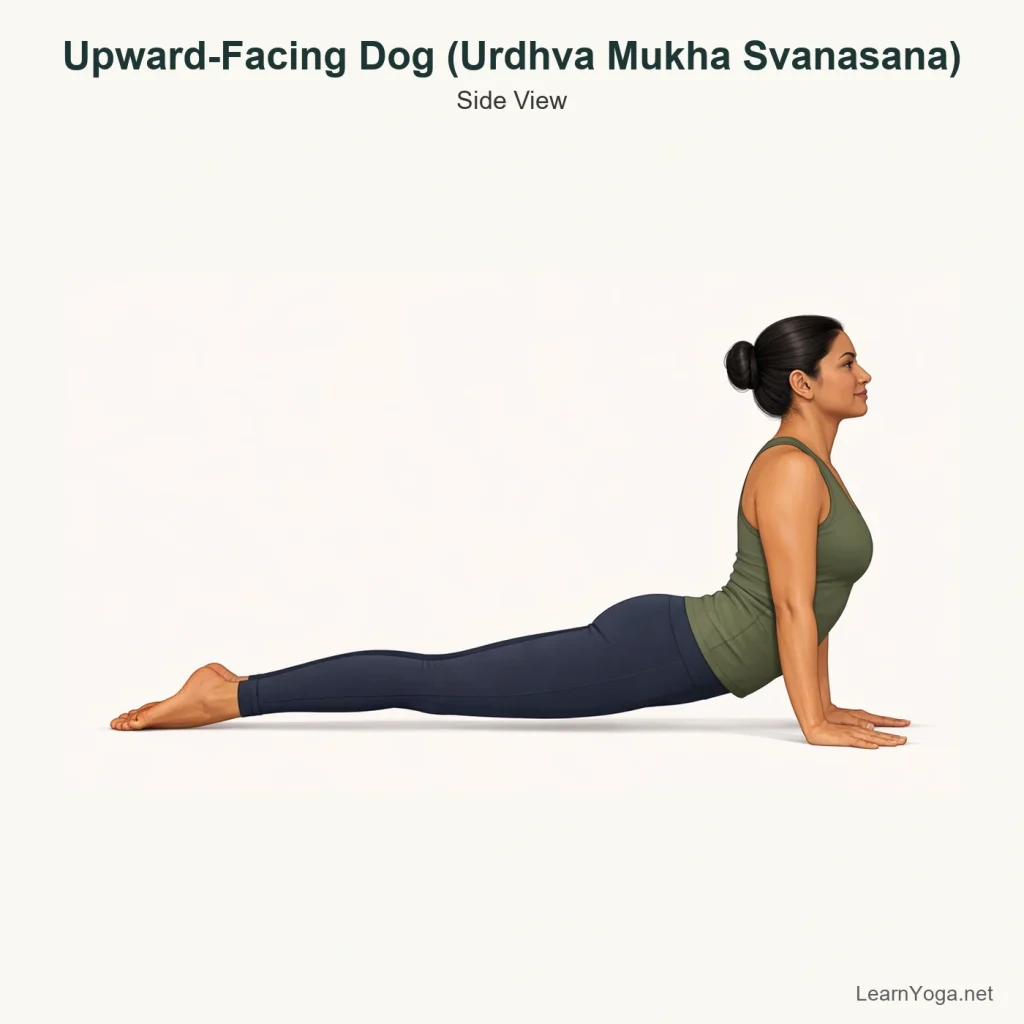
Sphinx Pose is a low supported backbend done on the belly with the forearms on the floor. It gives you a clear way to open the front of the chest and wake up the upper back without asking for a big lift.
Sphinx is often a useful place to learn how a backbend can feel steady rather than dramatic. Because your forearms stay down, there is less demand on the wrists than in straighter-arm shapes. The pose can be small. For some bodies, a very modest lift is the most comfortable version.
How to do Sphinx Pose
Lie on your belly with your legs reaching straight back. Let the tops of the feet rest on the floor and place your forearms down in front of you.
Bring your elbows roughly under your shoulders, with your forearms parallel or slightly angled in if that feels more natural.
Press down lightly through the forearms and draw the chest forward, as if you are sliding it through the arms rather than pushing straight up.
Let the front of the shoulders move away from the ears. Keep the back of the neck long and look slightly forward or down, not sharply upward.
Allow the lower ribs and belly to stay heavy enough that the lift spreads through the whole spine instead of jamming into one spot.
Stay for 5 to 10 breaths. On each inhale, feel a little more length through the breastbone. On each exhale, soften the jaw, throat and lower back.
To come out, lower the chest down slowly and rest one cheek on the mat or take Child's Pose if kneeling feels comfortable.
Yogita's tip
If Sphinx feels pinchy in the lower back, try dragging your elbows back very slightly without actually moving them. That gentle isometric action often helps the chest come forward and spreads the bend more evenly.
Benefits
Gives a gentle supported backbend with less wrist demand than straighter-arm poses.
Helps you practise lifting through the chest without forcing a high shape.
Brings awareness to the upper back and shoulder position.
Can lightly stretch the front of the body, especially across the chest and belly.
Works well as a preparation for Cobra Pose, Upward-Facing Dog or other backbends.
Common mistakes
Letting the shoulders creep up toward the ears.
Pushing so high that the sensation collects only in the lower back.
Throwing the head back instead of keeping the neck long.
Setting the elbows too far forward, which can make the chest collapse.
Gripping the buttocks hard and losing ease in the breath.
Make it work for you
Elbows slightly forward
If the backbend feels strong, move the elbows a little in front of the shoulders. This lowers the lift and usually makes the shape easier to stay with.
Blanket under forearms
Place a folded blanket under the forearms and elbows if the floor feels too hard or if you want a bit more comfort while holding the pose.
Wider forearm placement
Take the forearms a little wider if the shoulders feel crowded. Keep pressing down evenly and let the chest move forward between the arms.
Alternatives
Crocodile Pose
Rest on your belly with your forehead or one cheek supported on your hands.
Use this if even a small backbend feels tiring or you want a prone resting option.
Baby Cobra
Keep the hands beside the chest and lift only a little, with very light pressure in the hands.
Use this if Sphinx feels too passive and you want to explore a small active backbend.
Supported Fish Pose
Lie back over a bolster or folded blankets to open the chest without being on the belly.
Use this if getting onto the stomach is uncomfortable or difficult.
Common variations
Low Sphinx
The elbows are placed slightly ahead of the shoulders to reduce the depth of the backbend.
Seal-style variation
From Sphinx, some practitioners explore a higher lift by straightening the arms partway or fully, though this becomes a different and stronger backbend.
Sphinx with bent knees
The knees bend and the lower legs lift while the chest stays in Sphinx, creating a different front-body sensation for some people.
Safety and contraindications
When to avoid or get individual guidance
Recent or aggravated low back pain may call for a smaller range or a different prone rest shape.
Skip or reduce the pose if lying on the belly is uncomfortable for you today.
Keep the lift mild enough that you can breathe comfortably and turn your head only minimally.
If your lower back feels compressed, bring the elbows a little forward or come down partway.
If the front of the shoulders feels pinchy, widen the forearms slightly or reduce the height.
Pause Sphinx and lower all the way down when you notice sharp pinching in the low back, tingling, or discomfort that does not settle after reducing the lift or resting. Choose a gentler prone rest shape and get individual guidance before continuing.
Accessibility and limited mobility
If lying on the belly is uncomfortable, choose Supported Fish Pose instead.
A folded blanket under the ribs or forearms can make the floor feel more manageable.
For older adults or anyone with limited range in the spine, a very low version with elbows further forward is often more comfortable than trying to match a picture.
If getting down to the floor is difficult, a reclining chest opener such as Supported Fish may be more practical for regular practice.
Easier options
Use these related poses when you want a more accessible way to practise a similar movement or prepare for this pose.
That is a useful starting point, but it does not need to be exact. If the pose feels too strong in your lower back, moving the elbows a little forward usually makes it more comfortable. If your chest collapses, bring them slightly back.
Why does Sphinx feel stronger in my lower back than in my upper back?
That often happens when the chest is pushing up instead of reaching forward. Try pressing the forearms down, lengthening the breastbone forward, and keeping the lower ribs heavy. A smaller lift is often the better one here.
What should my legs be doing in this pose?
Keep them long and fairly relaxed, with the tops of the feet on the floor. Some light engagement through the legs can help you feel steady, but there is no need to clamp the buttocks or make the legs rigid.
Can I stay in Sphinx for more than a few breaths?
Yes, if the shape stays easy in your breath and your lower back does not start to feel crowded. You might hold for 30 to 60 seconds, but there is no extra value in staying longer if the pose becomes tense.
Reviewed for yoga instruction
Yogita
Certified Yoga Instructor with 5+ years of Teaching and Consistent Practice