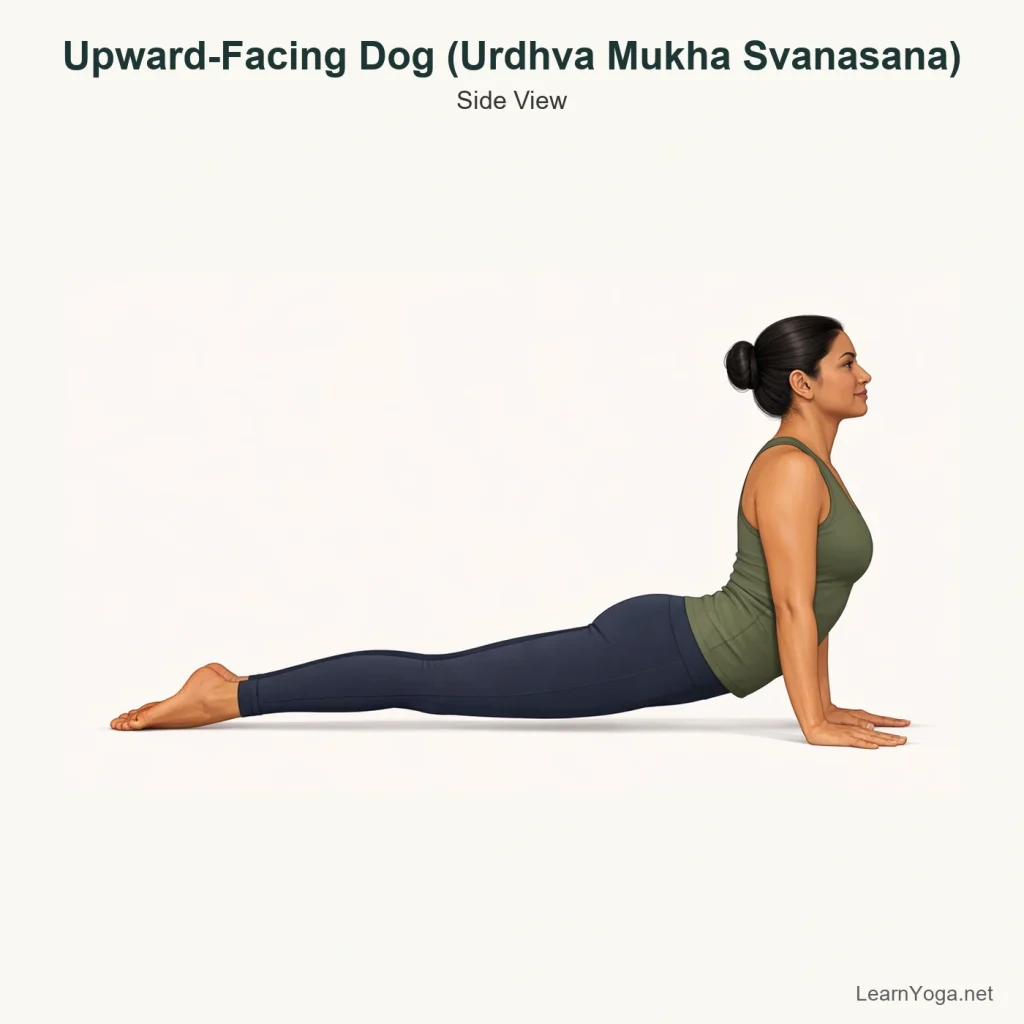
Upward-Facing Dog is a strong backbend done from the floor with straight arms, a broad chest and the thighs lifted away from the mat. It asks the legs, hands and spine to work together rather than dropping the weight into the lower back.
This pose shows up often in vinyasa practice, but it is easier to understand when you break down the shape. The hands press, the chest moves forward and up, and the legs stay active enough to keep some lift through the thighs. Your version does not need the deepest backbend. A smaller, steadier shape is usually clearer.
How to do Upward-Facing Dog
Lie on your belly with your legs extended straight back, tops of the feet on the mat, and your hands beside the lower ribs.
Draw your elbows in close to your body and gently firm the fronts of the thighs as if they are preparing to lift.
On an inhale, press into your hands and the tops of your feet, sliding your chest forward before lifting it up.
Straighten your arms only as much as you can without jamming the shoulders or dumping into the lower back.
Lift the thighs slightly away from the floor if that feels available, and keep the legs active from hips to toes.
Broaden across the collarbones and let the shoulder heads move back while the back of the neck stays long.
Stay for 1 to 3 breaths, keeping the front of the body open and the breath smooth rather than forcing more height.
To come out, lower with control to your belly or press back through hands-and-knees toward Child's Pose.
Yogita's tip
If the pose feels stuck in your lower back, think of pulling your chest forward through your arms before trying to lift higher. That small glide usually spreads the curve more evenly through the spine.
Benefits
Builds arm and shoulder support while the spine moves into back extension.
Opens the front of the chest and helps counter the rounded shape many people carry after sitting.
Strengthens the legs and feet when you keep the thighs active instead of resting heavily on the floor.
Can bring more awareness to how the upper back, shoulders and lower ribs work together in backbends.
Common mistakes
Pushing straight up without moving the chest forward first, which can compress the lower back.
Letting the shoulders creep toward the ears and the chest collapse between the arms.
Leaving the legs passive so the pelvis and thighs feel heavy.
Locking the elbows to force a bigger shape instead of choosing a workable height.
Throwing the head back and shortening the back of the neck.
Make it work for you
Lower Upward Dog
Keep a soft bend in the elbows and lift the chest only part way while still reaching the breastbone forward. This reduces the depth of the backbend.
Blocks Under Hands
Place your hands on yoga blocks set on a low height if you need more space across the chest or wrists. Move slowly so the shoulders stay steady.
Alternatives
Baby Cobra
Keep the pelvis and legs on the floor, lift the chest lightly, and use less pressure through the hands.
Use this if straight-arm backbending feels too strong or your lower back gets pinchy.
Sphinx Pose
Come onto your forearms with elbows under shoulders and gently draw the chest forward.
Use this if your wrists do not enjoy weight-bearing in extension.
Cobra Pose
Lift the chest with bent elbows and keep some weight grounded through the pelvis and legs.
Use this if you want a similar spinal action with less load than full Upward-Facing Dog.
Common variations
Flowing Upward-Facing Dog
Entered from Chaturanga or a floor transition on an inhale, then held for just one breath before moving on.
Supported Hand Variation
Practised with hands on blocks to change the wrist angle and give a little more room through the chest.
Safety and contraindications
When to avoid or get individual guidance
Recent wrist, shoulder or back aggravation may make this pose uncomfortable.
Avoid forcing straight arms if that creates joint pressure.
Keep the backbend spread through the whole spine rather than forcing the lower back to do all the work.
If your wrists feel strained, reduce the load with Cobra or choose Sphinx instead.
A little muscular effort is normal, but sharp pinching in the lower back, shoulders or wrists is a sign to come out.
Pause Upward-Facing Dog when sharp lower back pain, strong wrist pain, or shoulder pinching keeps showing up, even after lowering the intensity or switching to Cobra or Sphinx. Get individual guidance before continuing with stronger backbends.
Accessibility and limited mobility
Getting down to the floor and back up can be the main barrier here. If that transition is awkward, choose Sphinx Pose or a gentle Cobra variation and set up slowly.
Older adults or anyone with less spinal extension may prefer a lower version with bent elbows rather than aiming for straight arms.
If strong wrist extension is limited, forearm-based Sphinx is usually more practical than trying to push through discomfort.
Easier options
Use these related poses when you want a more accessible way to practise a similar movement or prepare for this pose.
In the fuller pose, yes, the thighs are usually slightly lifted. But many people learn the action first with the thighs still brushing the mat. If lifting them makes the lower back grip or the shoulders strain, work with Cobra for now.
Why does this feel much harder in my wrists than I expected?
Upward-Facing Dog puts the wrists into a strong bent-back position while you are also pressing body weight through them. Try reducing the load with Cobra, using blocks, or choosing Sphinx if the wrist angle is the main issue.
Should I straighten my arms completely?
Only if you can do that without the chest sinking and the lower back feeling jammed. For some bodies, a slight bend in the elbows keeps the pose more spacious and better organised.
Where should I look in Upward-Facing Dog?
Usually forward or slightly upward works well. You do not need to throw the head back. Keep the back of the neck long so the throat stays easy and the lift comes more from the chest than from the chin.
Is Upward-Facing Dog the same as Cobra?
They are related, but not the same. In Cobra, the pelvis and legs stay down and the elbows usually remain bent. In Upward-Facing Dog, the arms are straighter, the chest moves further forward, and the thighs may lift away from the floor.
Reviewed for yoga instruction
Yogita
Certified Yoga Instructor with 5+ years of Teaching and Consistent Practice