Plank Pose is a straight-arm strength pose that teaches you how to organise the whole body together. It asks the hands, shoulders, belly, legs and heels to work as one long line rather than hanging into the lower back.
Plank looks simple, but it is usually clearer when you build it from the floor instead of trying to force a perfect straight shape straight away. The useful work is in how you press the ground away, keep the chest broad, and reach back through the heels. For some bodies, a shorter hold with good organisation feels better than staying longer.
How to do Plank Pose
Start on hands and knees with your wrists under your shoulders and your fingers spread comfortably.
Press through the whole hand, especially the base of the index finger and thumb, and straighten one leg back, then the other.
Set your feet about hip-width apart, or a little wider if that helps you feel steadier.
Make one long line from the back of your head through your heels. Reach the heels back as the crown of the head reaches forward.
Lift the front of the thighs and gently firm the belly so the lower back does not sag toward the floor.
Push the floor away until the upper back feels broad, but keep the neck easy and your gaze slightly ahead of your hands.
Stay for 3 to 5 breaths, or a shorter hold if the shape starts to collapse.
Lower your knees to the mat or press back to Child's Pose when you are ready to come out.
Yogita's tip
If Plank feels heavier and heavier in the shoulders, check whether your chest has dropped between the arms. A small push through the floor to widen the space between the shoulder blades usually makes the pose feel more supported straight away.
Benefits
Builds practical strength in the arms, shoulders and front body.
Teaches you to coordinate the trunk and legs so the body works as one unit.
Improves awareness of how to support the lower back with the belly and legs.
Can prepare you for transitions such as moving between Downward-Facing Dog and the floor.
Common mistakes
Letting the lower back drop instead of reaching back through the heels and firming the belly.
Placing the shoulders too far behind the wrists, which can make the pose feel passive.
Locking the elbows rigidly and hanging in the joints rather than actively pressing the floor away.
Lifting the hips so high that the pose becomes more like Downward-Facing Dog.
Looking forward too much and tightening the back of the neck.
Make it work for you
Knees-Down Plank
Keep your knees on the mat with a straight line from head to knees. Press the floor away and keep the belly gently active. This reduces the load on the wrists, shoulders and core.
Shorter Hold
Come into full Plank for just 1 to 2 breaths, then lower the knees and repeat. Short, clean repetitions are often more useful than one long hold with collapsing form.
Hands Slightly Forward
If your wrists feel crowded, try moving the hands a small amount forward of the shoulders while still keeping the body long and active. Not every body is comfortable in exactly the same angle.
Alternatives
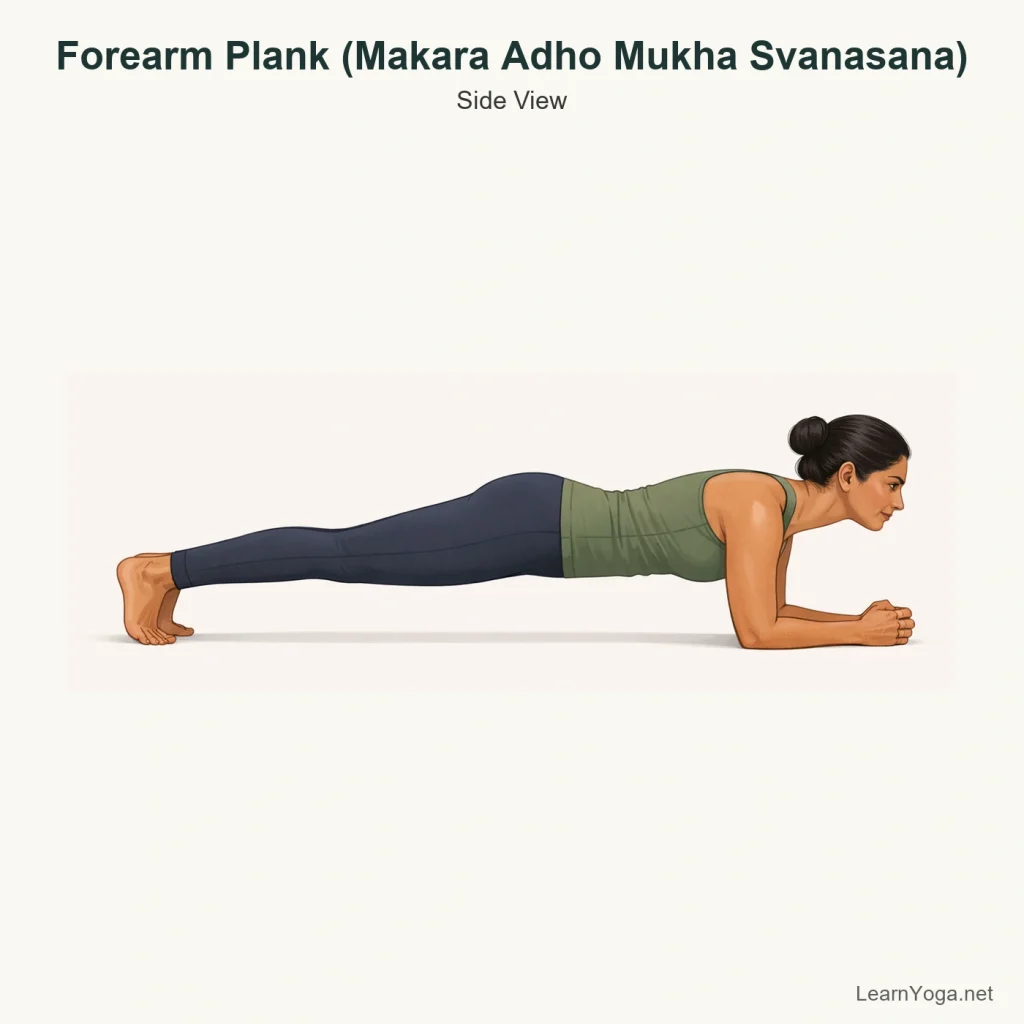
Forearm Plank
Lower onto your forearms with elbows under shoulders and legs extended back.
Use this if straight-arm weight bearing is uncomfortable for the wrists but your shoulders tolerate forearm support well.
Bird Dog Pose
Stay on hands and knees and extend one leg back, or opposite arm and leg, while keeping the trunk steady.
Use this if full Plank feels too demanding on the shoulders, core or wrists.
Wall Plank
Place your hands on a wall at about shoulder height and walk your feet back until your body is on a gentle diagonal.
Use this if getting to the floor is difficult or if you need much less weight through the hands.
Common variations
Knees-Down Plank
A beginner-friendly variation with the knees on the floor, reducing overall load while keeping the same basic alignment work.
Forearm Plank
A variation on the forearms that changes the wrist angle and increases the work through the front body and shoulders in a different way.
Side Plank
A one-arm variation that adds balance and more sideways trunk strength.
Safety and contraindications
When to avoid or get individual guidance
Recent or current wrist irritation that worsens with hand weight bearing.
Shoulder pain that increases when you push through straight arms.
Acute abdominal strain or a range where bracing feels uncomfortable.
This pose places moderate load on the wrists, shoulders and front body.
If your lower back starts to dip or your shoulders feel pinched, lower the knees and rebuild the shape from there.
Keep the neck in line with the spine rather than dropping the head or craning forward.
If Plank repeatedly brings sharp wrist pain, shoulder pinching, or strain in the front of the belly even after you reduce the load with knees down or a wall version, pause and get individual advice before practising it longer.
Accessibility and limited mobility
A wall version can make this pose more accessible for older adults, anyone building strength gradually, or anyone who finds getting down to the floor awkward.
If kneeling is comfortable but full Plank is not, keeping the knees down usually gives a clearer starting point than pushing through a long shaky hold.
For sensitive wrists, placing the hands on a folded wedge or using forearms may feel better than forcing a flat-hand position.
Easier options
Use these related poses when you want a more accessible way to practise a similar movement or prepare for this pose.
Why does Plank feel harder in my wrists than in my core?
That often happens when too much weight drops into the heel of the hand or when the chest sinks behind the wrists. Try pressing through the whole hand, especially the base of the thumb and index finger, and push the floor away. If it still feels sharp or crowded, use knees-down Plank, forearm Plank, or a wall version.
Should my hips be perfectly level with my shoulders?
Aim for one long line rather than a rigid shape. If the hips are a little high while you learn how to support the trunk, that is usually easier to manage than letting the lower back sag. Over time, work toward a steadier diagonal line from shoulders through heels.
How long should I hold Plank Pose?
A short hold with steady breathing is enough. For many people, 3 to 5 breaths works well. If the shape starts to wobble, the shoulders burn sharply, or the belly drops, come down and rest. Two or three shorter rounds can be more useful than one long one.
Is it better to practise on my hands or on my forearms?
Neither is automatically better. Straight-arm Plank is useful for learning hand and shoulder support. Forearm Plank changes the wrist demand and can feel more comfortable there, though some people find it stronger through the belly and shoulders. Choose the version that lets you keep a clear, steady shape.
Reviewed for yoga instruction
Yogita
Certified Yoga Instructor with 5+ years of Teaching and Consistent Practice