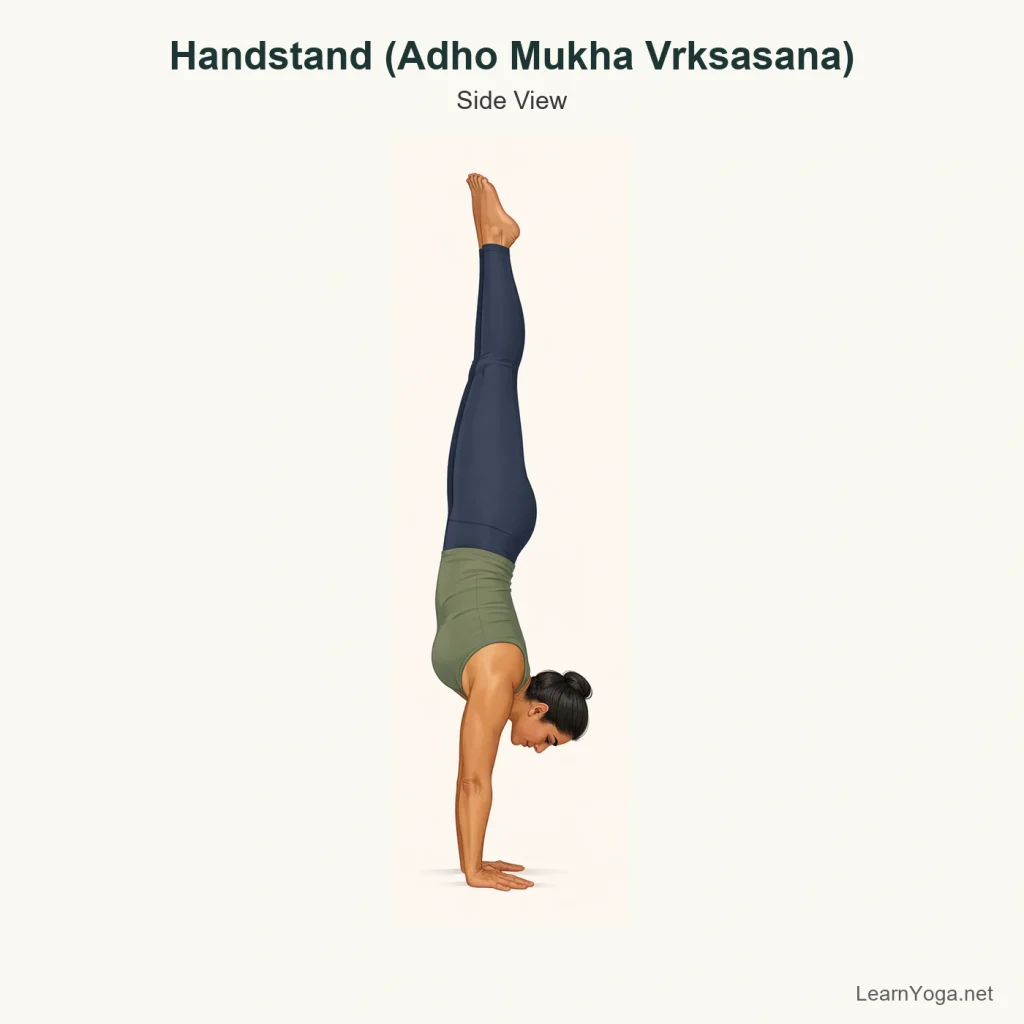
Handstand is a strong, balance-heavy inversion that asks for organised shoulders, active hands and a steady centre. For many people it is best approached progressively, often first with wall support.
Handstand is not only about getting upside down. The more useful work is in how you press the floor, stack the arms and ribs, and keep enough control that the shape does not turn into a jump and hope. Some bodies find the line quickly, while others need more time in the wrists, shoulders or core. Both are normal. A wall can be a sensible learning tool rather than a shortcut.
How to do Handstand
Start in Downward-Facing Dog with your hands shoulder-width apart. Spread the fingers and press especially through the base of the index finger and thumb.
Walk your feet in a little so the hips come more over the shoulders. Keep the elbows straight without locking them rigidly, and push the floor away so the upper back feels broad.
Step one foot slightly forward and bend that knee. Keep the other leg reaching back and up, as if you are already sending it toward the ceiling.
Take a small inhale to prepare. As you exhale, make a light hop from the bent leg and let the lifted leg travel upward first. Think of moving the pelvis over the hands rather than throwing the feet.
If you come to the wall, touch it lightly with one heel or both heels. Then firm the legs, point or flex the feet naturally, and draw the front ribs gently in so the lower back does not over-arch.
Keep pressing strongly through the hands. Let the shoulders lift away from the wrists so you do not sink into them, and keep the gaze slightly between the hands rather than craning the neck.
Stay for a few steady breaths if you are balanced. Come down with control one foot at a time, then pause in Child's Pose or standing before repeating.
Yogita's tip
If you keep missing the balance point, look at your rib cage rather than your feet. When the front ribs push forward, the legs often have to chase the shape behind you.
Benefits
Builds shoulder and arm strength in a weight-bearing position.
Improves balance and body awareness upside down.
Trains active support through the hands, wrists and shoulder girdle.
Gives the core a clear job in organising the spine and pelvis.
Can sharpen focus because small shifts in pressure matter straight away.
Common mistakes
Kicking too hard and overshooting the balance point.
Letting the lower back arch strongly so the ribs spill forward.
Sinking into the shoulders instead of pressing the floor away.
Looking forward and compressing the neck.
Placing most of the pressure into the heel of the hand rather than spreading it through the whole palm and fingers.
Make it work for you
Wall Handstand
Practice with your heels at a wall so you can work on stacking hands, shoulders and pelvis without needing to catch the balance in open space. Touch the wall lightly rather than leaning heavily.
L-Shape at the Wall
Place your feet on a wall at hip height and your hands on the floor under the shoulders, making an L shape. This reduces the balance demand while still building shoulder strength and overhead organisation.
Tuck Entry
Instead of trying to jump up with straight legs, bring one or both knees toward the chest as you lift. A compact shape often makes the centre easier to find.
Alternatives
Dolphin Pose
Practice with forearms on the floor and hips lifting up and back, pressing the forearms down firmly.
Useful if full wrist extension in Handstand is not comfortable or if you need more shoulder preparation.
Forearm Plank
Hold a straight line from heels to head while pressing the forearms down and drawing the front ribs in.
Useful when you want inversion-related strength work without the balance demand.
Legs Up the Wall Pose
Lie on your back with the legs resting up a wall and the pelvis a comfortable distance away.
Useful if being upside down is the main interest but bearing weight through the hands is not suitable today.
Common variations
Wall-Facing Handstand
Set up with the belly facing the wall and walk the feet up until the body is close to vertical. This usually gives clearer feedback about rib position and shoulder flexion.
Split-Leg Handstand Entry
Enter with one leg leading and the other following, keeping a scissor shape briefly as you organise the balance.
Tuck Handstand
Balance with the knees bent and drawn in. This shortens the lever and can make control easier than a straight-line version.
Safety and contraindications
When to avoid or get individual guidance
Avoid or modify if you currently have wrist, elbow or shoulder pain with weight-bearing.
Avoid free-balancing if you are not able to exit with control.
This pose may not be appropriate if inversions are not suitable for you today.
Handstand places meaningful load through the wrists, shoulders and elbows, and it also asks for balance under pressure. Warm up those areas first.
Use a wall if you are learning the entry, but try not to slam into it. Small, controlled hops are usually more useful than big kicks.
If your lower back keeps taking over, return to an L-shape at the wall or Dolphin Pose and rebuild the shoulder and core organisation there.
Come down as soon as the breath becomes held or the shoulders start to collapse.
Sharp wrist pain, a slipping or unstable shoulder, or repeated uncontrolled falls are signs to come down and pause Handstand. Build back with wall drills or Dolphin, and get individual guidance before trying to balance again.
Accessibility and limited mobility
This pose is not a good fit for every practice space or every body, and it is not essential for a complete yoga practice.
If getting down to the floor or back up again is difficult, choose a wall-based alternative such as L-Shape at the Wall only if you can set it up safely. Otherwise use a non-floor option from your wider practice instead.
Older adults or anyone with reduced shoulder range may find wall-facing preparation more workable than free balancing because it gives a clearer limit and usually reduces the urge to kick hard.
If wrist extension is limited, a forearm-based alternative such as Dolphin Pose may be a better choice on that day.
Easier options
Use these related poses when you want a more accessible way to practise a similar movement or prepare for this pose.
Should I learn Handstand at the wall or in the middle of the room?
For most learners, the wall is the more practical place to start. It lets you work on shoulder position, rib control and entry without needing to catch the full balance straight away. The useful part is not just getting the feet up, but learning to touch the wall lightly rather than crashing into it.
Why do I keep arching my lower back in Handstand?
That usually happens when the ribs move forward and the pelvis stays behind the line of the hands. Try pressing the floor away more, keeping the front ribs a little quieter, and entering with a tuck or a smaller hop. Wall-facing practice can also make the line easier to feel.
How much should I kick to get up?
Usually less than you think. A big kick often sends you past the point where you can organise the shoulders and centre. Try one leading leg, one bent pushing leg, and a light hop on an exhale. The aim is to move the pelvis over the hands, not to throw the feet at the ceiling.
What if my wrists get tired before the rest of me?
Check how you are using your hands. If most of the pressure sits in the heel of the palm, the wrists often complain early. Spread the weight through the whole hand, grip lightly with the fingertips, and shorten your holds. On days when the wrists are not happy, switch to Dolphin Pose or another forearm-based option.
Do my legs need to be perfectly straight?
No. Straight legs are one version, not the only useful one. Many people learn control more clearly with a tuck or a slight split in the legs first. If that helps you keep the shoulders strong and the breath steady, it is a sensible step.
Reviewed for yoga instruction
Yogita
Certified Yoga Instructor with 5+ years of Teaching and Consistent Practice