Dolphin Pose is a forearm version of an inverted V shape. It builds shoulder and upper-back strength, asks the core to stay organised, and can prepare the body for stronger overhead work without as much wrist extension as Downward-Facing Dog.
Dolphin Pose looks familiar if you know Downward-Facing Dog, but the work feels different. With the forearms on the floor, the shoulders have to carry more of the effort, and many people notice the upper back and ribs much more clearly. It does not need to be a very deep hamstring stretch. For plenty of bodies, a slight bend in the knees makes the shape steadier and more useful.
How to do Dolphin Pose
Start on hands and knees, then lower both forearms to the mat with elbows about shoulder-width apart.
Spread the fingers and press the full length of each forearm down. Keep the elbows from splaying wider as you set the base.
Tuck the toes under and lift the knees, sending the hips up and back.
Walk the feet in only as far as you can keep the shoulders broad and the neck easy. It is fine to keep the knees bent.
Press the forearms firmly into the floor and gently move the chest away from the hands so the upper back lifts.
Let the head hang naturally between the upper arms rather than pushing it to the floor. Keep the gaze soft toward the feet or the mat.
Stay for 3 to 8 slow breaths. On each exhale, draw the lower ribs in a little and lengthen the hips up.
To come out, lower the knees to the mat and rest in Child's Pose or Supported Child's Pose.
Yogita's tip
If the pose feels stuck in the shoulders, try bending the knees more. That often gives you enough space to press the forearms down and lift the upper back instead of hanging through the chest.
Benefits
Strengthens the shoulders, arms and upper back in a clear, weight-bearing way.
Gives the wrists a break from full extension compared with Downward-Facing Dog or Plank.
Builds awareness of how the ribs and core support overhead work.
Lengthens the back line of the body, especially when the legs can straighten comfortably.
Can be a practical preparation for Forearm Stand and other stronger shoulder-loading poses.
Common mistakes
Letting the elbows slide wider than the shoulders, which makes the base less steady.
Dropping the chest heavily toward the floor instead of pressing the forearms down and lifting through the upper back.
Forcing the heels down and locking the knees even when that rounds the lower back awkwardly.
Clenching the neck or trying to rest weight into the head.
Standing too close with the feet so the shape becomes cramped and the breath short.
Make it work for you
Bent-knee Dolphin
Keep both knees softly bent and focus on pressing the forearms down and lifting the hips. This usually makes the shoulder work clearer and reduces strain from tight hamstrings.
Elbows at the Wall
Place the forearms on the floor with the fingertips close to a wall and lightly press the thumbs or hands toward the wall to help keep the elbows from sliding apart.
Short Holds
Practice 2 to 3 rounds of 2 to 3 breaths instead of one long hold if the shoulders tire quickly or the breath becomes choppy.
Alternatives
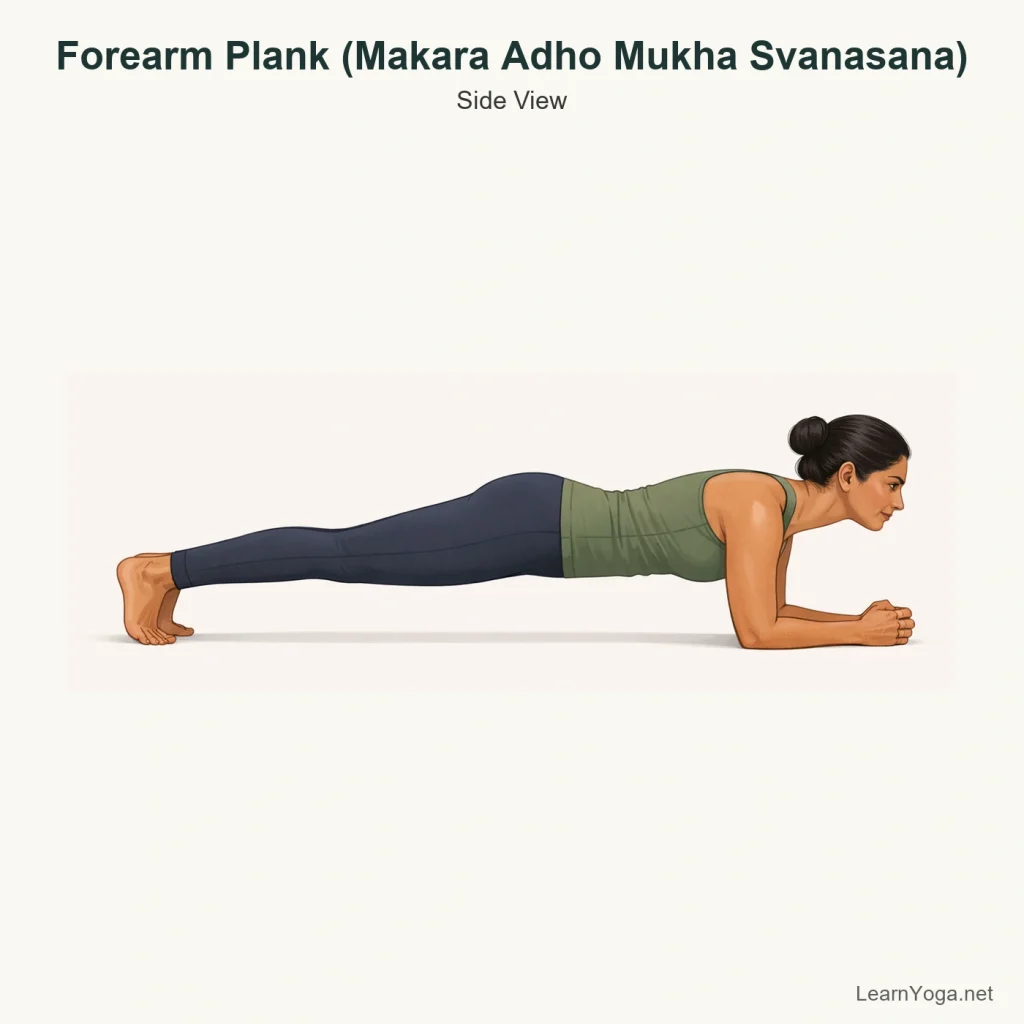
Forearm Plank
Keep the body in one long line with forearms on the floor and heels reaching back.
Use this if lifting the hips overhead feels too strong but you still want forearm and core work.
Puppy Pose
From hands and knees, walk the hands forward and let the hips stay over the knees.
Use this if you want shoulder opening with much less load through the arms.
Downward-Facing Dog
Practice the same inverted V shape with straight arms and hands on the floor.
Use this if your shoulders tolerate arm support better than forearm support, or if the elbows feel crowded.
Common variations
Dolphin with Bent Knees
A steadier version that keeps the focus on shoulder strength and upper-back lift rather than hamstring length.
Walking Dolphin
From the base shape, walk the feet a little closer in and then back out again while keeping the forearms grounded. This changes the shoulder demand and can prepare for stronger inversions.
One-Legged Dolphin
Lift one leg while keeping the pelvis as level as you reasonably can. This increases the balance and shoulder challenge.
Safety and contraindications
When to avoid or get individual guidance
Recent or aggravated shoulder, elbow or forearm pain
Neck symptoms that worsen when the head is below the heart
A wrist issue may still be relevant for some people, even though the wrists are less extended here
This pose places meaningful load through the shoulders and forearms, so set the elbows carefully and do not force a deeper shape.
Keep most of the weight in the forearms and shoulders rather than dropping into the head or neck.
A small bend in the knees is often safer and more stable than insisting on straight legs.
If the shoulders feel pinched, come down and try Puppy Pose or Forearm Plank instead.
Come down right away for sharp shoulder or elbow pain, strong pressure in the neck, or numbness spreading into the forearm or hand. Choose Puppy Pose or Forearm Plank instead, and get individual guidance before trying Dolphin again.
Accessibility and limited mobility
This pose can be hard to set up if getting down to the floor is difficult. A wall-based shoulder opener or Puppy Pose may be more practical on those days.
If hamstrings are tight, bending the knees is often the difference between a workable pose and a strained one.
Older adults or anyone with reduced shoulder range may prefer shorter holds with more rest between rounds.
If forearm pressure is uncomfortable, fold the front edge of the mat or use a thin blanket under the forearms.
Easier options
Use these related poses when you want a more accessible way to practise a similar movement or prepare for this pose.
Usually it is more stable to keep the forearms parallel and the hands separated. Clasping the hands can work in some lineages or for some bodies, but it often makes the shoulders rotate differently and may narrow the chest too much.
Why do my elbows keep sliding apart?
That often happens when the shoulders are working near their limit or when the base is set too wide. Start with elbows at shoulder width, press the inner forearms down, and shorten the hold. A wall cue or a strap around the upper arms can also help, though the strap setup is best used carefully.
Do my heels need to touch the floor?
No. Heels lifted is completely fine. In this pose, the more important actions are a steady forearm base, supported shoulders and easy breathing. Many people benefit from bent knees and lifted heels.
Why do I feel this more in my shoulders than in my hamstrings?
That is normal. Dolphin is mainly a shoulder and upper-back strengthening pose, even though the backs of the legs may stretch too. If the shoulders feel overloaded, shorten the hold or use Puppy Pose for a lighter version.
Can Dolphin Pose prepare me for Forearm Stand?
Yes, it is one of the more useful preparations because it teaches forearm pressure, shoulder organisation and rib control. There is no need to rush that progression, though. Stay with Dolphin if you can keep the shape clear and the breath steady there.
Reviewed for yoga instruction
Yogita
Certified Yoga Instructor with 5+ years of Teaching and Consistent Practice