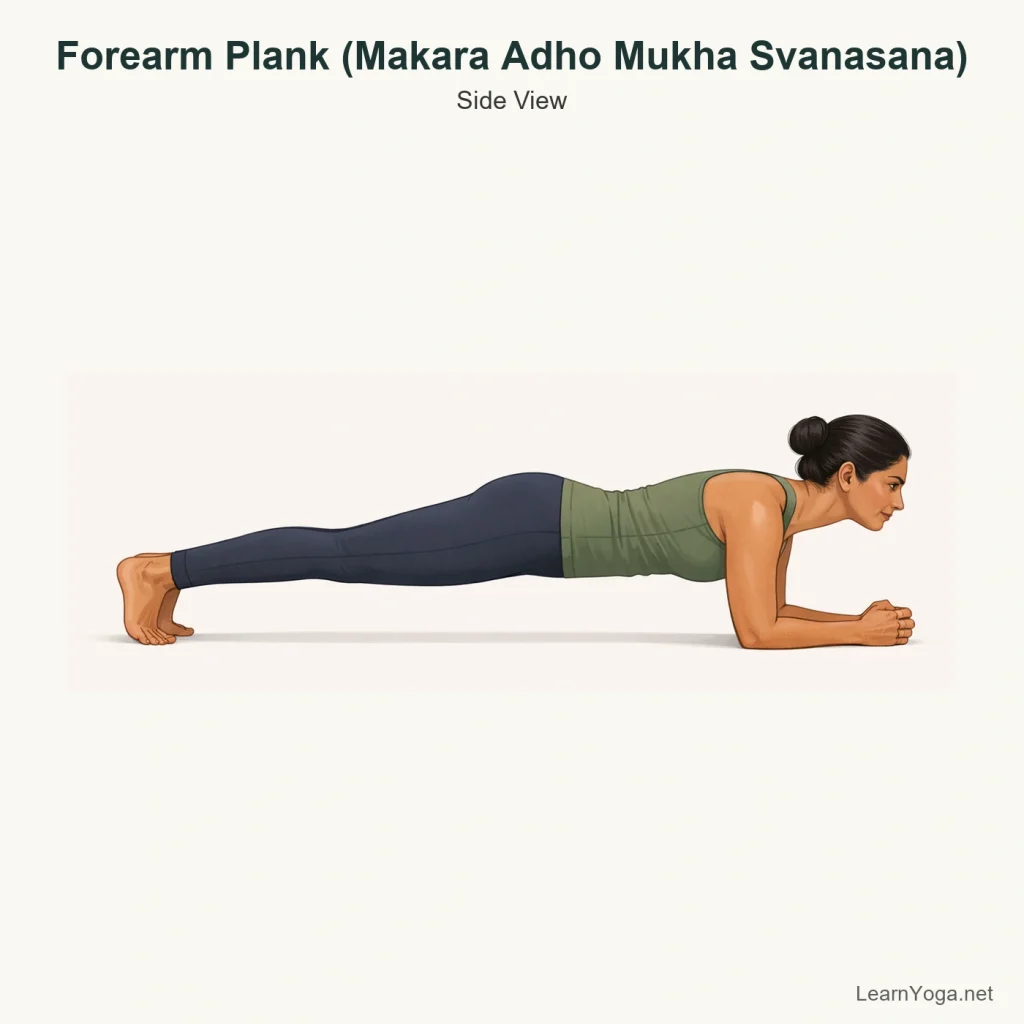
Forearm Plank is a strong, straightforward shape that builds organised support through the shoulders, belly, hips and legs. It asks for steady effort rather than strain, and it usually works best when you think of reaching long from heels to crown instead of trying to hold yourself rigid.
Forearm Plank can be a useful step when you want core work without as much wrist extension as a regular Plank. Even so, it is not an easy rest position. The shoulders still work, the front body has to stay awake, and the legs matter more than many people expect. You do not need to hold it for a long time for it to be worthwhile. A short, clean hold is often more useful than staying longer and letting the lower back sag or the shoulders drop.
How to do Forearm Plank
Start on your belly, then place your forearms on the floor with elbows under or slightly in front of the shoulders.
Press the forearms down evenly and spread the chest broad across the upper back rather than sinking between the shoulders.
Tuck the toes under and lift the knees and thighs away from the floor.
Step the feet back until the body forms one long line from head to heels.
Draw the lower belly gently in, lengthen the tail toward the heels, and keep the front ribs from spilling down.
Press back through the heels and forward through the crown so the pose feels long, not collapsed.
Keep the neck neutral and let the gaze rest slightly ahead of the hands or down at the floor.
Hold for 3 to 5 steady breaths, or up to 30 seconds if the shape stays organised.
Yogita's tip
If the pose feels much harder in the shoulders than in the centre of the body, press the floor away and slide the heels back as though you are trying to lengthen the mat. That usually wakes up the legs and takes some of the load out of the neck.
Benefits
Builds strength and endurance through the abdominal wall, shoulders and legs.
Helps you practise keeping the trunk steady while the arms and feet support weight.
Can improve awareness of rib position and pelvic alignment during weight-bearing.
Offers a wrist-friendlier alternative to straight-arm Plank for some people.
Common mistakes
Letting the lower back dip while the ribs and belly fall toward the floor.
Piking the hips high to avoid using the centre of the body.
Dropping the chest between the shoulders instead of pressing the forearms down.
Clenching the jaw or lifting the chin, which makes the neck work harder than it needs to.
Holding too long after the shape has already started to sag.
Make it work for you
Knees-Down Forearm Plank
Keep the forearms where they are, lower both knees to the floor, and maintain a straight line from head to knees. Press the forearms down and lightly draw the lower belly in.
Shorter Hold
Hold for 2 or 3 careful breaths, come down, rest, and repeat for 2 to 3 rounds instead of forcing one long hold.
Elbows Slightly Forward
If stacking the elbows directly under the shoulders feels too compressed, move the elbows a little forward and keep the chest broad.
Alternatives
Bird Dog Pose
From hands and knees, extend one leg back and the opposite arm forward while keeping the trunk steady.
Use this if full body weight-bearing in Forearm Plank is too demanding for the shoulders or core.
Dead Bug Pose
Lie on your back with knees lifted and move one heel and the opposite arm away without letting the ribs flare.
Use this if getting down into a plank shape is not practical or if you want core work with no arm loading.
Forearm Plank at a Wall
Place the forearms on a wall at shoulder height, walk the feet back, and hold a straight line from head to heels.
Use this if you want to practise the same organisation with much less load.
Common variations
Knees-Down Forearm Plank
A reduced-load version with the knees on the floor, useful for building alignment and breath control before longer full holds.
Forearm Plank with Feet Wider Apart
Taking the feet a little wider can make the pose feel steadier and may help if balance is part of the struggle.
Forearm Plank Rock
A small shift forward and back over the forearms adds challenge through the shoulders and core once the basic shape is steady.
Safety and contraindications
When to avoid or get individual guidance
Recent or aggravated shoulder injury may make this pose unsuitable right now.
Skip or modify if forearm pressure is painful at the elbows.
If strong core bracing increases discomfort in the lower back, choose a lighter alternative.
This pose meaningfully loads the shoulders and asks the trunk to resist sagging, so shorten the hold if the lower back starts to dip.
If the shoulders feel pinched, try knees down or practise at the wall instead.
Keep the neck in line with the spine rather than looking forward sharply.
Pause forearm plank for sharp shoulder or elbow pain, or for lower back pain that keeps returning even with knees down or a wall version. Get individual guidance before continuing.
Accessibility and limited mobility
If getting to the floor is difficult, practise the same shape with forearms on a wall.
A folded blanket under the forearms can make the pressure on the elbows more comfortable.
Older adults or anyone rebuilding strength may find several brief holds more manageable than one long effort.
Easier options
Use these related poses when you want a more accessible way to practise a similar movement or prepare for this pose.
Why does my lower back start to sag in Forearm Plank?
Usually the hold has gone on a little too long, or the legs are not doing enough. Press strongly back through the heels, lightly draw the lower belly in, and shorten the time. A knees-down version can help you find the shape without fighting gravity quite so much.
Is Forearm Plank easier than regular Plank?
Not always. It removes some wrist extension, which can make it more comfortable for some people, but it can feel more intense in the shoulders and belly. It is better to think of it as different rather than easier.
Where should my elbows go?
A good starting point is under the shoulders, with the forearms parallel if that is available in your body. If that feels cramped in the shoulders, move the elbows slightly forward and keep pressing down through the full length of the forearms.
What if my shoulders get tired before my core does?
That often means the chest is sinking and the legs are not helping enough. Push the floor away, broaden across the upper back, and reach back firmly through the heels. If the shoulders still fatigue quickly, work at the wall or with the knees down for now.
How long should I hold Forearm Plank?
Long enough to keep the shape clear. For many people, 15 to 30 seconds or 3 to 5 slow breaths is plenty. Several shorter rounds with good form are usually more useful than one long, shaky hold.
Reviewed for yoga instruction
Yogita
Certified Yoga Instructor with 5+ years of Teaching and Consistent Practice