Bird Dog Pose is a simple hands-and-knees balance that trains the body to stay steady while one arm and the opposite leg reach away. It is often used to wake up the core, shoulders and hips without asking for a big range of motion.
Bird Dog looks straightforward, but the useful work is in keeping the middle of the body quiet while the limbs move. Rather than lifting as high as possible, think about making a long line from fingertips to heel. For many people, a smaller reach feels more organised than a dramatic one.
How to do Bird Dog Pose
Start on hands and knees with your wrists under your shoulders and your knees under your hips.
Spread your fingers and press the floor away so the upper back stays broad rather than sinking between the shoulders.
Look down at the floor and keep the back of your neck long.
Draw your lower belly in gently, as though you are narrowing the waist a little without holding your breath.
Slide your right leg straight back with the toes tucked or untucked, and reach through the heel.
If you feel steady, extend your left arm forward at shoulder height with the palm facing in.
Keep both front hip points aiming toward the floor. Try not to let the lifted-leg side roll open.
Stay for 3 to 5 breaths, or for one inhale and one exhale if you are moving dynamically.
Place your hand and knee back down with control, then repeat on the other side.
Yogita's tip
If your lower back starts to do the work, make the lifted leg a little lower and reach more through the heel. In this pose, a long line is usually more useful than a high lift.
Benefits
Builds coordination between the trunk, shoulders and hips.
Strengthens the muscles that help keep the spine steady during limb movement.
Gives a gentle balance challenge without requiring standing balance.
Can be a practical warm-up before stronger kneeling, plank or standing work.
Helps you notice whether your ribs, pelvis or shoulders tend to shift when one side works harder.
Common mistakes
Lifting the arm or leg so high that the lower back dips and the ribs flare forward.
Letting the standing hand press weakly into the floor, which collapses the chest toward the mat.
Turning the lifted leg open to the side instead of keeping the pelvis mostly level.
Looking forward and shortening the back of the neck.
Rushing the transition and losing control as the hand or knee comes down.
Make it work for you
Toes on the floor
Keep the back toes lightly on the mat as you reach the opposite arm forward. This reduces the balance demand while you organise the trunk.
Leg only
Extend one leg back without lifting the opposite arm. Keep both hands grounded and focus on keeping the pelvis steady.
Hand on a block
Place the supporting hand on a yoga block if the floor feels far away or you want a little more space through the chest and wrist angle.
Alternatives
Bird Dog at the wall
Stand facing a wall with both hands on it. Step one leg back behind you and reach the opposite arm forward or keep both hands on the wall while you work on trunk stability.
Use this if getting to the floor is difficult or if kneeling is uncomfortable.
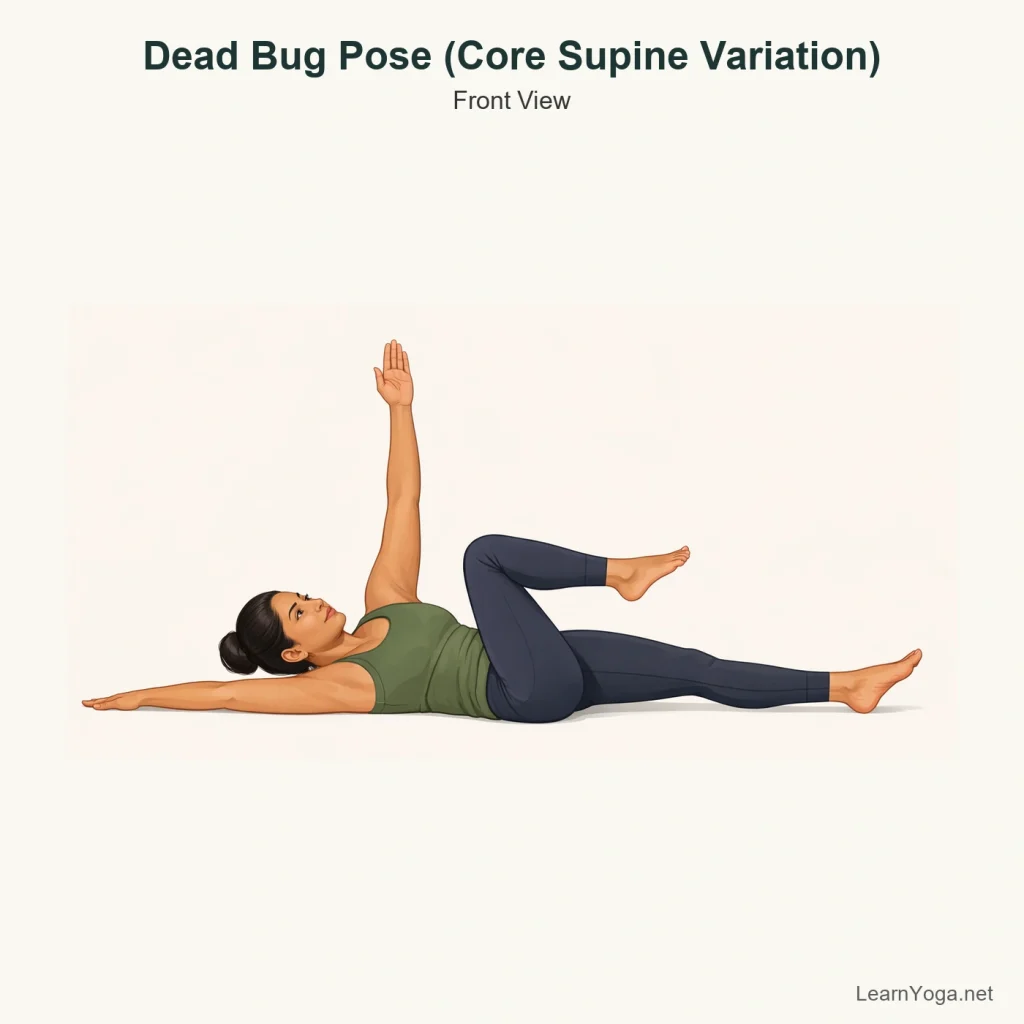
Dead Bug Pose
Lie on your back with knees over hips and arms up. Lower one heel and the opposite arm toward the floor while keeping your ribs and pelvis steady.
Use this if weight-bearing through the wrists or kneeling does not feel comfortable.
Tabletop hold
Stay on hands and knees with a neutral spine and practise gently drawing the belly in while pressing the floor away.
Use this if lifting an arm and leg together feels too unstable for now.
Common variations
Dynamic Bird Dog
Move into the pose on an inhale and return to hands and knees on an exhale, alternating sides for several rounds.
Bird Dog with elbow to knee
From the extended shape, draw the front elbow and back knee toward each other under the body, then re-extend with control.
Bird Dog leg variation
Keep both hands on the floor and work with only the back leg reaching and lifting.
Safety and contraindications
When to avoid or get individual guidance
Use care with wrist pain, kneeling discomfort, or if balancing on one hand causes shoulder strain.
Skip the full version for now if you cannot keep weight comfortably on hands and knees.
Keep the movement small enough that you can breathe normally and keep the trunk steady.
If your wrists are sensitive, reduce the time spent weight-bearing or choose a supine alternative such as Dead Bug Pose.
If kneeling bothers your knees, add padding or practise the wall version instead.
Stop Bird Dog Pose and switch to a smaller range or an easier variation if you get sharp pain in the wrist, shoulder, knee, or lower back. Ongoing trouble with weight-bearing on the hands or kneeling is a good reason to get individual guidance before continuing.
Accessibility and limited mobility
A folded blanket under the knees can make the pose more comfortable on a hard floor.
If wrist extension is limited, try making fists, using a wedge, or choose Dead Bug Pose instead.
If getting down to the floor is awkward, a wall version gives a similar coordination challenge without kneeling.
Older adults or anyone who feels unsteady may prefer to keep the toes of the lifted leg on the floor at first.
Easier options
Use these related poses when you want a more accessible way to practise a similar movement or prepare for this pose.
Not necessarily. Many people do better with the leg slightly lower than hip height. If you can keep the pelvis level, the belly gently active and the lower back long, the height is probably workable. If those things disappear, lower the leg a little.
What if I wobble as soon as I lift one hand?
That is common. Start by reaching only the leg back, or keep the toes of the lifted leg on the floor while you extend the opposite arm. Press the supporting hand firmly down and slow your breath. The pose usually becomes steadier when the reach is smaller.
Where should I feel Bird Dog Pose?
Usually you will notice light work through the belly, the side waist, the supporting shoulder and the standing hip. You may also feel the lifted leg working. It should not feel like a pinch in the lower back or a strain in the neck.
Can I do this pose if kneeling hurts my knees?
You can try extra padding under the knees, but if kneeling still feels unpleasant, choose the wall version or Dead Bug Pose. Those options train similar control without loading the knees in the same way.
Reviewed for yoga instruction
Yogita
Certified Yoga Instructor with 5+ years of Teaching and Consistent Practice