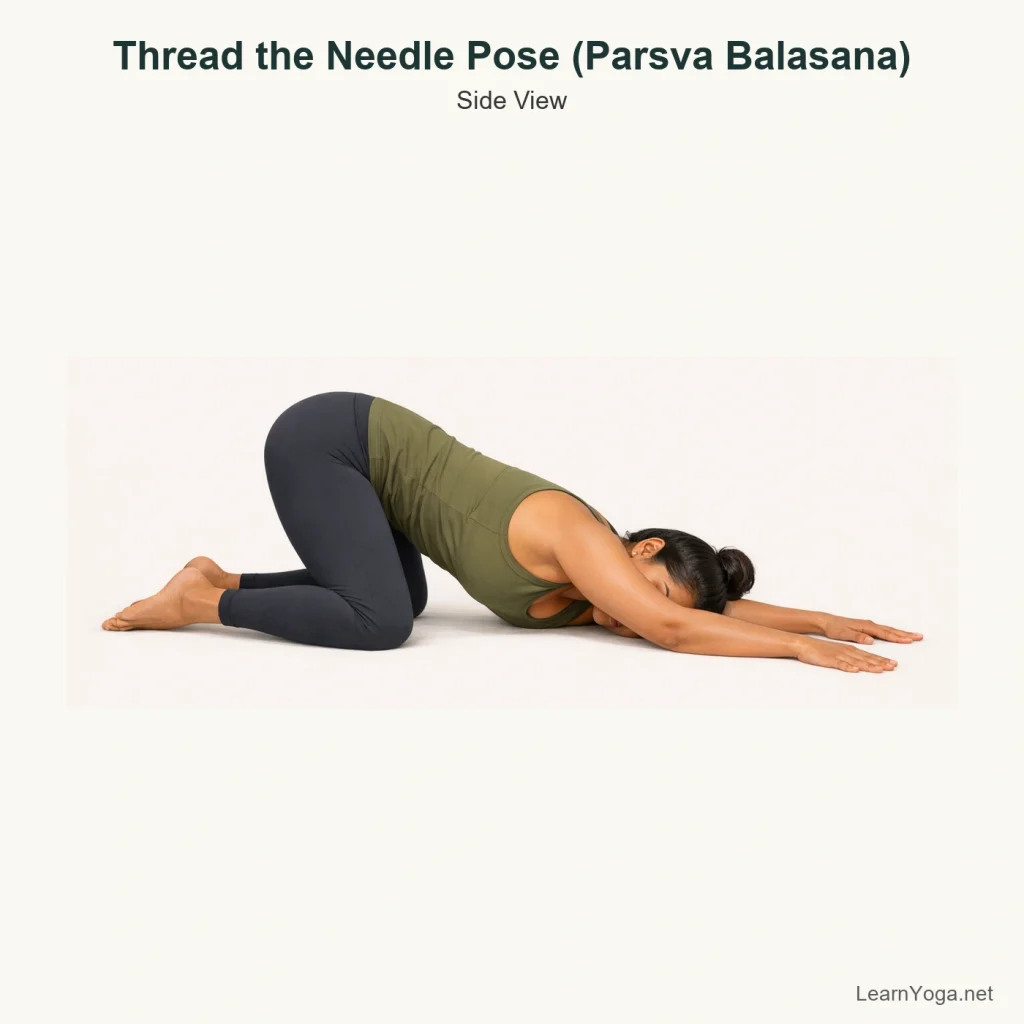
Thread the Needle is a gentle kneeling twist for the upper back and shoulders. It gives you a clear way to rotate through the thoracic spine without needing a large range, and you can keep it quite small if that feels better in your body.
This pose is often used in warm-ups, but it can also stand on its own when your upper back feels stiff or your shoulders want a little more room. The shape is simple: one arm slides under the other, and the floor supports part of the twist. You do not need to force the shoulder down or turn very far. A quieter version is often the more useful one.
How to do Thread the Needle Pose
Start on hands and knees with your wrists under your shoulders and knees under your hips.
Press the floor away lightly so the space between your shoulder blades is broad, and keep your neck easy.
Inhale with your right arm reaching slightly forward or up if that feels natural.
Exhale and slide your right arm underneath your chest to the left, turning your palm up as your right shoulder and the side of your head move toward the floor.
Let your right shoulder and temple or ear rest down only as far as is comfortable. Your left hand can stay where it is to support some weight.
Keep your hips roughly over your knees rather than drifting far back, and let the twist spread through the upper back more than forcing the neck.
Stay for 3 to 8 breaths. On each inhale, feel the back ribs widen. On each exhale, soften into the floor without collapsing.
To come out, press into your left hand, slide your right arm back out, and return to hands and knees before changing sides.
Yogita's tip
If the twist feels stuck in the neck, ease a little weight out of the head and think about turning from the back of the ribs instead. That usually makes the pose feel broader and less cramped.
Benefits
Gently improves rotational movement through the upper back.
Can create more space around the back of the shoulders and shoulder blades.
Offers a supported way to explore a mild twist without standing balance demands.
May help you notice whether you are turning mostly from the neck or sharing the movement through the spine.
Works well as a quieter warm-up before poses that need shoulder mobility.
Common mistakes
Dropping heavily onto the shoulder instead of easing weight down gradually.
Pushing the twist mostly into the neck rather than allowing the upper back to rotate.
Letting the hips slide far back toward the heels, which changes the shape and can reduce the spinal twist.
Locking the supporting elbow and hanging in the shoulder.
Forcing the lower arm deep under the body even when the breath becomes tight.
Make it work for you
Head on a block or folded blanket
Place a block or folded blanket under the side of the head so you do not need to drop as far to the floor. This can make the neck and shoulder feel more settled.
Keep the supporting hand close
Instead of walking the top hand forward, keep it under the shoulder and press gently into the floor. This reduces the depth and gives you more control.
Smaller range
Slide the arm only partway through and pause before the shoulder reaches the floor. You can still feel the rotation without taking the full expression.
Alternatives
Child's Pose
Rest in Child's Pose with arms forward or by your sides.
Use this if kneeling and twisting together feels like too much, or if you want a simpler resting shape between sides.
Supine Spinal Twist
Lie on your back and take a gentle twist with bent knees, keeping the shoulders easy.
Use this if bearing weight through the knees or one supporting arm is uncomfortable.
Thread the Needle Pose with a chair support
From kneeling beside a chair, slide one arm across the chair seat and rest your head on a folded blanket on the seat so less weight goes into the floor.
Useful if getting the shoulder or head to the floor is not practical.
Common variations
Supported Thread the Needle
The head or shoulder rests on a block or folded blanket to reduce the depth and make the twist easier to sustain.
Extended top arm variation
After sliding one arm through, the top arm reaches forward overhead on the floor, adding more length through the side body and shoulder if comfortable.
Bind variation
The top arm wraps behind the lower back or to the outer thigh for a stronger shoulder opening. This suits students who already feel steady and easy in the basic pose.
Safety and contraindications
When to avoid or get individual guidance
Recent or aggravated shoulder, neck, or knee irritation may call for a smaller version or a different pose.
Skip the fuller version if turning the head to the side is uncomfortable today.
Keep the twist comfortable and supported rather than pressing into the shoulder or neck.
Use padding under the knees if kneeling is sensitive.
If the lower shoulder or side of the head does not reach the floor comfortably, bring the floor up with a block or folded blanket.
Pause Thread the Needle and use more support or a smaller twist when sharp pain shows up in the shoulder, neck, or knees, or tingling starts down the arm. Get individual guidance before continuing if that keeps happening.
Accessibility and limited mobility
If kneeling on the floor bothers your knees, place extra padding under them or choose a supine twist instead.
If lowering all the way down is awkward, support the head on a block, bolster, or chair seat to shorten the distance.
Older adults or anyone who finds transitions to the floor tiring may prefer a seated or supine twist on a bed or firm mat nearby.
Easier options
Use these related poses when you want a more accessible way to practise a similar movement or prepare for this pose.
Not necessarily. Some bodies reach the floor easily, and some do not. You can stop earlier or place support under the shoulder or head. The pose should feel steady and breathable, not like you are dropping into it.
What do I do with the top hand?
The simplest option is to keep it planted under the shoulder so you can control how much weight goes into the twist. If you want a little more stretch and the neck feels easy, you can walk that hand forward.
Why do I feel this mostly in my neck?
Usually that means the head has turned more than the upper back has. Try taking less depth, press gently into the supporting hand, and think of rotating around the shoulder blades and ribs rather than cranking the head further.
Can I do this if kneeling hurts my knees?
Sometimes extra padding is enough. If kneeling still feels uncomfortable, choose a Supine Spinal Twist instead, or use a chair to support the head and upper body so the pose asks less from the knees.
How long should I stay in the pose?
Three to five slow breaths per side is plenty for most people. If the shape feels restful and your breathing stays smooth, you might stay a little longer, up to about 30 seconds per side.
Reviewed for yoga instruction
Yogita
Certified Yoga Instructor with 5+ years of Teaching and Consistent Practice