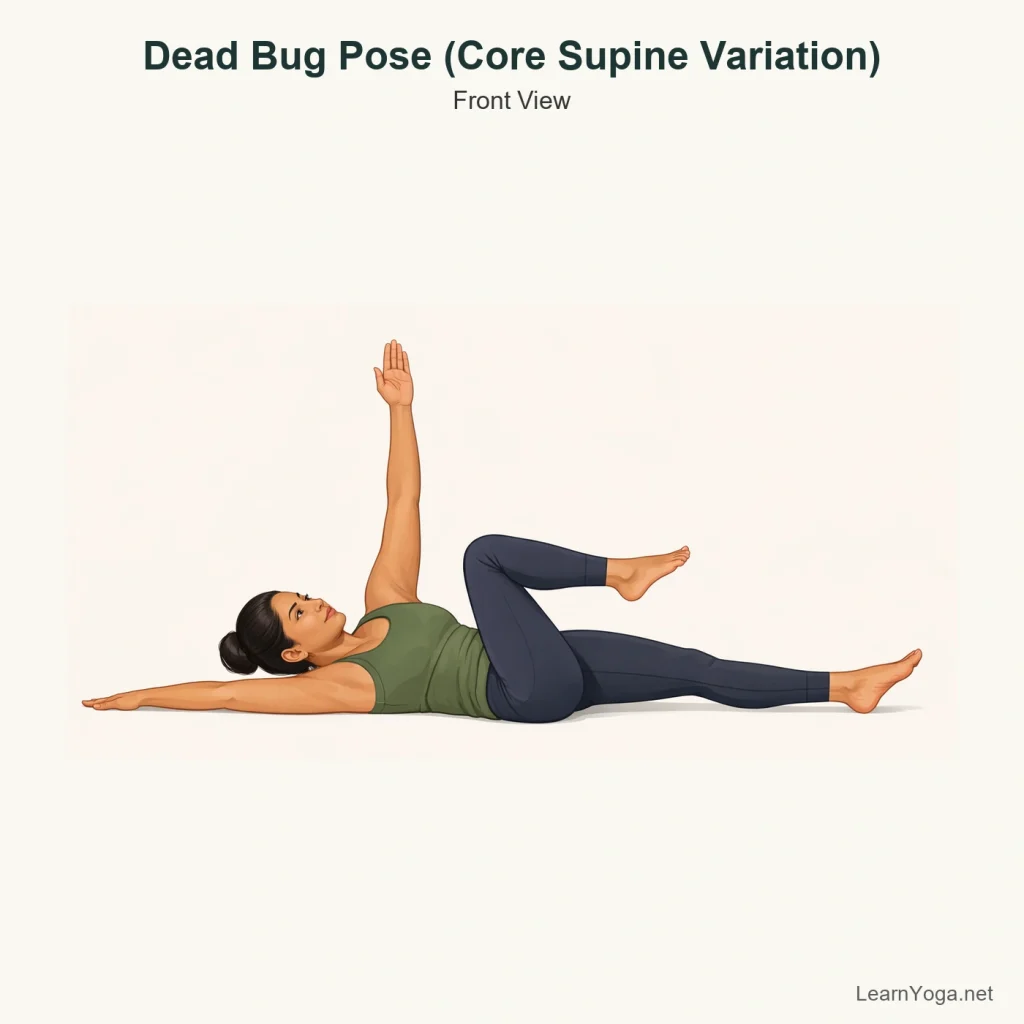
Dead Bug Pose is a simple supine core exercise that teaches you to move the arms and legs while keeping the trunk steady. It is useful for building coordination and noticing how to support the lower back without gripping the neck or shoulders.
Beginnercoresupinecorehipslower-backNeutral
Typical hold: 5 to 10 slow repetitions per side, or 3 to 5 breaths each side
Timing: 5 slow rounds per side · 8 alternating reps total with a steady exhale on each reach · Hold each reach for 2 to 3 breaths if you want more control than speed
This pose looks straightforward, but it asks for careful control. The main job is not to lower the leg as far as possible. The main job is to keep the ribs from popping up and the lower back from taking over as the limbs move. A smaller range often makes the pose clearer. Some bodies will keep a gentle natural curve in the lower back, while others prefer to feel the back a little more grounded.
How to do Dead Bug Pose
Lie on your back with your knees bent and feet on the floor. Let your arms rest by your sides for a moment and settle the back of the ribs onto the mat.
Lift your knees one at a time so they stack roughly over your hips, with the shins parallel to the floor. Reach your arms straight up toward the ceiling over your shoulders.
Take a breath in to prepare. As you exhale, slowly lower your right leg away from you and your left arm overhead, only as far as you can without the ribs lifting or the low back arching more than feels steady.
Inhale to bring the arm and leg back to centre. Pause for a brief reset.
Exhale and switch sides, lowering the left leg and right arm with the same slow control.
Continue alternating sides for 5 to 10 rounds. Keep your jaw soft, throat easy, and shoulders broad on the floor.
If the full version feels too strong, keep the knees bent and tap one heel to the floor instead of straightening the leg.
Yogita's tip
If your lower ribs keep springing upward when the arm goes overhead, shorten the arm range before you shorten the leg range. For many people, the overhead arm is what unsettles the trunk first.
Benefits
Builds coordination between the limbs and trunk
Helps you practise keeping the ribs and pelvis more organised during movement
Strengthens the abdominal muscles in a controlled, low-impact position
Can be a useful warm-up before stronger core work, standing balance, or backbends
Offers a clear way to notice the difference between moving from the hips and moving from the lower back
Common mistakes
Lowering the leg so far that the lower back lifts sharply away from the floor
Letting the ribs flare upward when the arm reaches overhead
Moving quickly and using momentum instead of steady control
Tensing the neck or jutting the chin upward
Trying to straighten the leg fully even when a bent-knee version would be steadier
Make it work for you
Heel Tap Version
Keep both knees bent at 90 degrees. On the exhale, lower one heel to lightly tap the floor while the opposite arm moves overhead, then return on the inhale.
Arms Still
Keep both arms reaching to the ceiling and move only one leg at a time. This reduces the amount of trunk control needed.
Head Supported
Place a thin folded blanket under the head if the chin lifts or the throat feels strained. Keep the face relaxed and the back of the neck long.
Alternatives
Constructive Rest
Lie on your back with knees bent and feet on the floor. Rest your hands on the lower ribs and belly and practise gentle exhale control without lifting the legs.
Use this if lifting both legs into tabletop feels too demanding for the lower back or neck.
Dead Bug at the Wall
Lie close enough to a wall that both feet can press into it with knees bent. Keep one foot pressing as you slide the other heel down or lift one arm overhead.
Use this if you need more feedback and support through the legs.
Knees-to-Chest Pose
Hug one or both knees in and breathe into the back of the ribs, then release.
Choose this if your body wants a gentler supine option instead of active core work.
Common variations
Bent-Knee Alternating Dead Bug
The working leg stays bent as the heel lowers toward the floor. This is often the clearest starting version for beginners.
Straight-Leg Dead Bug
The lowering leg straightens more fully as it moves away from centre. This increases the lever length and usually asks for more abdominal control.
Arms-Only Dead Bug
Both knees stay over the hips while one or both arms move overhead. This helps isolate rib control.
Safety and contraindications
When to avoid or get individual guidance
Skip or reduce the pose if lying on your back is currently uncomfortable for your lower back or neck.
Use a smaller version if lifting the legs causes strain in the hip flexors.
Keep the range small enough that the lower back does not feel strained or tugged.
If the neck grips, support the head and relax the jaw before continuing.
Move slowly enough that you can keep the breath smooth rather than bracing hard.
If this movement repeatedly causes sharp pain, tingling, or radiating discomfort into the back, hip, or leg, stop and get individual advice before continuing.
Accessibility and limited mobility
This pose can be easier to access than seated or kneeling core work because you stay on your back throughout.
If getting down to the floor is difficult, try the same coordination pattern lying on a firm bed or with calves supported on a chair seat.
A small cushion or folded blanket under the head can make the position more comfortable for older adults or anyone with limited neck range.
Keep the movement range modest. Reaching less far is still useful if that helps you stay steady through the trunk.
Easier options
Use these related poses when you want a more accessible way to practise a similar movement or prepare for this pose.
Not necessarily completely flat. What matters more is that the trunk stays steady and the back does not arch more as the limbs move. Some people feel best with the lower back gently grounded, while others keep a small natural curve.
Why do I feel this more in my hip flexors than my abdomen?
That usually means the leg is reaching too low or the variation is a bit too strong for now. Bend the knee more, try a heel tap, or keep the arms still. A smaller range often brings the work back into the trunk.
Is it better to move slowly or do more repetitions?
For most learners, slower is better at first. A steady exhale as the arm and leg move away gives you time to notice whether the ribs lift or the neck tightens. Once the shape stays organised, you can add more repetitions.
What should I do with my head and neck?
Let the back of the head stay heavy and keep the throat soft. If your chin tips up or your neck feels busy, place a thin folded blanket under the head so the face is a little more level.
Reviewed for yoga instruction
Yogita
Certified Yoga Instructor with 5+ years of Teaching and Consistent Practice