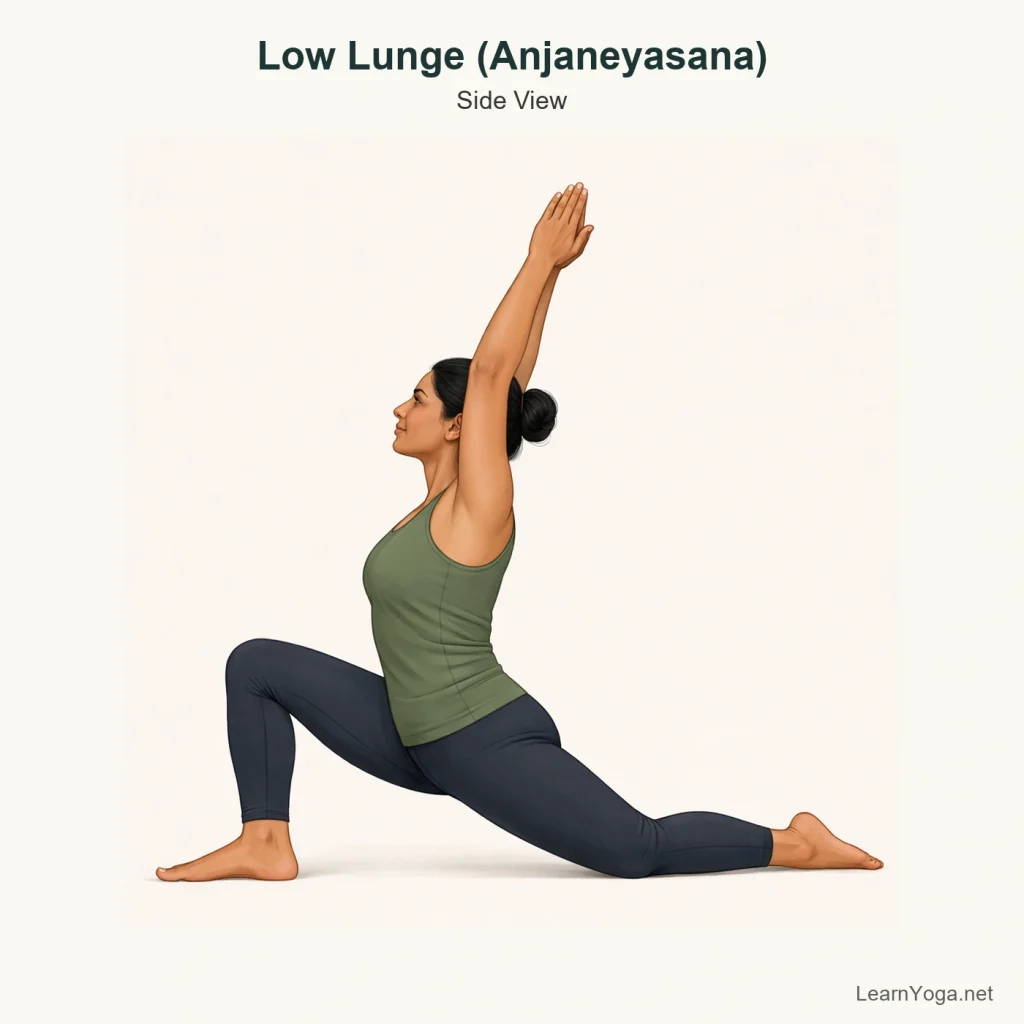
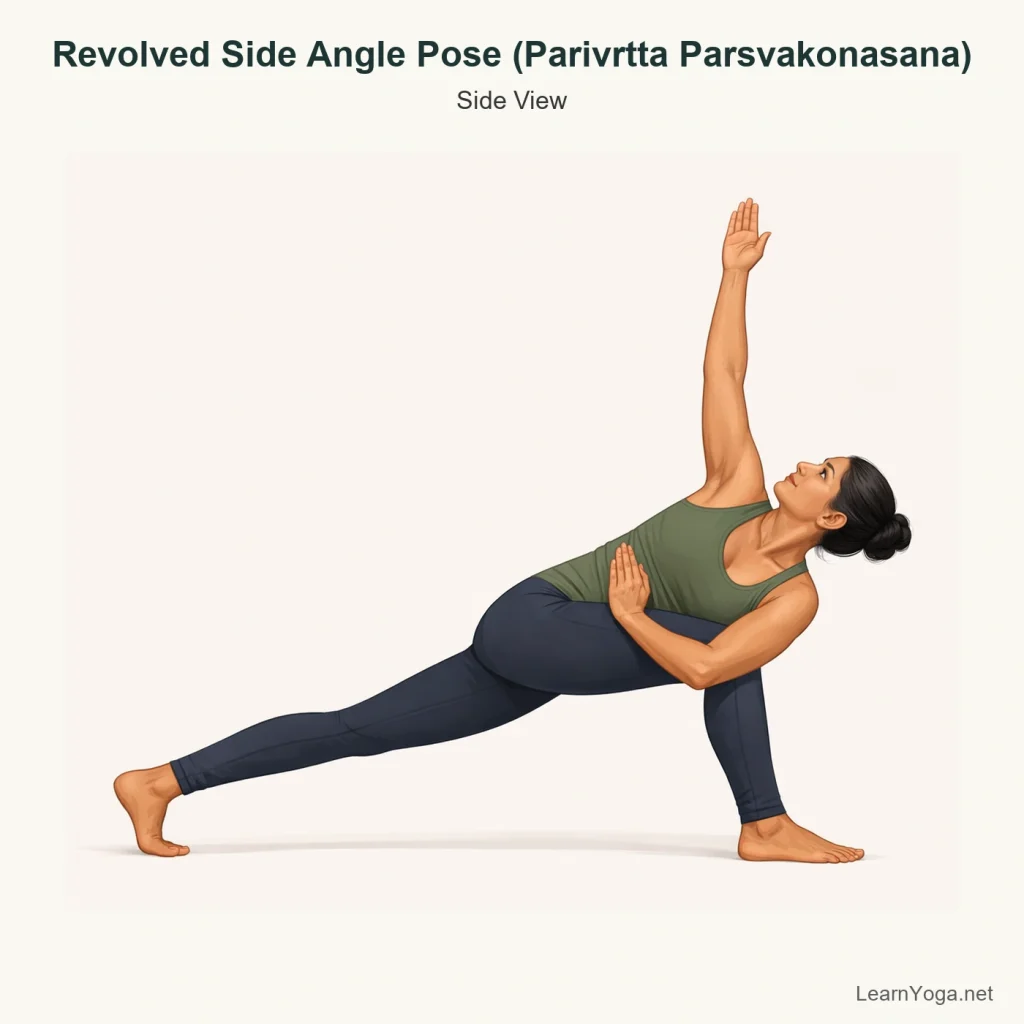
Low Lunge Twist combines a lunge with a gentle rotation through the spine. It can help you organise the legs, steady the pelvis, and explore twisting without needing a very deep range.
This pose asks for two clear actions at once: the legs stay grounded and directional while the torso turns. Most of the useful work comes from creating length before you twist. Keep the range moderate enough that you can still breathe evenly and keep the front knee tracking comfortably.
How to do Low Lunge Twist
Start in Low Lunge with your right foot forward and your left knee on the floor. Place your right hand on your right thigh and tuck the back toes or keep the top of the foot down, whichever makes the kneeling knee more comfortable.
Draw the front heel back and the back knee forward slightly so the legs feel steady. Lift the lower belly gently and lengthen up through the chest.
Bring your hands to prayer at the centre of your chest. Inhale to grow taller through the spine.
As you exhale, turn to the right from your waist and ribs. Hook your left elbow lightly to the outside of the right thigh, or keep the elbow unhooked and simply rotate with the hands at the chest.
Press the palms together softly and broaden across the collarbones. Keep the front knee pointing in the same direction as the middle toes rather than letting it collapse inward.
Stay for 3 to 5 breaths. Each inhale gives you a little more length; each exhale can deepen the twist a little if the breath stays smooth and the pelvis remains steady.
To come out, inhale back to centre, place your hands on the floor, and return to Low Lunge before changing sides.
Yogita's tip
If the twist feels stuck, check the front knee first. When that knee drifts inward, the pelvis usually shifts with it and the rotation gets muddy. Firming the knee back over the foot often makes the twist feel clearer straight away.
Benefits
Builds awareness of how to stabilise the legs while the spine rotates.
Gives a practical stretch through the front of the back hip and thigh in the kneeling leg.
Encourages mobility through the waist, ribs, and upper back.
Lightly challenges balance and core control without needing a full standing twist.
Can prepare the body for stronger lunges, standing twists, and side-angle shapes.
Common mistakes
Trying to crank the twist with the arms instead of creating length first.
Letting the front knee roll inward or slide far past the ankle.
Dumping weight into the lower back rather than lifting through the chest.
Holding the breath once the elbow connects to the thigh.
Pushing so far into the shape that the twist shifts into strain at the knee or hip.
Make it work for you
Hands at chest, no elbow hook
Keep your hands in prayer and turn only as far as you can without placing the elbow outside the thigh. This reduces leverage and often makes the twist smoother.
Back knee padding
Place a folded blanket under the back knee if the floor feels too hard. Extra padding can make it easier to stay long through the spine instead of bracing.
Back toes tucked
Tuck the back toes under for a little more lift and steadiness in the lunge. This can help if you feel wobbly or compressed in the kneeling leg.
Alternatives
Low Lunge
Stay in Low Lunge with your hands on your front thigh and focus on length through the spine without adding rotation.
Use this if the twist makes the pose unstable or if your knee and hip are already working enough.
Kneeling Crescent Pose
Come into Kneeling Crescent Pose and keep both hands reaching up or resting on the front thigh.
Use this if you want the lunge shape without the leverage of the twist.
Supine Spinal Twist
Practise a gentle twist on your back instead, with bent knees and easy arm placement.
Use this if getting up and down from a lunge is difficult or if you want to reduce load through the knees.
Common variations
Prayer twist in Low Lunge
The classic version with hands at the chest and the opposite elbow near or outside the front thigh. The range can stay small or become deeper depending on balance and mobility.
Open-arm Low Lunge Twist
Instead of prayer hands, one hand stays on the floor or thigh while the other arm reaches up. This often feels less compressed across the chest.
Low Lunge Twist with back toes tucked
Keeping the back toes tucked can give the pose a more active base and may help some people lift out of the kneeling hip.
Safety and contraindications
When to avoid or get individual guidance
Recent or aggravated knee discomfort may make the kneeling position unsuitable.
Reduce or skip the elbow hook if twisting bothers your lower back or sacroiliac area.
Keep the front knee tracking with the toes and reduce the twist if the knee feels torqued.
Use padding under the back knee if kneeling is uncomfortable.
Rotate through the waist and ribs more than the lower back, and keep the breath moving.
Pause Low Lunge Twist if the front knee, back kneecap, or low back gives sharp pain or a catching feeling, especially as you deepen the twist or add the elbow hook. Choose a gentler twist or a supported lunge, and get individual guidance before pushing this shape deeper.
Accessibility and limited mobility
If kneeling on the floor is uncomfortable, place generous padding under the back knee or practise a gentler twist on your back instead.
For older adults or anyone with limited balance, keeping the hands on the front thigh rather than in prayer usually makes the shape more manageable.
If getting down to the floor or back up again is the main difficulty, choose a supine twist or another seated twist on a higher support.
Easier options
Use these related poses when you want a more accessible way to practise a similar movement or prepare for this pose.
Only twist far enough that you can keep both sides of the waist long and breathe without strain. If the twist makes the front knee wobble or the lower back grip, come to a smaller range.
What if my elbow does not reach outside the front thigh?
That is completely fine. Keep your hands at your chest and rotate without the elbow hook, or rest one hand on the front thigh. The pose still works well with less leverage.
Should my back toes be tucked or untucked?
Either can work. Tucked toes often give more steadiness and lift, while the top of the foot down can feel softer. Choose the version that lets your kneeling knee feel more comfortable and your spine stay long.
Where should I feel the pose?
Many people notice work in the legs, especially the front hip and the thigh of the kneeling leg, along with a turning sensation through the waist, ribs, and upper back. You should not feel a sharp twist in the knee or a jam in the low back.
Reviewed for yoga instruction
Yogita
Certified Yoga Instructor with 5+ years of Teaching and Consistent Practice