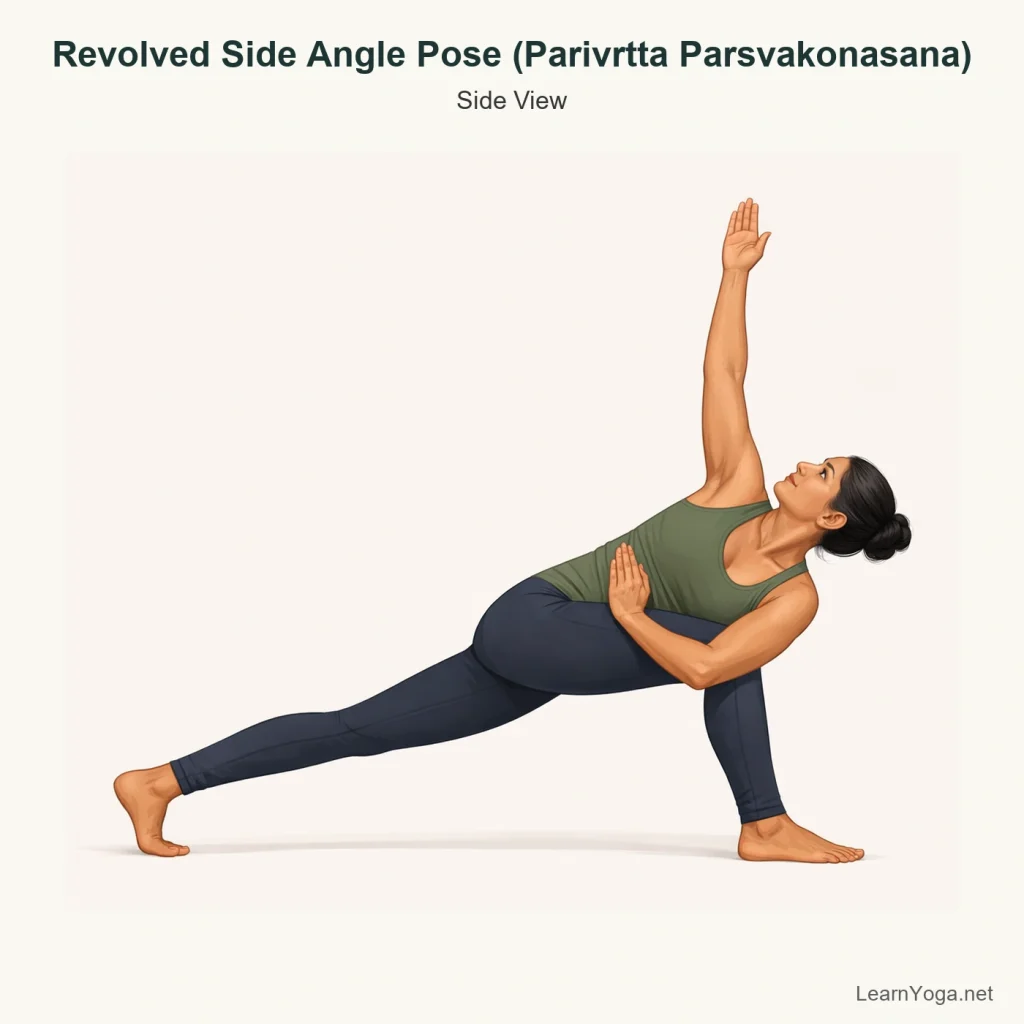
Revolved Chair Pose combines a squat-like base with a steady spinal twist. It asks for leg work, balance and clear organisation through the torso, and it is usually more useful when kept compact rather than pushed into a big turn.
In Revolved Chair Pose, the lower body needs to stay fairly even while the upper body rotates. That is the main challenge. If the knees drift out of line or one heel lifts, the twist often gets bigger but less stable. A smaller shape with a longer spine usually feels clearer. Some people will comfortably bring palms together at the chest and hook the elbow across the thigh. Others do better keeping the hands apart or twisting less. Both are valid.
How to do Revolved Chair Pose
Begin in Mountain Pose with your feet together or about hip-width apart if that gives you a steadier base.
Bend your knees and sit your hips back into Chair Pose. Keep the weight spread through both feet, especially the heels and the base of the big toes.
Bring your hands to prayer at your chest and lengthen upward through the sternum.
On an exhale, rotate your torso to the right from around the waist and ribs. Keep both knees pointing forward as evenly as you can.
Place your left upper arm or elbow to the outside of the right thigh only if you can do that without collapsing your chest.
Press the palms gently together to help turn the chest, and draw the right shoulder slightly back. Keep the spine long rather than rounding hard.
Stay for 3 to 5 breaths. With each inhale, create a little more space through the spine. With each exhale, refine the twist without forcing it.
To come out, inhale back to centre in Chair Pose. Repeat on the second side, then stand up to Mountain Pose.
Yogita's tip
If one knee slides noticeably ahead of the other, ease the twist first and square the knees again. In this pose, even knees usually tell you more than how far the chest has turned.
Benefits
Builds strength and staying power in the legs while you hold a bent-knee position.
Practises rotating the spine with more awareness and control.
Challenges balance and concentration because the base is small and the torso is turning.
Encourages coordination between the feet, pelvis and rib cage.
Can be a useful warming pose in standing sequences because it combines effort, length and rotation.
Common mistakes
Letting one knee move far forward or drift sideways as the twist deepens.
Lifting one heel and losing contact through the feet.
Rounding the back to force the elbow across the thigh.
Pulling strongly with the hands instead of lengthening the spine first.
Dropping the hips too low, which can make the chest collapse and the twist feel stuck.
Make it work for you
Hands at chest, smaller twist
Keep the palms together at the sternum and turn the chest only partway, without bringing the elbow across the thigh. This often helps you keep the knees and feet more even.
Feet hip-width apart
Set the feet about hip-width apart instead of touching. The wider base can make balance easier and give the torso more room.
Chair Pose with open arms
Twist and extend the arms wide like a T-shape instead of using prayer hands. This reduces the push of the elbow into the thigh and can help you find the twist more gradually.
Alternatives
Revolved Chair at the wall
Stand with your back close to a wall, come into a smaller Chair Pose, and rotate without hooking the elbow. The wall can help you notice if the hips and shoulders are shifting unevenly.
Use this if balance is the main difficulty.
Chair Pose
Stay in Chair Pose without twisting and focus on even weight through both feet and steady breathing.
Use this if the bent-knee position already feels demanding.
Bharadvaja's Twist
Practise the twisting action in a seated position where the legs are supported and balance is not part of the task.
Use this if standing twists feel unsteady or your knees are not comfortable in Chair Pose.
Common variations
Prayer twist with elbow to outer thigh
The most common version, with palms pressed together and the opposite elbow or upper arm placed outside the front thigh to support the turn.
Open-arm Revolved Chair
A less bound version where the arms open apart, making it easier to work on spinal length and shoulder placement without pushing the twist.
Feet-together Revolved Chair
A narrower base that increases the balance challenge and asks for more precision through the knees and ankles.
Safety and contraindications
When to avoid or get individual guidance
Recent flare of knee pain, ankle instability or an irritated low back may make this pose less suitable.
Skip the elbow-hook version if it causes strain in the shoulders or chest.
Keep the twist moderate if your knees are sensitive. It helps to keep the knees aligned and avoid dropping the hips very low.
If your lower back feels compressed, make the pose smaller and lengthen the spine more before turning further.
Use a hip-width stance or practise near a wall if balance feels unreliable today.
Pause Revolved Chair if sharp pain keeps showing up in the knees, low back, or shoulders, or the twist feels so unsteady that you might lose balance. Choose a smaller twist or wall support, and get individual guidance before going deeper with standing twists.
Accessibility and limited mobility
If getting low into Chair Pose is uncomfortable, keep the bend in the knees shallow. The pose does not need to be deep to be useful.
Practising with feet hip-width apart is often more manageable for older adults or anyone who feels wobbly with the feet together.
If getting down to the floor is difficult, this standing twist can be a practical alternative to seated twists, but use a wall nearby if balance feels uncertain.
Easier options
Use these related poses when you want a more accessible way to practise a similar movement or prepare for this pose.
No. Feet together is one common setup, but many people feel steadier with the feet hip-width apart. If your knees knock into each other, your heels lift, or balance becomes the whole story, take the wider stance.
What if I cannot hook my elbow outside the thigh?
You do not need to hook the elbow to practise the pose well. Keep your hands at your chest and make a smaller twist, or open the arms instead. The main aim is an organised twist with a stable lower body, not reaching a particular bind.
Why do my knees become uneven when I twist?
That usually means the twist is coming partly from the pelvis and legs instead of mostly from the torso. Back off a little, press evenly through both feet, and draw the knees back into line before turning again.
Should I look up or keep my gaze forward?
Either is fine. Looking forward or slightly down is often easier for balance and neck comfort. If the neck feels free and the pose is stable, you can turn the gaze upward, but it is optional.
How low should I sit in the pose?
Only as low as you can keep the spine long and the heels grounded. A medium or even shallow bend in the knees is often more useful than sitting deeply and losing the shape of the twist.
Reviewed for yoga instruction
Yogita
Certified Yoga Instructor with 5+ years of Teaching and Consistent Practice