
Explore by goal

Yoga Poses for Strength

Build strength through yoga poses that ask your muscles to support, stabilise and control your body. Browse poses for the core, legs, arms and upper body, and choose variations that suit your current level of practice.

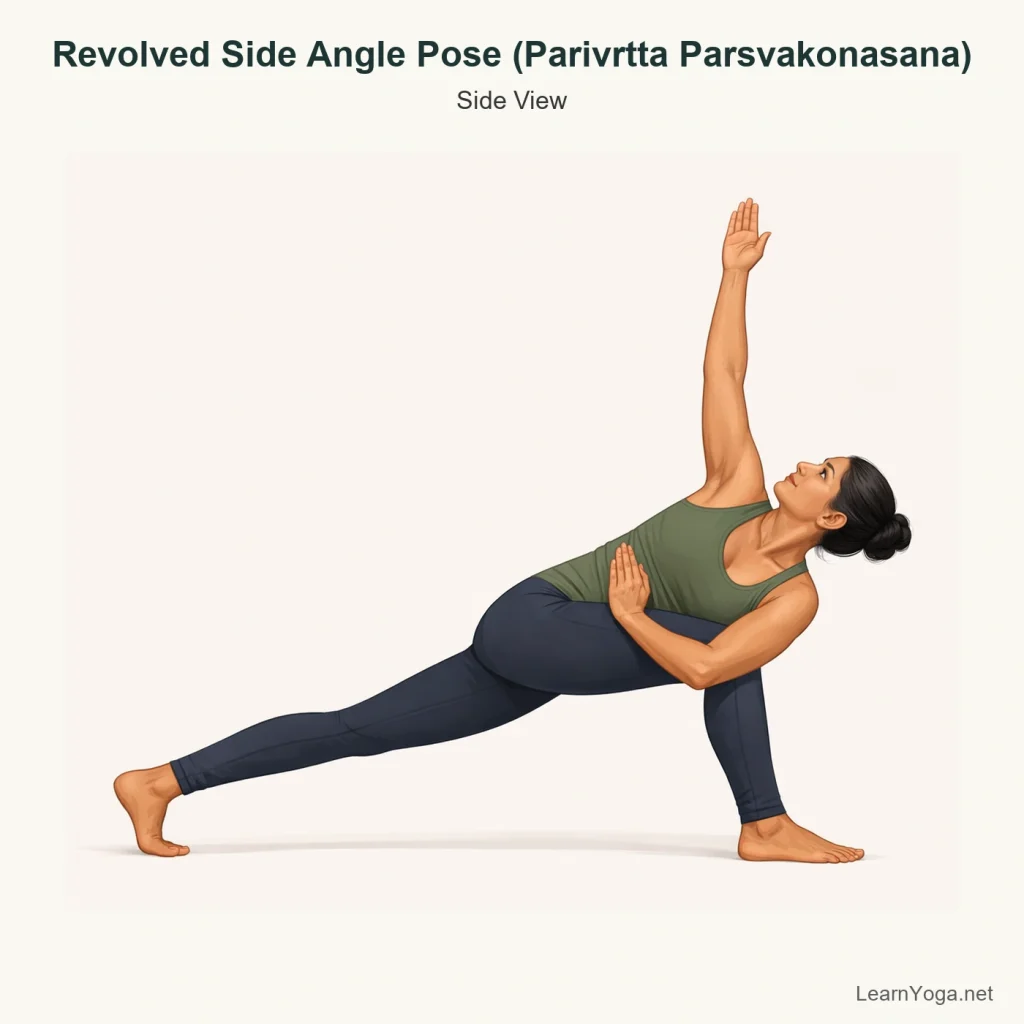
Side view of Revolved Side Angle Pose in a twisting lunge with hands in prayer.

Revolved Side Angle Pose

Parivrtta Parsvakonasana

Revolved Side Angle Pose is a standing twist that asks for steady legs, a long spine and controlled rotation. It can be practised in a smaller, more workable shape with the back knee lowered or the bottom hand lifted onto a block.

Person practising Revolved Chair Pose with palms at the chest and torso twisting over bent knees.

Revolved Chair Pose

Parivrtta Utkatasana

Revolved Chair Pose combines a squat-like base with a steady spinal twist. It asks for leg work, balance and clear organisation through the torso, and it is usually more useful when kept compact rather than pushed into a big turn.

Side view of Revolved Half Moon Pose with one hand on the floor and the opposite leg lifted behind.

Revolved Half Moon Pose

Parivrtta Ardha Chandrasana

Revolved Half Moon Pose combines single-leg balance, a standing hamstring fold and a controlled twist. It usually works best when you lower your expectations a little, use support if needed and build the shape from length first, then rotation.

Side view of Reverse Tabletop Pose with hands and feet pressing into the floor and hips lifted.

Reverse Tabletop Pose

Ardha Purvottanasana

Reverse Tabletop is a simple back-body strength pose that opens the front of the shoulders and chest while asking the hips to lift. It can be useful after sitting, though the comfortable range will vary from body to body.

Person practising Reverse Warrior in a wide standing stance with front knee bent, back leg straight, and top arm reaching overhead in side view.

Reverse Warrior

Viparita Virabhadrasana

Reverse Warrior keeps the legs working as they do in Warrior II while adding a side bend and lift through the front body. It is less about dropping back and more about finding length from the outer edge of the back foot up through the top fingertips.

Side view of Peacock Pose with the body balanced parallel to the floor on the hands.

Peacock Pose

Mayurasana

Peacock Pose is a demanding arm balance where the elbows press into the abdomen while the body tips forward into a long, low line. It asks for organised wrists, strong shoulder support and a clear weight shift more than brute force.

Side view of Plank Pose with straight body line, hands under shoulders and heels reaching back.

Plank Pose

Phalakasana

Plank Pose is a straight-arm strength pose that teaches you how to organise the whole body together. It asks the hands, shoulders, belly, legs and heels to work as one long line rather than hanging into the lower back.

Side view of Locust Pose with chest, arms and legs lifting gently from the floor.

Locust Pose

Salabhasana

Locust Pose is a prone backbend that strengthens the back body and teaches you to lift from length rather than from force. It can be practised very mildly, with just the chest or just the legs lifting, or as a fuller shape when that feels steady.

Little Thunderbolt Pose shown from the side in a deep kneeling backbend with thighs upright and chest lifting.

Little Thunderbolt Pose

Laghu Vajrasana

Little Thunderbolt Pose is a deep kneeling backbend where the thighs stay roughly upright as the body arcs back. It asks for strong leg engagement, open front thighs and a backbend that spreads through the whole front body rather than dropping into the lower back.

Side view of Knees-Chest-Chin Pose with knees on the mat, elbows bent close to the ribs, chest lowered and hips slightly lifted.

Knees-Chest-Chin Pose

Ashtanga Namaskara

Knees-Chest-Chin is a simple transition pose that brings the chest forward between the arms while the hips stay slightly lifted. It helps you organise elbows, shoulders and upper back before deeper weight-bearing shapes.