Peacock Pose is a demanding arm balance where the elbows press into the abdomen while the body tips forward into a long, low line. It asks for organised wrists, strong shoulder support and a clear weight shift more than brute force.
Timing: Hold for 1 breath to start · Hold for 2 to 3 steady breaths if the shape feels stable · Practise 3 to 5 setup attempts without lifting both feet
This pose can look like a simple lean on the hands, but the details matter. The elbows need to be placed well, the chest has to move forward, and the legs have to stay active so the body works as one piece. Many people do better when they first practise the setup and the forward shift without worrying about a full lift. Comfortable range differs, especially at the wrists and shoulders.
How to do Peacock Pose
Kneel and place your hands on the floor with the fingers turning back toward your knees if that wrist position is available to you. Bring the hands close enough together that the forearms can stay fairly parallel.
Bend your elbows and draw them into the front of the abdomen, usually somewhere between the navel and lower ribs depending on your build. Squeeze the elbows in rather than letting them slide wide.
Lean your chest forward and extend one leg back, then the other, with the toes still on the floor. Keep the legs firm and together if possible.
Shift more weight into your hands and move the shoulders slightly past the wrists. Look a little forward on the floor so the body does not tip straight down.
On a light exhale, press the floor away and float one foot, then the other, or lift both together if the balance is there. Reach back strongly through the legs as the chest continues forward.
Hold for 1 to 3 breaths. To come down, lower the feet with control and bring the knees back to the floor before sitting up.
Yogita's tip
If the lift never quite happens, check where your gaze goes. Looking slightly forward usually helps the chest travel far enough ahead of the hands; looking straight down often leaves the weight too far back.
Benefits
Builds strong support through the wrists, arms and shoulders.
Teaches a coordinated forward weight shift for arm balances.
Challenges the deep front body to stay firm while the legs reach back.
Improves focus because small changes in hand pressure and body angle affect the balance immediately.
Common mistakes
Placing the elbows too wide, which makes the torso slide down between the arms.
Trying to kick up instead of moving the chest forward first.
Letting the belly soften completely onto the elbows so the body loses one long line.
Looking straight down or back, which often throws the balance off.
Forcing the wrist position even when the hands cannot bear weight comfortably there.
Make it work for you
Toe-supported Peacock setup
Keep both toes on the floor and practise leaning forward with the elbows firmly placed into the abdomen. Work on shoulder position and hand pressure without lifting the legs.
One-foot hover
From the setup, keep one set of toes on the floor and lift the other foot for a breath or two. Alternate sides to learn the forward shift with less load.
Wider hand angle
If turning the fingers fully back is too intense, angle the hands slightly out to the sides and reduce the depth of the lean. Only use a hand position that allows steady pressure without sharp wrist discomfort.
Alternatives
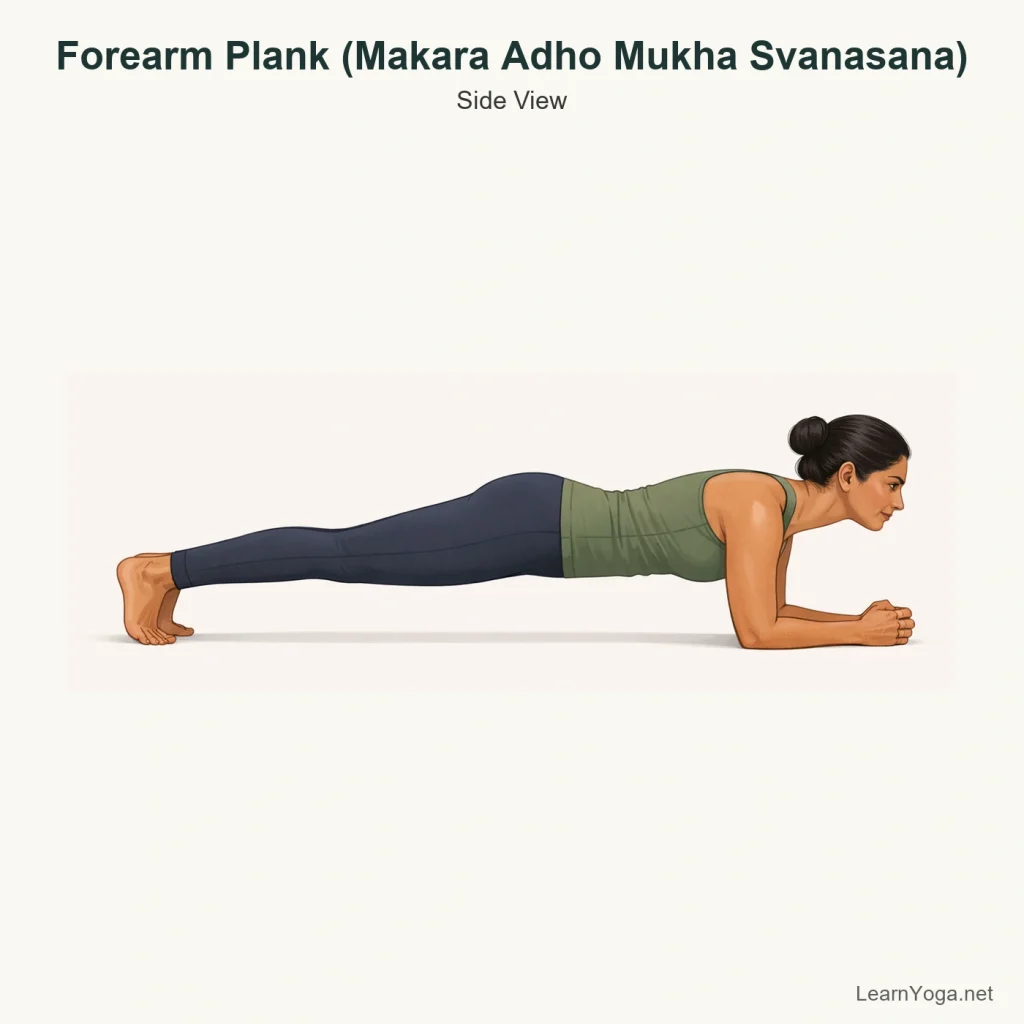
Forearm Plank
Practise a long, firm body line with shoulders supported over the forearms and heels reaching back.
Use this if wrist extension or balance is the main limit.
Plank Pose
Work on pressing the floor away and shifting the shoulders slightly forward while keeping the trunk steady.
Use this if you want arm-balance preparation with less compression through the abdomen.
Crow Pose
Practise lifting the feet and balancing over the hands with bent knees and a shorter body shape.
Use this if Peacock Pose feels too demanding but you want to work on hand balance.
Common variations
Bent-knee Peacock
A shorter version where the knees stay slightly bent as you lift, reducing the amount of leverage from the legs while you learn the balance point.
Toes-down Peacock preparation
The classic setup with the elbows placed and the body leaning forward, but the toes remain on the floor for support.
Safety and contraindications
When to avoid or get individual guidance
Avoid this pose with a current wrist, elbow or shoulder injury.
Skip it if pressure at the front of the abdomen feels uncomfortable or not appropriate for you today.
Avoid practising it when you cannot control the forward lean without dropping suddenly.
This pose places high load on the wrists and asks the shoulders to support a strong forward shift.
If the traditional hand position strains your wrists, stop and use a different arm-balance preparation instead.
Keep the elbows pressing in and come down if they start slipping outward.
Stop practising Peacock Pose for any sharp pain in the wrists, elbows, shoulders, or at the front of the abdomen, or when you cannot support the forward lean on your hands without lingering strain afterwards. Choose a simpler arm-balance preparation and get individual guidance before trying it again.
Accessibility and limited mobility
This pose is not usually suitable for people who find floor transitions difficult, since the setup is low to the ground and needs a strong forward lean onto the hands.
If wrist extension is limited, practise forearm-based alternatives such as Forearm Plank instead of forcing the traditional hand position.
Older adults or anyone rebuilding upper-body strength may find the setup practice more useful than attempting a full lift.
Easier options
Use these related poses when you want a more accessible way to practise a similar movement or prepare for this pose.
That is very common. Practise with the toes down and focus on moving the chest forward while keeping the elbows steady. Often the balance improves before the full lift appears.
Do my hands have to turn all the way back toward my knees?
Not always. That is the usual version, but not every wrist tolerates it well. You can angle the hands a little outward if that lets you press evenly without sharp discomfort.
Where should I feel the effort most clearly?
Usually in the wrists, arms, shoulders and the centre of the body. You may also notice firm pressure where the elbows contact the abdomen, but it should feel steady rather than sharp.
Is it better to jump into the pose or lean into it slowly?
A slow lean is usually more useful. Peacock Pose depends on getting the weight far enough forward with control. Jumping often sends the legs up before the shoulders and chest are organised.
How long should I stay in Peacock Pose?
For most people, 1 to 3 breaths is enough. A short, clean hold is usually more useful than staying longer with collapsing shoulders or strained wrists.
Reviewed for yoga instruction
Yogita
Certified Yoga Instructor with 5+ years of Teaching and Consistent Practice