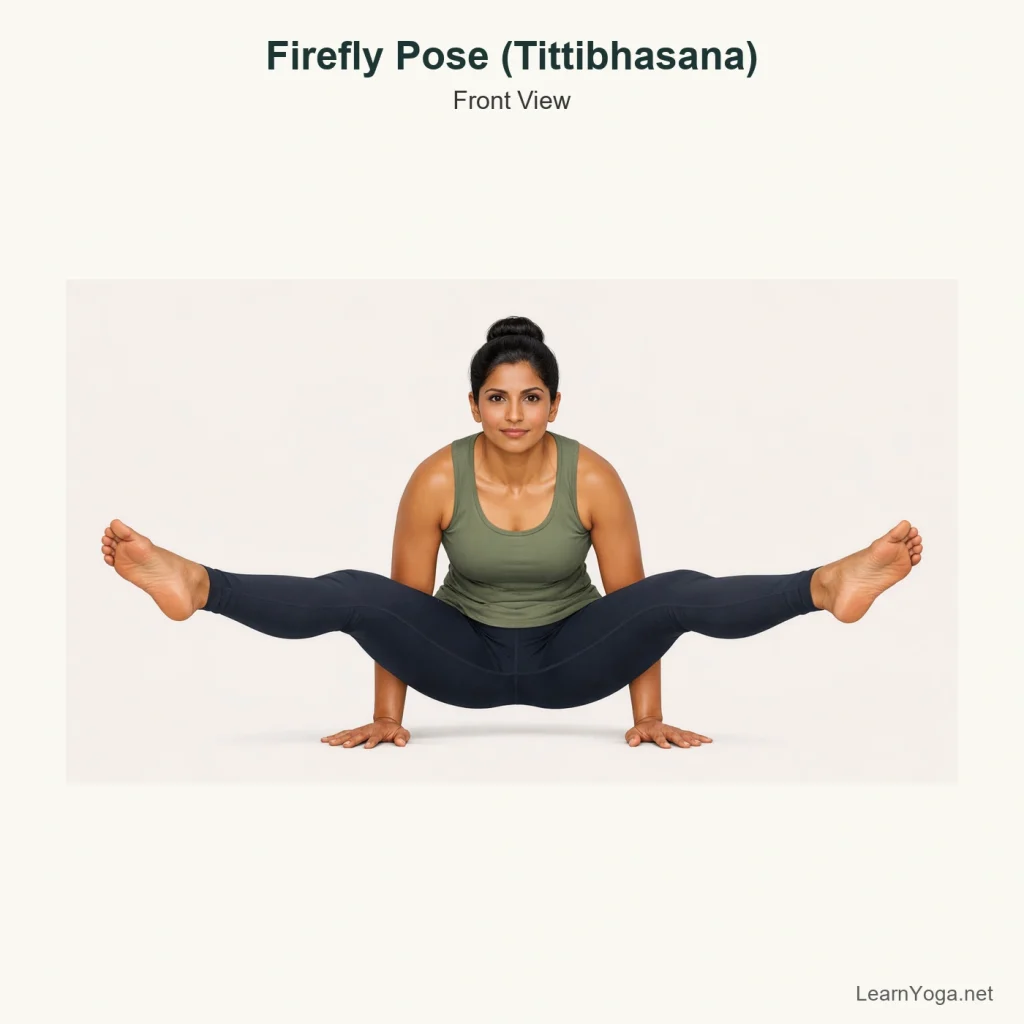
Crane Pose is a compact arm balance that asks for rounded upper back strength, deep hip flexion and a clear forward shift over the hands. It is less about jumping and more about placing the body carefully so the feet can become light.
Crane Pose and Crow Pose are often grouped together, and naming can vary a little between schools. In this version, think of the knees or inner shins drawing high onto the upper arms while the arms stay more bent than in a straighter-armed balance. The pose needs courage, but it also needs organisation. If you move slowly and keep the gaze forward rather than down, the balance usually makes more sense.
How to do Crane Pose
Begin in a squat with your feet a little apart and your heels lifted if needed.
Place your hands on the floor about shoulder-width apart, spread the fingers and press the whole hand down, especially the base of the index finger and thumb.
Bend your elbows slightly back as if starting a small shelf with the upper arms.
Lift your hips and place your knees or inner shins high onto the backs of the upper arms.
Lean your chest forward and look slightly ahead of your fingertips, not straight down.
On an exhale, shift more weight into your hands until one foot becomes light, then the other.
Draw the heels toward the sitting bones and let the upper back round slightly as you hug your midline.
Stay for 2 to 5 smooth breaths, or take a shorter hold if that keeps the shape organised.
To come out, lower one foot and then the other back to the floor with control.
Yogita's tip
If the pose feels as though it might tip you forward, look a little farther ahead and move the chest forward before you try to lift the second foot. In Crane, the balance usually comes from the forward shift, not from pulling the feet up harder.
Benefits
Builds weight-bearing strength in the hands, wrists and shoulders.
Trains the core and upper back to support a compact arm balance.
Improves coordination between forward shift, hand pressure and gaze.
Develops concentration because small changes in placement matter.
Common mistakes
Looking straight down, which often keeps the weight too far back.
Trying to hop both feet up instead of leaning forward gradually.
Letting the elbows splay wide, which can make the shoulders feel unstable.
Resting only in the heels of the hands and losing pressure through the fingers.
Placing the knees too low on the arms, so the body feels heavy and hard to organise.
Make it work for you
Toe-tip balance
Set up the pose fully but keep one or both sets of toes lightly on the floor. Practise the forward shift and hand pressure without needing to hold the full balance.
Block under the feet
Stand on a block or low sturdy support before placing the hands down. The extra height can make it easier to bring the knees high onto the arms and reduce the need to hop.
Cushion in front
Place a folded blanket or cushion in front of your face. This does not change the mechanics much, but it often helps you commit to the necessary forward lean.
Alternatives
Kneeling Side Plank
Practise supported arm and core loading with one knee down so there is less demand on wrist angle and no forward-balance fear.
Use this if full hand balance feels too intense or your wrists tire quickly.
Plank Pose
Work on pressing the floor away, firming the midline and shifting the shoulders slightly forward over the wrists.
Use this to build straight-arm strength and body awareness before returning to Crane.
Garland Pose
Stay in a deep squat with the chest lifted and elbows inside the knees to explore hip flexion and balance close to the floor.
Use this if getting the knees high onto the arms is the main limitation.
Common variations
Crow Pose
A closely related arm balance, often taught with the knees resting on the upper arms and the elbows more clearly bent.
Crane with blocks under the feet
The same basic action with the feet elevated to make the entry more manageable.
Straighter-arm Crane approach
In some traditions, Bakasana is practised with the arms working toward straighter lines, which changes the balance demand.
Safety and contraindications
When to avoid or get individual guidance
Avoid or modify if you have an active wrist, hand or shoulder injury.
Skip the full pose if deep squatting aggravates your knees or hips.
Do not practise the balance if you cannot bear weight through the hands without pain.
This pose places meaningful load on the wrists and shoulders and also asks for a deep squat entry.
Spread the fingers and press through the knuckles so the wrist does not collapse into one spot.
If your knees do not comfortably come high onto the arms, use a block under the feet or choose an alternative instead of forcing the setup.
Keep a cushion or folded blanket in front of you if fear of falling makes you hold back from the forward shift.
Stop and come out of Crane if you get sharp wrist pain, your shoulder feels unstable under the load, or weight-bearing into the hands brings on numbness. Choose a lower-demand variation and get individual guidance before trying the full balance again.
Accessibility and limited mobility
This pose is not ideal for many newer students, especially if getting down to the floor or rising from a squat is difficult.
If deep squatting is limited, try a block under the feet during setup, or work instead with Plank Pose or Kneeling Side Plank.
Older adults or anyone with reduced wrist extension may find the hand position more limiting than the balance itself. In that case, choose a lower-load alternative rather than forcing the shape.
Easier options
Use these related poses when you want a more accessible way to practise a similar movement or prepare for this pose.
Why do my feet stay heavy even when my knees are on my arms?
Usually the weight is still too far back. Press the floor firmly, look slightly forward and move the chest ahead of the hands a little more. Many people keep trying to lift upward when the missing piece is actually the forward lean.
Is it better to jump into Crane Pose?
For most learners, no. A small controlled weight shift is more useful than a hop. Jumping often skips the setup, throws the balance backward or forward, and makes it harder to learn where the pose really sits.
What should I do if my wrists hurt in the setup?
Come out and reduce the load. You can try a shorter hold, a block under the feet so the entry is easier, or practise Plank Pose or Kneeling Side Plank instead. If wrist pain appears every time you bear weight, the full pose is not the right choice for now.
Do my arms need to be straight in this pose?
Not necessarily. Naming and shape can vary by tradition. In this version, the arms stay somewhat bent to create a stable shelf. What matters most is that the hands press well, the elbows do not wing out, and the shoulders stay active.
How long should I try to hold Crane Pose?
Start with 1 to 3 breaths, or even a brief lift and lower with control. A short, clear attempt teaches more than gripping for too long. When the pose feels steady, stay for up to 5 smooth breaths.
Reviewed for yoga instruction
Yogita
Certified Yoga Instructor with 5+ years of Teaching and Consistent Practice