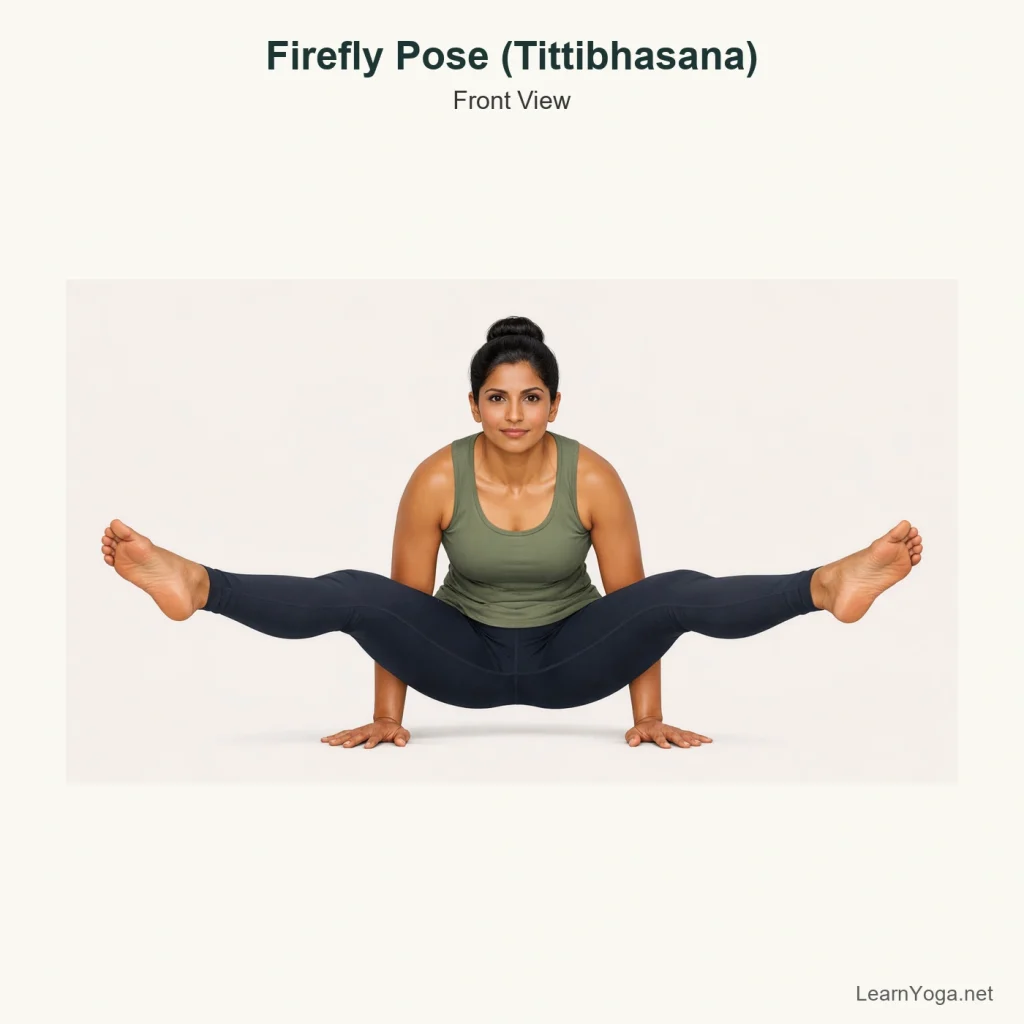
Firefly Pose is a strong arm balance with the legs reaching forward and the hips lifted from the floor. It asks for deep hip flexion, hamstring length, steady hands and a clear shift of weight into the arms.
Firefly Pose usually works better when you stop trying to throw the legs forward and instead organise the contact points first. The shoulders nestle under the legs, the hands press firmly, and the inner legs stay awake. Some bodies will straighten more easily than others. Bent knees are completely reasonable here if that helps you keep the lift and the breath.
How to do Firefly Pose
Begin in a low squat with your feet a little wider than hip-width apart.
Lean forward and slide one shoulder, then the other, as far under the thighs as is comfortable. Aim to place the legs high on the upper arms.
Set both palms on the floor behind the feet, about shoulder-width apart, with the fingers spread.
Bend the elbows slightly at first and shift your weight into your hands until your feet become light.
Cross one ankle lightly in front of the other if that helps you lift the hips off the floor.
Once you are balanced, begin to straighten the legs forward as much as your body allows. Keep the inner thighs hugging toward the arms and the toes drawing back.
Press the floor away so the chest stays broad rather than dropping heavily between the shoulders.
Look slightly forward, not straight down, and take 1 to 3 steady breaths.
To come out, bend the knees, lower the feet back to the floor with control, and return to a squat or seated position.
Yogita's tip
If the legs keep sliding down the arms, do not start by forcing them straighter. First pull the toes back and squeeze the upper inner thighs inward. That usually makes the contact on the arms much more reliable.
Benefits
Builds pressing strength in the hands, arms and shoulders.
Trains the core to support a forward weight shift without collapsing.
Explores deep hip flexion and hamstring length in an active way.
Improves coordination between arm support, leg action and balance.
Can sharpen focus because the shape asks for clear, organised effort.
Common mistakes
Trying to lift before the shoulders are far enough under the legs.
Looking straight down, which often keeps the chest too far back.
Locking the elbows and sinking into the shoulders instead of pressing the floor away.
Forcing the legs fully straight and losing the lift of the hips.
Letting the feet go soft, which can make the legs slide off the arms.
Make it work for you
Lift with crossed ankles
From the setup, cross one ankle over the other and lift the hips first. Stay there instead of straightening the legs right away. This reduces the hamstring demand and helps you feel the arm balance more clearly.
Hands on blocks
Place a block under each hand on the lowest or middle height if stable. The extra height can create more space for the hips to lift and may make it easier to shift weight into the arms.
Bent-knee Firefly
Lift into the pose but keep the knees bent and the shins angled forward. Focus on pressing down through the hands and lifting the chest rather than straightening the legs.
Alternatives
Crow Pose
Work with Crow Pose to practise leaning forward into the hands and lifting the feet with a compact shape.
Use this if the hamstring range in Firefly is the main limiting factor.
Boat Pose
Sit with the spine long and lift the feet into Boat Pose, keeping the knees bent if needed. This builds the hip flexor and core action needed to hold the legs up.
Use this if weight-bearing through the wrists is not comfortable today.
Seated Forward Fold
Practise a steady forward fold with bent or straight knees to explore hamstring length without the load on the hands.
Use this if the arm balance itself feels too intense or rushed.
Common variations
Bent-Knee Firefly
The hips lift and the arms support the body, but the knees stay bent instead of fully extending the legs forward. This is often the most useful working variation.
Block-Supported Firefly
The hands are placed on blocks to give more clearance for the hips and feet. This can help when the lift is close but not quite there.
Crossed-Ankle Entry
The ankles cross briefly during the lift, then separate only if there is enough control to extend the legs.
Safety and contraindications
When to avoid or get individual guidance
Avoid this pose if you have a current wrist, shoulder or hamstring strain.
Skip it if deep folding compresses the front of the hips sharply or causes pulling that feels abrupt rather than workable.
If you are returning after an upper-body injury, use a simpler alternative until weight-bearing feels steady again.
Firefly places strong load through the wrists and shoulders while asking for deep hip flexion and significant hamstring range.
Warm the hands, shoulders and hips first. Going in cold usually makes the setup feel stuck.
Keep some bend in the knees if straightening the legs pulls the pelvis down or strains the backs of the legs.
Use blocks under the hands or work with Crow Pose if you need less demand on the hamstrings during the lift.
Come out as soon as the breath becomes held or the shoulders feel as though they are dropping heavily.
Pause Firefly and step back to a lower-demand variation when the wrists give sharp pain, the shoulder catches under load, or the upper hamstring near the sit bone feels a sudden strong pull. Get individual guidance before trying the full pose again.
Accessibility and limited mobility
This pose is not the best entry point for many older adults or anyone who has difficulty getting low to the floor and lifting back up again.
If deep folding at the hips is limited, practise Boat Pose or Seated Forward Fold instead of forcing the legs high onto the arms.
If wrist loading is uncomfortable, choose a seated core alternative rather than pushing through pain.
Easier options
Use these related poses when you want a more accessible way to practise a similar movement or prepare for this pose.
Why can I lift my hips but not straighten my legs?
That is very common. The lift and the leg extension are related, but they are not the same skill. Often the shoulders are supporting well enough, but the hamstrings or inner legs are not ready to lengthen strongly in the air. Keep working with bent knees and active feet first.
Should my arms be straight in Firefly Pose?
Not necessarily at the start. Many people need a slight bend in the elbows while they organise the lift. What matters more is that the hands press firmly, the shoulders do not collapse, and the chest keeps some space.
What if my feet will not leave the floor at all?
Usually the setup needs more attention before more effort. Try placing the shoulders higher under the thighs, put the hands on blocks, and lean the chest a little more forward. Crossing the ankles for the initial lift can also help the hips become light.
Do I need to keep my legs completely straight?
No. Straight legs are part of the classical shape, but they are not the only useful version of the pose. Bent knees can be the more honest practice if that lets you keep the hips lifted, the feet active and the breath steady.
Where should I look in the pose?
A soft gaze slightly forward usually helps more than looking straight down. That small change often encourages the chest to move forward and keeps the balance from drifting back.
Reviewed for yoga instruction
Yogita
Certified Yoga Instructor with 5+ years of Teaching and Consistent Practice