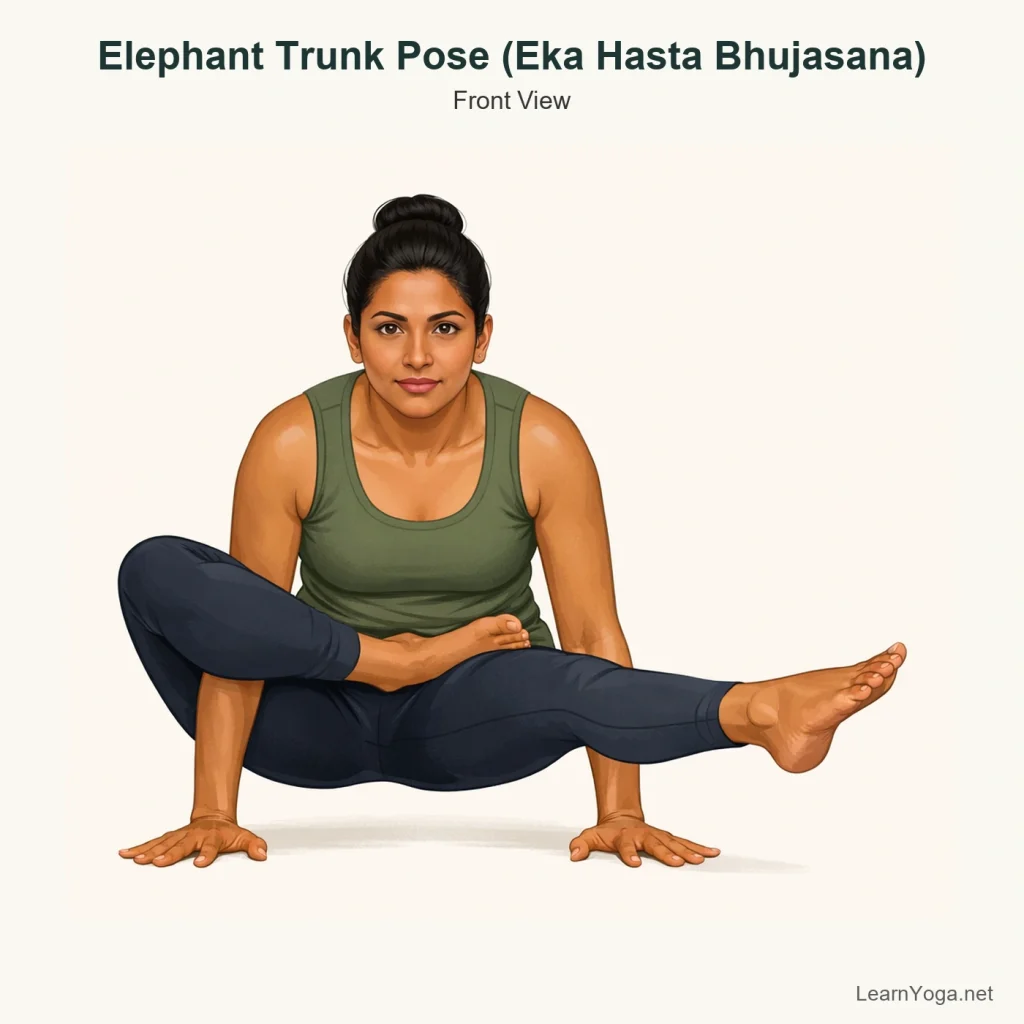
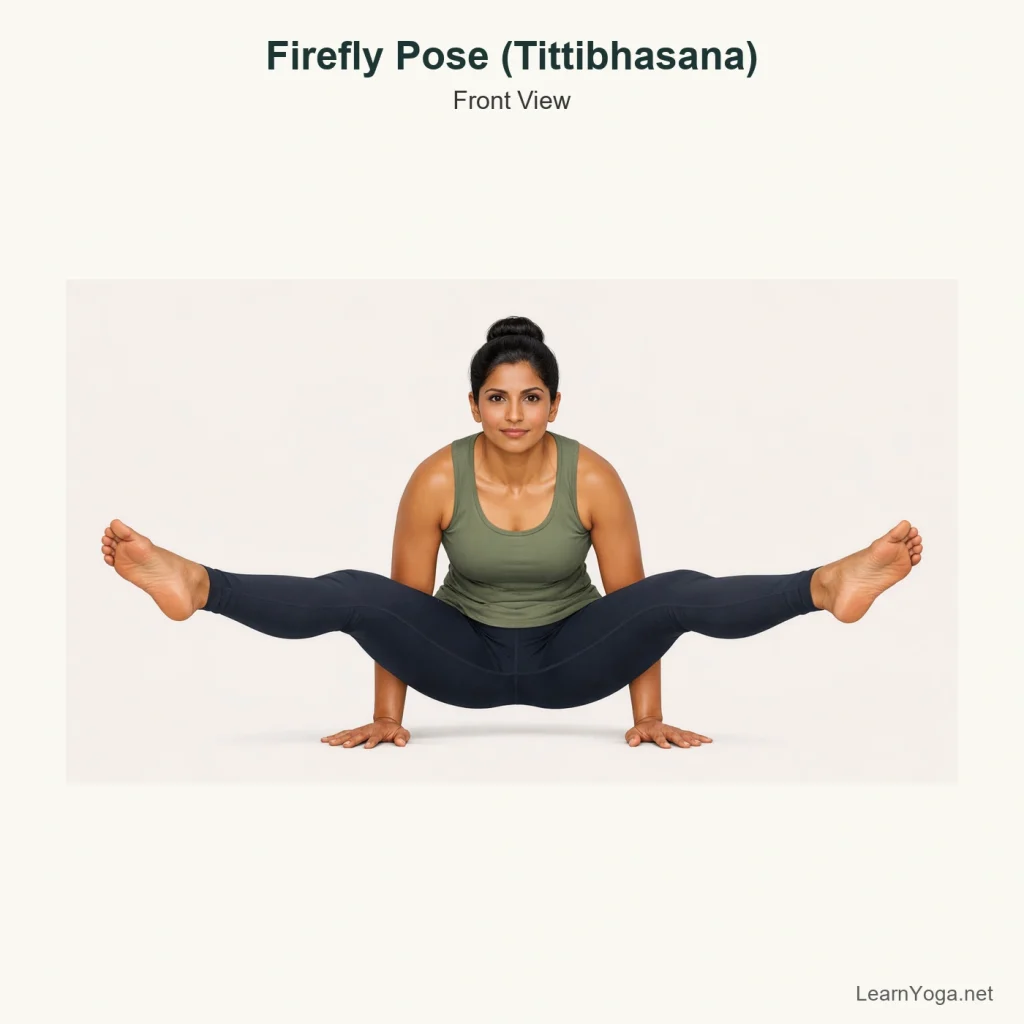
Elephant Trunk Pose is a compact seated balance where one leg comes high over the shoulder and the hands press into the floor. It asks for hip flexion, hamstring length, core support and enough spinal lift to stop the shape collapsing.
Timing: Hold for 2 to 3 steady breaths while setting the leg position. · If balancing, stay for 3 to 5 breaths, then lower with control. · Repeat once on each side if you still have a clean setup.
This pose is often limited by the setup rather than the lift. The leg needs to sit quite high on the upper arm, and the spine needs to stay long enough that the pelvis can tip forward a little. If the leg barely reaches the shoulder, it usually makes more sense to treat the pose as preparation and keep one or both hands on the floor.
How to do Elephant Trunk Pose
Sit on the floor with both legs extended in front of you.
Bend your right knee and place the right foot on the floor close to your body.
Take hold of the right shin or calf and lift the right leg with both hands.
Guide the right thigh high onto the back of the right upper arm. Bring it as close toward the shoulder as your body comfortably allows.
Flex the right foot and keep the toes active so the ankle does not go slack.
Place both hands on the floor beside your hips or slightly forward of them. Spread the fingers and press evenly through the palms.
Lean the chest slightly forward and lengthen through the spine instead of rounding straight back.
If available, begin to straighten the right leg out to the side while keeping it perched on the arm.
Stay here, or press down through the hands and lightly lift the left heel or the whole left leg from the floor for a brief balance.
Breathe steadily for 3 to 5 breaths, then lower the left leg, release the right leg and return to Staff Pose before changing sides.
Yogita's tip
The pose usually becomes lighter when the leg sits higher on the arm, even if the knee stays bent. Chasing a straighter leg too early often makes the thigh slide down and turns the pose into a struggle.
Benefits
Builds coordination between hip mobility, spinal lift and arm support.
Strengthens the hands, arms and deep front body in a short hold.
Gives a strong opening through the back of the lifted leg and outer hip, within your own range.
Develops balance and concentration because the shape changes quickly when the weight shifts.
Common mistakes
Trying to straighten the lifted leg before the thigh is high enough on the arm.
Rounding the back and dropping behind the sit bones, which makes the leg feel heavier.
Letting the foot of the lifted leg go soft so the knee and ankle lose support.
Placing the hands too far back, leaving no room to lean forward into the balance.
Forcing the leg into position instead of working with a bent knee and a smaller range.
Make it work for you
Bent-knee setup hold
Keep the lifted leg bent and simply practise placing the thigh high on the upper arm while both sitting bones stay on the floor. Hold the shin with one or both hands if needed.
Hands on blocks
Place a block under each hand to give the pelvis a bit more room and make the press into the floor more effective.
Floored support leg
Keep the opposite foot or heel on the floor while you work on the leg position and spinal lift. This reduces the balance demand without changing the main action.
Alternatives
Head-to-Knee Pose
Practise with one leg bent and the other extended forward, folding only as far as you can keep the spine long.
Use this if the hamstrings or lower back limit the setup before the leg can come onto the arm.
Reclining Hand-to-Big-Toe Pose
Lie on your back and work one leg upward with a strap, keeping the shoulders and jaw relaxed.
Use this if you want the hamstring opening without weight-bearing through the hands or the deep hip fold.
Boat Pose
Balance on the sit bones with the chest lifted and one or both knees bent.
Use this if the main challenge is core balance rather than the leg-behind-shoulder setup.
Common variations
Supported Elephant Trunk
The lifted leg stays high on the arm, but the opposite heel remains on the floor for support.
Straight-leg emphasis
The lifted leg extends more fully to the side while the pelvis stays grounded and the hands support on the floor.
Lifted balance variation
From the full setup, the hands press down and the supporting leg lifts briefly away from the floor.
Safety and contraindications
When to avoid or get individual guidance
Recent or aggravated hamstring, hip, wrist or shoulder injury.
Knee discomfort when lifting the leg high onto the arm.
Move into the pose gradually, especially when drawing the leg high toward the shoulder.
Keep some tone in the lifted foot to avoid hanging in the knee or ankle.
If the lower back rounds sharply or the thigh will not stay on the arm, back out and use a smaller version.
Come out of Elephant Trunk right away for sharp pain where the hamstrings attach, a pinching feeling at the front of the hip, or wrist pain that is still there once you release the pose. Use a lower-demand variation and get individual guidance before trying it again.
Accessibility and limited mobility
This pose is not very accessible for many learners because it asks for a deep hip fold and getting up and down from the floor.
If sitting upright on the floor is difficult, sit on a folded blanket to tip the pelvis forward a little.
Older adults or anyone with limited hamstring range may find the setup more workable in Reclining Hand-to-Big-Toe Pose or Head-to-Knee Pose instead.
If bearing weight through the wrists is uncomfortable, use a non-weight-bearing alternative rather than forcing the hand press.
Easier options
Use these related poses when you want a more accessible way to practise a similar movement or prepare for this pose.
Do I need to lift the opposite leg for it to count as the pose?
No. For many people, the useful work is getting the thigh high onto the arm and keeping the chest lifted. Keeping the opposite heel on the floor is a valid way to practise the shape.
What if my leg will not go very high over the shoulder?
Usually that means the pose is asking for more hamstring length, hip flexion, or both. Keep the knee bent, sit on a folded blanket, and work with the leg as high as it can go without tugging sharply at the back of the leg.
Should the lifted leg be completely straight?
Not necessarily. A partly bent leg is often the more stable and safer version. Straightening matters less than keeping the thigh secure on the arm and the spine from collapsing.
Where should I feel the pose most clearly?
Most people feel it in the back of the lifted leg, the hip crease, the low belly working, and the hands pressing firmly into the floor. It should feel effortful, but not sharp in the knee, groin or wrists.
Is it better to hold my breath when I try to lift?
It usually works better to keep the breath moving. Inhale to sit taller, then use a slow exhale to firm the centre and press down through the hands. Holding the breath often makes the shoulders harden and the leg feel heavier.
Reviewed for yoga instruction
Yogita
Certified Yoga Instructor with 5+ years of Teaching and Consistent Practice