Reverse Warrior keeps the legs working as they do in Warrior II while adding a side bend and lift through the front body. It is less about dropping back and more about finding length from the outer edge of the back foot up through the top fingertips.
This pose is often entered from Warrior II. The front knee stays bent, the back leg stays active, and the upper body arcs gently back. For many people, the useful work is not in how far back they go but in keeping the side body long and the front knee steady. Comfortable range differs, so a small shape is completely valid.
How to do Reverse Warrior
Start in Warrior II with the front knee stacked roughly over the ankle and the back foot grounded.
Turn the front palm up and let that arm reach forward slightly first, as if you are making space before you lift.
On an inhale, sweep the front arm up and overhead, lifting through the front ribs and side waist.
Let the back hand rest lightly on the back leg rather than pressing down hard into it.
Keep the front knee bent and pointing in the same direction as the front toes.
Press firmly through the outer edge of the back foot so the back leg stays awake.
Allow a gentle side bend and slight back arc through the upper body, but avoid collapsing into the lower back.
Keep the neck easy. You can look up, forward, or down depending on what feels steady.
Stay for 3 to 5 breaths, using each inhale to create length and each exhale to keep the legs stable.
Inhale back to Warrior II, then repeat on the second side.
Yogita's tip
If the pose starts feeling like a backbend in the lower back, reach the top arm a little more toward the back wall instead of dropping deeper behind you. That usually spreads the shape along the whole side body.
Benefits
Builds stamina in the legs while the front knee stays bent.
Creates length through the side waist, ribs and top arm.
Opens the chest without needing a very deep backbend.
Improves awareness of how to keep the lower body steady while the upper body moves.
Can prepare the body for other standing poses and flowing transitions.
Common mistakes
Straightening the front knee as soon as the torso starts to lean back.
Dumping a lot of weight into the back hand on the rear leg.
Collapsing into the lower back instead of lengthening through the side body.
Letting the front knee drift inward.
Tensing the neck by forcing the gaze upward.
Make it work for you
Shorter stance
If it is hard to keep the legs steady, bring the feet a little closer together. This often makes the front knee easier to track and reduces strain in the hips.
Hand to hip
Keep the back hand on the back hip instead of sliding it down the leg. This can help you avoid leaning heavily backward.
Smaller arm arc
Reach the top arm up rather than far overhead if the shoulder or ribs feel cramped. You still get the shape without forcing range.
Alternatives
Standing Side Stretch
Practise the side bend with both legs straight and a narrower base before adding the deeper lunge shape.
Use this if the bent front knee or wide stance feels like too much.
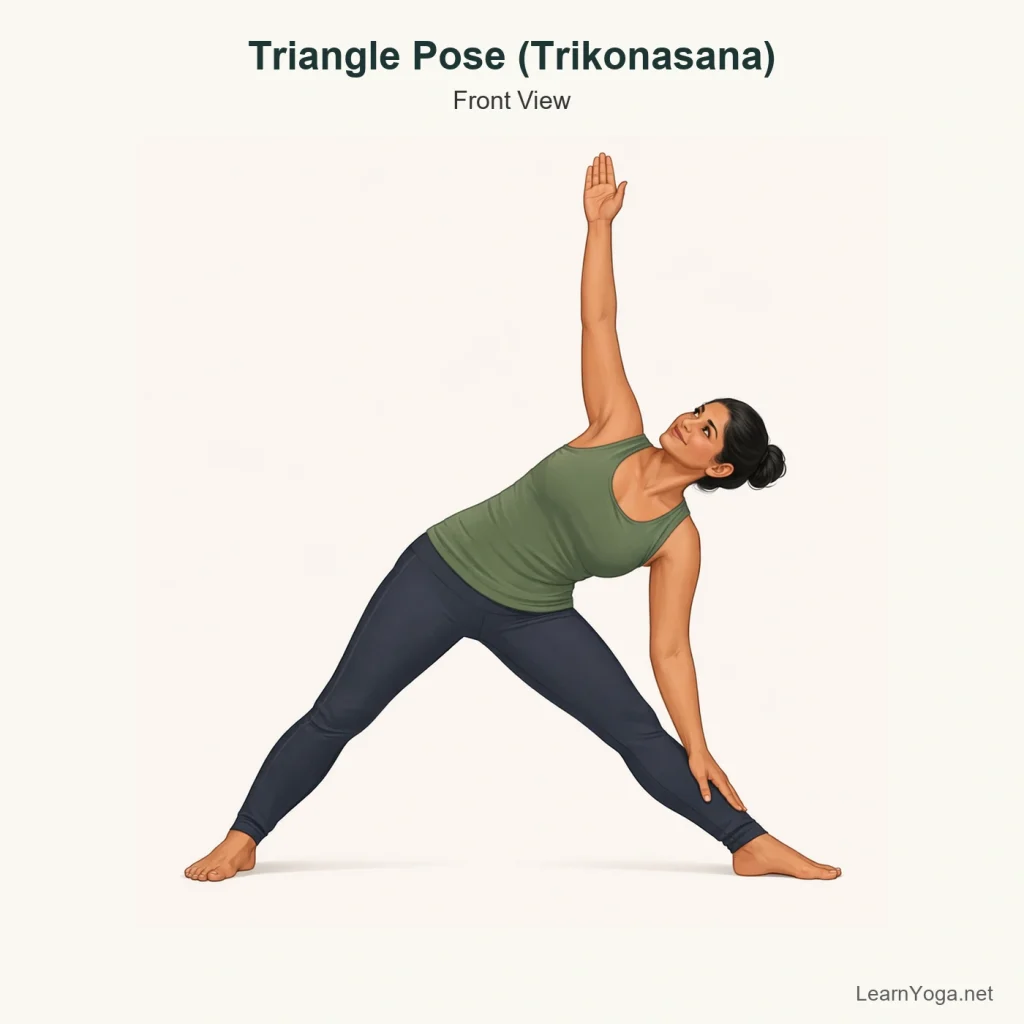
Triangle Pose
Take Triangle Pose instead and keep the top arm reaching up or overhead without bending the front knee deeply.
Use this if you want a similar side-body opening with less load in the front thigh.
Gate Pose
Try Gate Pose for a side stretch in a supported kneeling position.
Use this if balance in standing feels unsteady.
Common variations
Reverse Warrior from Warrior II
The standard version, with the front knee bent and the top arm reaching overhead while the back hand rests lightly on the rear leg.
Peaceful Warrior with a softer bend
A milder version with less bend in the front knee and a smaller side arc, useful when building familiarity with the pose.
Flowing Reverse Warrior
A dynamic version moving in and out with the breath from Warrior II, often used in standing sequences.
Safety and contraindications
When to avoid or get individual guidance
Recent or aggravated knee pain may make the bent front leg uncomfortable.
Shoulder irritation can be aggravated by the overhead arm position.
If backbending or side bending reliably causes pain in your lower back, keep the shape small or choose a simpler alternative.
Keep the front knee tracking over the foot rather than collapsing inward.
Let the side bend stay spacious. The pose should not feel like a hard drop into the lower back.
If looking up strains the neck, keep the gaze forward or down.
Use a shorter stance or a smaller bend if the front thigh, hips or balance feel overworked.
Pause Reverse Warrior when sharp pain keeps showing up in the front knee, the lifted arm shoulder feels pinched, or the low back still aches even after shortening the stance and making the side bend smaller. Choose an easier variation and get individual guidance before continuing.
Accessibility and limited mobility
If getting into a wide stance is difficult, shorten the distance between the feet and reduce how deeply you bend the front knee.
If balance feels uncertain, practise near a wall so you have a reference point beside you.
For older adults or anyone with limited stamina in the legs, hold for one or two breaths rather than staying longer.
If reaching overhead is uncomfortable, keep the top hand on the hip and work mainly with the legs and side waist.
Easier options
Use these related poses when you want a more accessible way to practise a similar movement or prepare for this pose.
Should I lean back as far as possible in Reverse Warrior?
No. For most people, the pose works better when the side body stays long and the legs stay steady. A smaller arc usually feels clearer than throwing the chest back and losing support in the front knee or lower back.
Why does my front thigh get tired so quickly?
That is common because the front leg is doing a lot of work. Try shortening the stance a little or bending the front knee less deeply. You can also come in for one breath at a time and build up gradually.
Where should my back hand go?
It can rest lightly on the back leg, or you can place it on the back hip. The main point is that it should not push hard enough to force a deeper bend.
What if looking up makes me feel strained or wobbly?
Keep your gaze forward or even slightly down. The neck does not need to be in extension for the pose to be useful, and many people feel more stable with a neutral head position.
Reviewed for yoga instruction
Yogita
Certified Yoga Instructor with 5+ years of Teaching and Consistent Practice