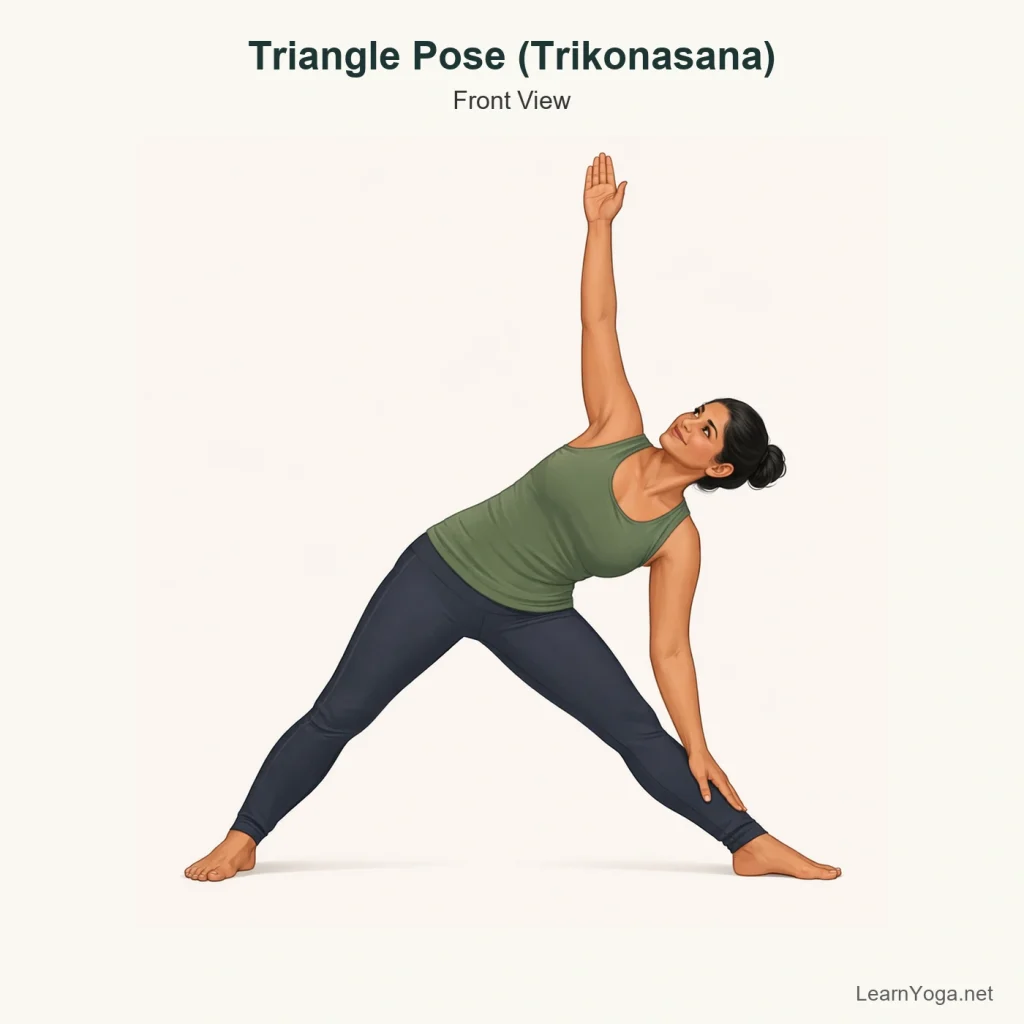
Triangle Pose is a standing side-bending shape that asks for steady legs, a long spine and a clear turn through the chest. It can help you explore hamstring length and side-body space without having to fold deeply, and it is often easier when you use a block rather than reaching for the floor.
In Triangle Pose, the shape matters less than how evenly you organise it. Many people try to get the lower hand down first, then lose the length of the waist or lock into the front knee. A better approach is to build from the feet up: ground both legs, tip from the front hip, and let the hand land where your spine can still feel long. The pose may feel very different from one side to the other, which is normal.
How to do Triangle Pose
Start in a wide stance facing the long side of your mat, with your arms stretched out at shoulder height.
Turn your right foot out so the toes point to the front of the mat, and turn your left foot in slightly.
Line your right heel roughly with your left arch, or take a slightly wider track if that feels steadier.
Firm both legs without locking the knees. Press through the base of the big toe of the front foot and the outer edge of the back foot.
Inhale and lengthen both sides of your waist.
Exhale and reach your right arm forward, as if someone is gently drawing your fingertips away from you.
When you cannot reach farther without shortening the right side waist, let your right hand come to your shin, a block, or the seat of a chair.
Stack your left shoulder over your right as much as is comfortable, and turn the chest open without forcing it.
Let the left arm reach up if that feels fine in your shoulder, or keep the top hand on your hip.
Keep the neck neutral. Look forward, down, or up toward the top hand depending on what feels easiest on your neck and balance.
Stay for 3 to 6 breaths. On each inhale, make space through the chest and spine. On each exhale, root the feet and keep the legs steady.
Press into both feet to come up on an inhale, return to centre, and repeat on the second side.
Yogita's tip
If the front hand keeps creeping lower but the chest starts collapsing, raise the hand onto a block. In this pose, a higher hand often gives you a truer Triangle than reaching the floor does.
Benefits
Builds awareness of how to lengthen the spine while moving at the hip joint.
Gives a clear stretch through the front leg hamstrings and inner thigh, depending on your proportions.
Encourages steadiness and activity in both legs and feet.
Creates space across the chest and side body when the top shoulder can turn open.
Helps you practise balance and orientation in a wide standing position.
Common mistakes
Dropping the lower hand too far and rounding or collapsing the side waist.
Locking the front knee back instead of keeping the leg active and steady.
Letting the weight fall only into the front foot and forgetting the back leg.
Turning the chest down toward the floor rather than opening it gradually.
Forcing the head to look up when the neck would be more comfortable looking forward or down.
Make it work for you
Hand on a block
Place a yoga block outside or inside the front shin and rest your lower hand there. Choose the block height that lets your spine stay long and your chest stay broad.
Top hand on hip
Keep the upper hand on your hip instead of reaching it to the ceiling. This can make it easier to learn the chest rotation without straining the neck or shoulder.
Shorter stance
Bring the feet a little closer together if the hamstrings or groins feel over-pulled. A slightly shorter stance often makes the pose more stable and easier to organise.
Alternatives
Chair-supported Triangle shape
Place your front hand on the seat or back of a chair so you do not need to reach downward as far.
Useful if balance feels uncertain, if getting low strains the hamstrings, or if you want a more upright version.
Gate Pose
Practise a side-bending shape from kneeling in Gate Pose instead of a wide standing stance.
Useful if the wide standing position feels unstable or if you want less demand on the hamstrings.
Half Standing Forward Fold
Work with a long spine and hip hinge in Half Standing Forward Fold before adding the side-opening element.
Useful if Triangle feels too complex in the legs and spine at the same time.
Common variations
Triangle with a block inside the front foot
Placing the block inside the front foot can help some people keep more length in the front side waist and stay lifted through the chest.
Triangle with top hand on hip
This variation reduces shoulder and neck demand while you work on the foundation of the pose.
Short-stance Triangle
A slightly shorter distance between the feet can make balance easier and reduce the pull in the front hamstring.
Safety and contraindications
When to avoid or get individual guidance
Use care with current hamstring strain, sacroiliac irritation, or neck pain that is aggravated by turning the head.
If balance is limited, practise with your hand on a chair or with your back near a wall.
Keep a soft micro-bend rather than pushing the front knee into a hard lock.
If the hamstring feels sharp or pinchy, come up slightly and shorten the stance or use a block.
Choose a neutral head position if looking up strains the neck or affects balance.
If the lower back feels compressed, come a little higher and think more about length through both sides of the waist.
Pause Triangle Pose when sharp or pinchy pain shows up in the hamstring, hip, low back, or neck, or when balance feels too shaky to stay steady. Choose a shorter stance, a block, or wall support, and get individual guidance before continuing if it keeps happening.
Accessibility and limited mobility
A chair or block can make this pose much more workable for older adults or anyone who does not want to reach toward the floor.
If turning the head upward affects your balance or neck comfort, keep your gaze forward or down.
If a wide stance is hard to manage, reduce the distance between the feet and focus on the hip hinge and chest opening rather than the depth of the shape.
Easier options
Use these related poses when you want a more accessible way to practise a similar movement or prepare for this pose.
Do I need to put my hand on the floor in Triangle Pose?
No. For many people, the floor is too low to reach without collapsing the spine or twisting awkwardly. A block, shin or chair is often the better choice because it helps you keep length through the torso.
Why does my front hamstring feel much more than my side body?
That usually means the stance is a bit long for your current range, or you are reaching down before you reach forward. Shorten the stance slightly and think of gliding the front arm forward first, then lowering the hand.
Should my front knee be completely straight?
The leg is usually straight, but not jammed back. Keep the thigh active and let there be a tiny softness if locking the knee makes the pose feel strained or unstable.
What should I do with my head if looking up feels uncomfortable?
Keep your gaze forward or down. The neck does not need to be turned upward for the pose to count. A neutral head position is often steadier and more comfortable.
Why do I feel wobbly in this pose?
Triangle can be less stable if the feet are too narrow, the stance is too long, or the back foot is not pressing well into the floor. Try widening the track between your feet a little, shorten the stance, and root the outer edge of the back foot more clearly.
Reviewed for yoga instruction
Yogita
Certified Yoga Instructor with 5+ years of Teaching and Consistent Practice