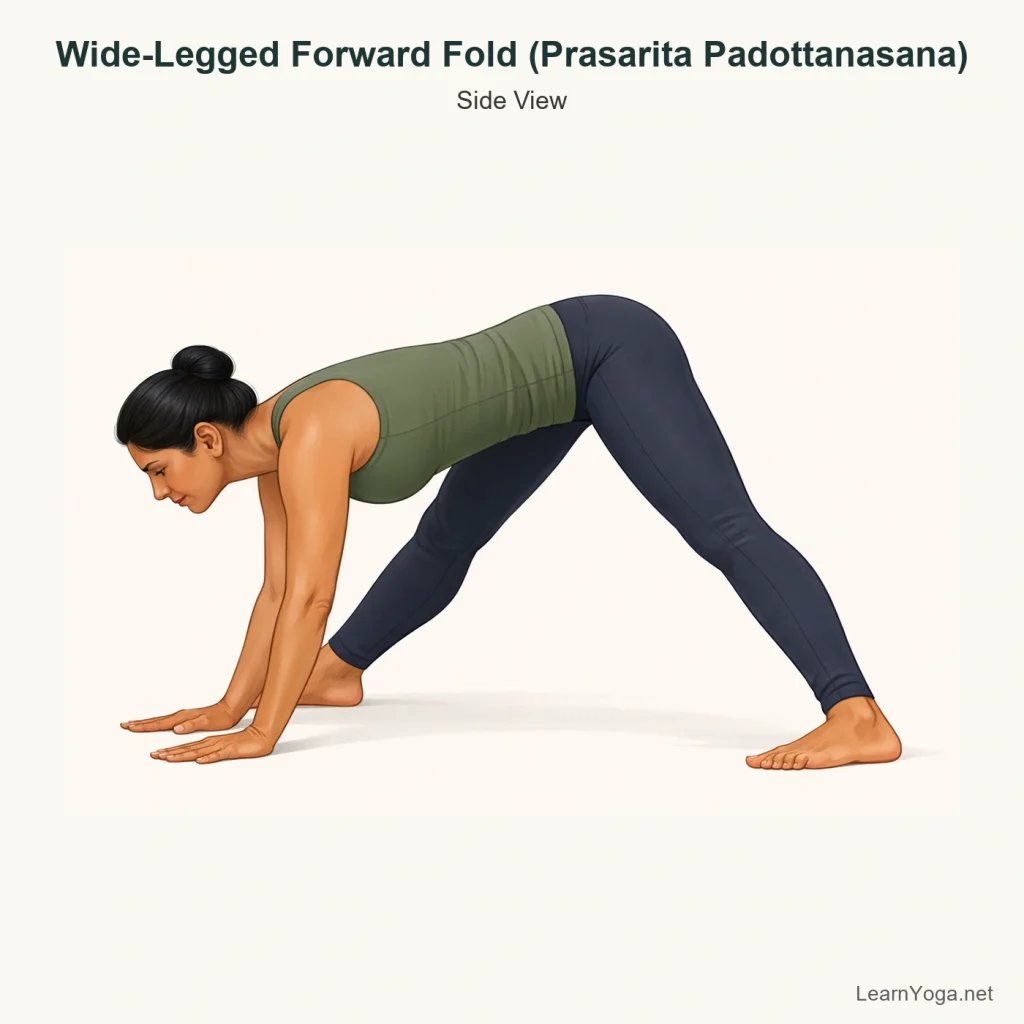
Wide-Legged Forward Fold opens into the backs of the legs and the inner hips while also asking for steady feet and a clear hip hinge. It can be a useful standing fold when you want more space than a narrow stance gives.
This pose is a forward fold with the feet set wide apart. For many people, that wider base makes it easier to tip from the hips, though it can also ask more of the hamstrings and inner legs than expected. There is no need to force depth. A smaller fold with a long spine is usually more useful than dropping the head lower and rounding through the back.
How to do Wide-Legged Forward Fold
Stand facing the long edge of the mat and step your feet wide apart, roughly under your wrists if you stretch your arms out, or a little narrower if that feels steadier.
Place your hands on your hips and turn your toes slightly inward or keep them close to parallel, choosing the angle that lets your knees track comfortably.
Press through the outer edges and big-toe mounds of both feet so the weight does not collapse only into the heels or the inner arches.
Inhale and lift through the chest, making the spine long from tailbone to crown.
Exhale and hinge forward from the hips, keeping the front of the torso reaching ahead as long as possible before the hands come down.
Place your fingertips on the floor or on blocks under the shoulders. If your hamstrings feel tight, bend the knees a little and keep the spine long.
Stay here with a flat back, or if it suits your body, walk the hands back slightly and let the fold deepen without pushing.
Keep a light lift in the kneecaps and avoid locking the knees back. Let the head hang only if the neck feels easy.
Take 3 to 8 slow breaths, using each inhale to create length and each exhale to soften the fold in a controlled way.
To come out, bring your hands to your hips, bend the knees a little, inhale and rise with a long spine.
Yogita's tip
If the fold keeps shifting into the outer edges of your feet, press the base of the big toes down a little more. That often helps the inner legs wake up and gives the pelvis a clearer path to tip forward.
Benefits
Lengthens the hamstrings, calves and inner legs.
Gives many people more room to fold from the hips than a feet-together forward bend.
Builds awareness of how the feet and legs support a standing fold.
Can help the spine feel longer when you use blocks and hinge carefully.
Offers a quieter shape for settling the breath near the middle or end of practice.
Common mistakes
Taking the feet so wide that the pelvis cannot hinge smoothly.
Locking the knees back and shifting all the weight into the heels.
Rounding the back to reach the floor instead of raising the hands onto blocks.
Letting the arches collapse inward as the fold deepens.
Trying to force the crown of the head toward the mat.
Make it work for you
Hands on blocks
Place a block under each hand so you can keep more length through the spine and avoid pulling yourself down.
Soft knees
Bend the knees slightly if the hamstrings or lower back feel restricted. Keep that small bend as you fold and as you come back up.
Halfway version
Stop with the torso parallel or closer to parallel to the floor, hands on blocks or a chair seat, and work on the hip hinge without going deeper.
Alternatives
Half Standing Forward Fold
Practice with feet hip-width apart and hands on blocks or shins, keeping the spine long.
Use this if the wide stance strains the hamstrings or feels unsteady.
Ragdoll at the wall
Stand with your back lightly touching a wall, hinge forward only partway, and rest your hands on a chair or blocks.
Use this if balance is the main difficulty or getting very low is not comfortable.
Wide-Legged Fold with chair support
Take a moderate wide stance and place both hands on the seat of a chair in front of you, keeping the chest broad and the knees soft if needed.
Use this if reaching the floor is not practical or if you want less load on the back.
Common variations
Flat-Back Wide-Legged Fold
The torso stays long and nearer parallel to the floor with hands on blocks, the floor or a chair. This is often the most useful version for learning the shape.
Deeper Fold with Hands on the Floor
From a steady hinge, the hands walk back between the feet and the torso folds further only if the spine and hamstrings allow it comfortably.
Hands on Hips Entry
The fold is entered and exited with hands on the hips to help organise the pelvis and keep the spine long.
Safety and contraindications
When to avoid or get individual guidance
Use extra care with hamstring strain, low back irritation or dizziness in forward bends.
If a very wide stance bothers the inner knees or groins, shorten the distance between the feet.
Move into the fold from the hips rather than pulling yourself down with the arms.
Keep a small bend in the knees if the hamstrings tug sharply or the lower back rounds.
If your balance feels uncertain, keep the hands on blocks or a chair instead of reaching lower.
Come up slowly, especially after a longer hold.
Repeated sharp hamstring or groin pain in this wide fold, or dizziness that does not ease after you rise, is a good reason to pause deeper forward bends and get individual guidance before continuing.
Accessibility and limited mobility
A chair in front of you can make this pose much more workable if reaching the floor is difficult.
Older adults or anyone with balance concerns may prefer to practise with the back close to a wall or with hands supported the whole time.
If getting the head below the heart does not feel comfortable, stay in the halfway version with the torso lifted.
Easier options
Use these related poses when you want a more accessible way to practise a similar movement or prepare for this pose.
Start wide enough that you feel space in the pelvis, but not so wide that the legs start sliding or the fold feels stuck. For many people, a moderate stance works better than the biggest possible one. You can adjust after one breath or two and see where the hinge feels clearer.
Should my toes point forward or turn in slightly?
Either can work. Slightly turned-in toes often help people keep the outer hips and outer feet engaged, while a more parallel stance may feel natural for others. Choose the angle that lets your knees and feet feel even and stable.
Why do I feel this more in my lower back than in my legs?
That usually means the fold has gone deeper than your hips are ready to tip. Try bending the knees, lifting the hands onto blocks, and pausing with the spine longer. Think of moving the sitting bones up rather than dragging the chest down.
Do I need to bring my head to the floor?
No. That version suits some bodies, but it is not the goal. A smaller fold with steady feet, active legs and an easy breath is often the better practice.
What if I feel lightheaded when I come out?
Come up more slowly, keep a slight bend in the knees, and place your hands on your hips before rising. You can also stay in the halfway version instead of folding fully, especially if your head below your heart does not feel comfortable that day.
Reviewed for yoga instruction
Yogita
Certified Yoga Instructor with 5+ years of Teaching and Consistent Practice