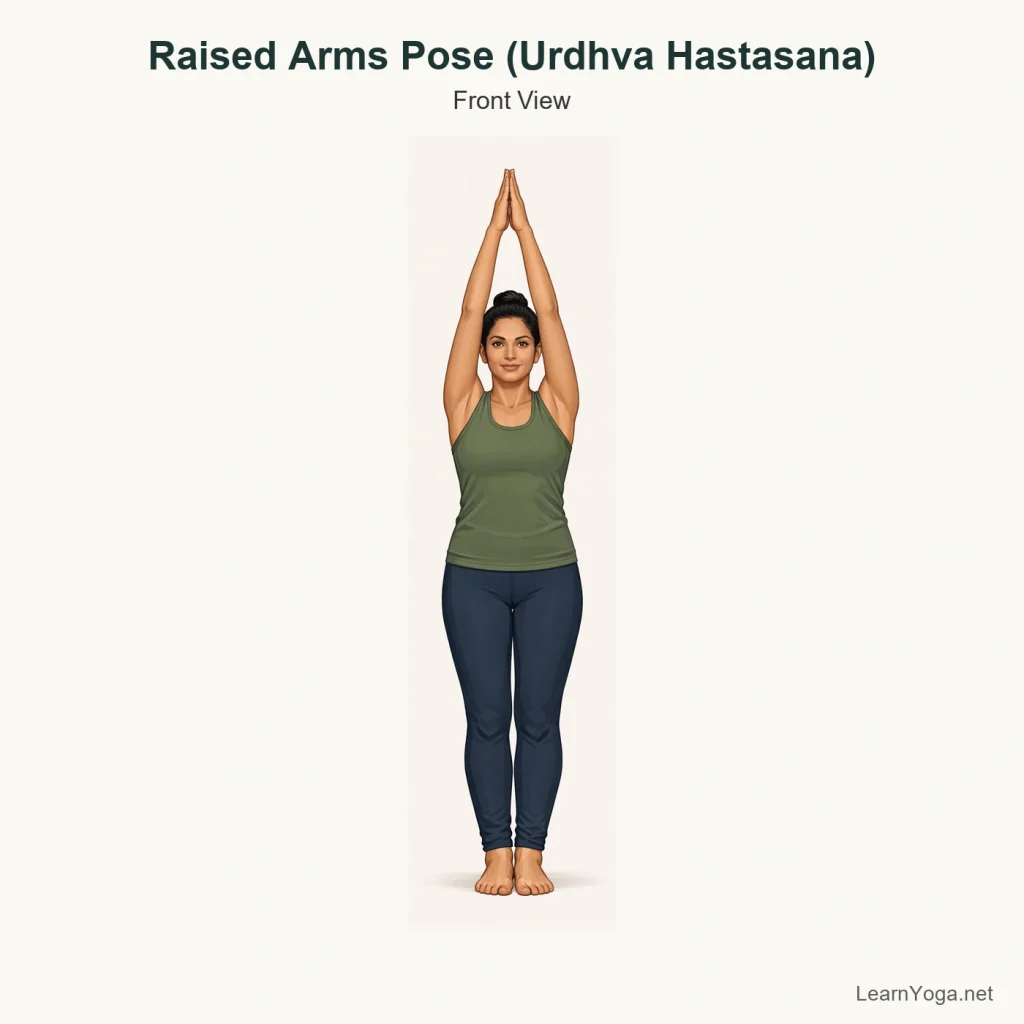
Raised Arms Pose is a simple standing reach that lengthens the sides of the body and brings attention to how the ribs, shoulders and pelvis organise as the arms go overhead.
This is a clear, useful shape for the start of practice, between standing poses, or as part of a few slow rounds with the breath. The action seems straightforward, but it works better when the upward reach comes from the whole body rather than only from the hands. For some people the palms touch easily. For others, keeping the hands apart feels much more comfortable. Both are fine.
How to do Raised Arms Pose
Stand in Mountain Pose with your feet hip-width apart or together, whichever gives you a steadier base.
Spread your weight evenly through heels, big-toe mound and little-toe mound, and let the legs feel awake without hard gripping.
On an inhale, sweep your arms out to the sides or forward and up overhead.
Keep the front ribs from jutting forward as the arms lift. Think of the lower front ribs staying soft while the sides of the waist lengthen.
Reach up through the fingers, but let the shoulders stay as easy as they can. Your palms may touch, stay shoulder-width apart, or face each other.
Stay for 3 to 5 breaths, breathing smoothly. If you prefer movement, lower the arms on an exhale and repeat for 3 to 6 rounds.
To come out, exhale and lower the arms with control back to your sides.
Yogita's tip
If the arms are overhead but the neck feels crowded, turn the palms to face each other and keep a little space between the hands. That often lets the upper arms rotate more naturally and frees the base of the neck.
Benefits
Encourages a fuller overhead reach through the arms and shoulders.
Helps you notice when the ribs push forward and how to keep the trunk more organised underneath the arms.
Lengthens the sides of the waist and body in a simple, accessible way.
Can prepare the body for standing flows, backbends and poses with the arms overhead.
Builds basic awareness of posture and balance while standing still.
Common mistakes
Throwing the ribs forward and compressing the lower back to get the arms higher.
Lifting the shoulders up into the ears instead of reaching upward with a steady neck.
Locking the knees and leaning back into the heels.
Forcing the palms to touch when the shoulders would be more comfortable with the hands apart.
Holding the breath while reaching overhead.
Make it work for you
Hands shoulder-width apart
Keep the arms parallel instead of bringing the palms together. This usually gives the shoulders more room.
Bent elbows
If a straight-arm reach feels strained, bend the elbows slightly and focus on length through the sides of the body.
Back to wall
Stand with your back lightly touching a wall and raise the arms without letting the ribs pop forward. Use the wall as feedback, not something to press into.
Alternatives
Palm Tree Pose
Raise the arms only to a height that feels comfortable and keep the reach gentle.
Use this if a full overhead lift feels too strong or restricted.
Prayer Pose
Keep the hands at the chest and focus on steady standing with a long spine.
Use this if shoulder movement overhead is not comfortable today.
Common variations
Palms touching overhead
A more traditional-looking version where the palms meet above the head, if the shoulders allow it without strain.
Arms parallel
The hands stay apart at about shoulder width, often making the pose more comfortable through the shoulders and neck.
Dynamic arm lift
The arms lift on each inhale and lower on each exhale for several rounds instead of holding the shape.
Safety and contraindications
When to avoid or get individual guidance
Recent shoulder irritation may make a full overhead reach uncomfortable.
If standing with the arms up makes you dizzy, come out and rest.
Keep the movement smaller if overhead reaching pinches at the front or top of the shoulder.
If your lower back feels compressed, separate the hands and reach more upward than backward.
Choose a stable foot position if lifting the arms affects your balance.
If overhead reaching causes sharp pain, repeated pinching, or dizziness that does not settle when you lower the arms, get individual advice before continuing.
Accessibility and limited mobility
A wider stance can make balance easier, especially if standing with the feet together feels unsteady.
Practising with the back near a wall can help you feel where the ribs and pelvis are in space.
If getting the arms fully overhead is difficult, stop at a lower height and keep the movement comfortable rather than forcing the range.
Easier options
Use these related poses when you want a more accessible way to practise a similar movement or prepare for this pose.
No. Many people are more comfortable with the hands apart. If bringing the palms together makes the ribs push forward or the shoulders tense, keep the arms parallel instead.
Why do I feel this more in my lower back than my shoulders?
That usually happens when the ribs drift forward as the arms lift. Soften the front ribs a little, keep the tail heavy, and think of reaching up rather than leaning back.
What if I cannot straighten my arms fully?
A small bend in the elbows is completely fine. Work within the range where your neck stays easy and your breath stays smooth. Over time, the shape may become clearer without forcing it.
Is it better to hold the pose or move with the breath?
Both are useful. Holding for 3 to 5 breaths can help you organise the shape. Moving the arms up on an inhale and down on an exhale for several rounds is often better as a warm-up.
Reviewed for yoga instruction
Yogita
Certified Yoga Instructor with 5+ years of Teaching and Consistent Practice