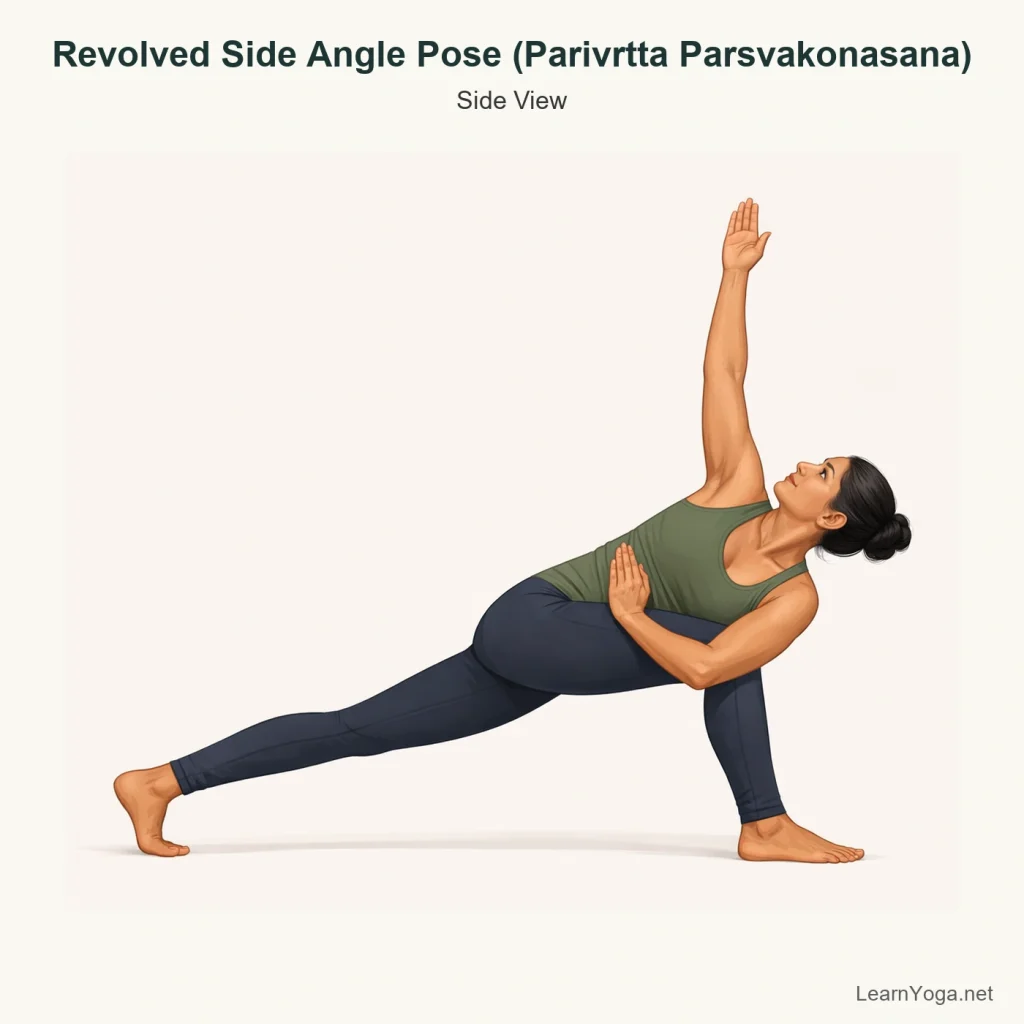
Revolved Triangle is a standing twist with a narrow base, so it asks for steadiness as much as flexibility. It can build awareness through the feet, legs, spine and breath, but it usually works better when the range is moderate rather than forced.
This pose combines a split stance, a forward tilt from the hips and a spinal rotation. For many people, the challenge is not how far they can twist but how well they can keep length through both sides of the waist while staying balanced. A block under the lower hand is often the most useful starting point.
How to do Revolved Triangle Pose
Begin in Mountain Pose, then step your left foot back into a shorter stance than you might use for Warrior I. Keep both legs fairly straight, but do not lock the knees.
Turn your left foot slightly inward and point your right foot forward. Square your hips as much as is comfortable, knowing they may not become perfectly even.
Place your hands on your hips and inhale to lengthen up through the spine. As you exhale, hinge forward over the front leg with a long back.
Bring your left hand to a block, the floor, or the outside of your right shin, depending on what lets your spine stay long. Keep some weight in both feet rather than dropping into the front leg.
Place your right hand on your hip first. Inhale to extend the chest forward; exhale to rotate your ribcage to the right.
If the twist stays steady, reach your right arm up toward the ceiling. You can keep your gaze down, to the side, or up, whichever helps the neck stay easy.
Press the back heel firmly down and draw the front outer hip slightly back. Let the twist rise from the waist and chest instead of pulling with the shoulder.
Stay for 3 to 5 breaths. To come out, lower the top hand to your hip, inhale to lengthen the spine, and rise back up with a strong back leg. Repeat on the second side.
Yogita's tip
If the twist keeps collapsing into the front side of the waist, place the lower hand a little more inward on a block rather than reaching all the way to the floor. That small lift often gives the spine room to rotate cleanly.
Benefits
Practises rotating the spine while keeping the legs active and grounded.
Builds balance and attention because the base is narrow and the shape is asymmetrical.
Lengthens through the hamstrings and outer hips, especially in the front leg.
Strengthens postural support through the legs and trunk to hold the twist with more control.
Can improve awareness of how to hinge from the hips without rounding the whole back.
Common mistakes
Forcing the lower hand to the floor and rounding the spine to get there.
Letting most of the weight fall into the front foot so the back leg becomes passive.
Twisting mainly from the shoulder and arm instead of from the ribcage and waist.
Locking the front knee backward and losing steadiness in the leg.
Lifting the back heel or letting the back foot collapse inward.
Make it work for you
Bottom hand on a block
Place a block inside or outside the front foot at a height that allows you to keep the chest broad and the spine long. This is often the simplest way to make the pose more workable.
Top hand stays on hip
Keep the upper hand on your hip instead of reaching it up. This reduces the balance demand and can help you turn from the trunk with more control.
Shorter stance
Bring the back foot a little closer in. A slightly shorter stance can make it easier to square the pelvis and keep the back heel grounded.
Alternatives
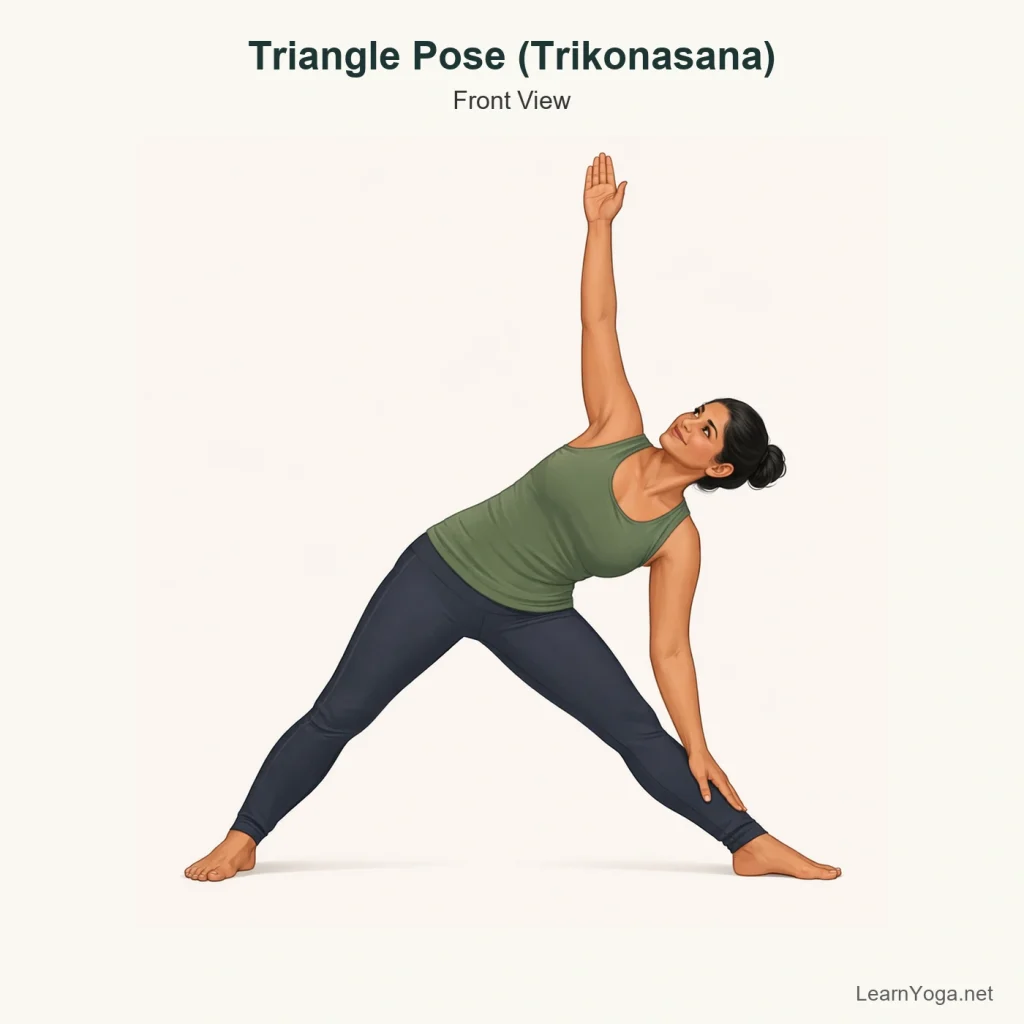
Triangle Pose
Practise the same leg shape without the deep rotation of the torso.
Use this if the twisting action feels strained or you lose length in the spine.
Pyramid Pose
Keep both hands on blocks and focus on the hip hinge and leg work without adding a strong twist.
Useful when hamstrings or balance are the main limiting factors.
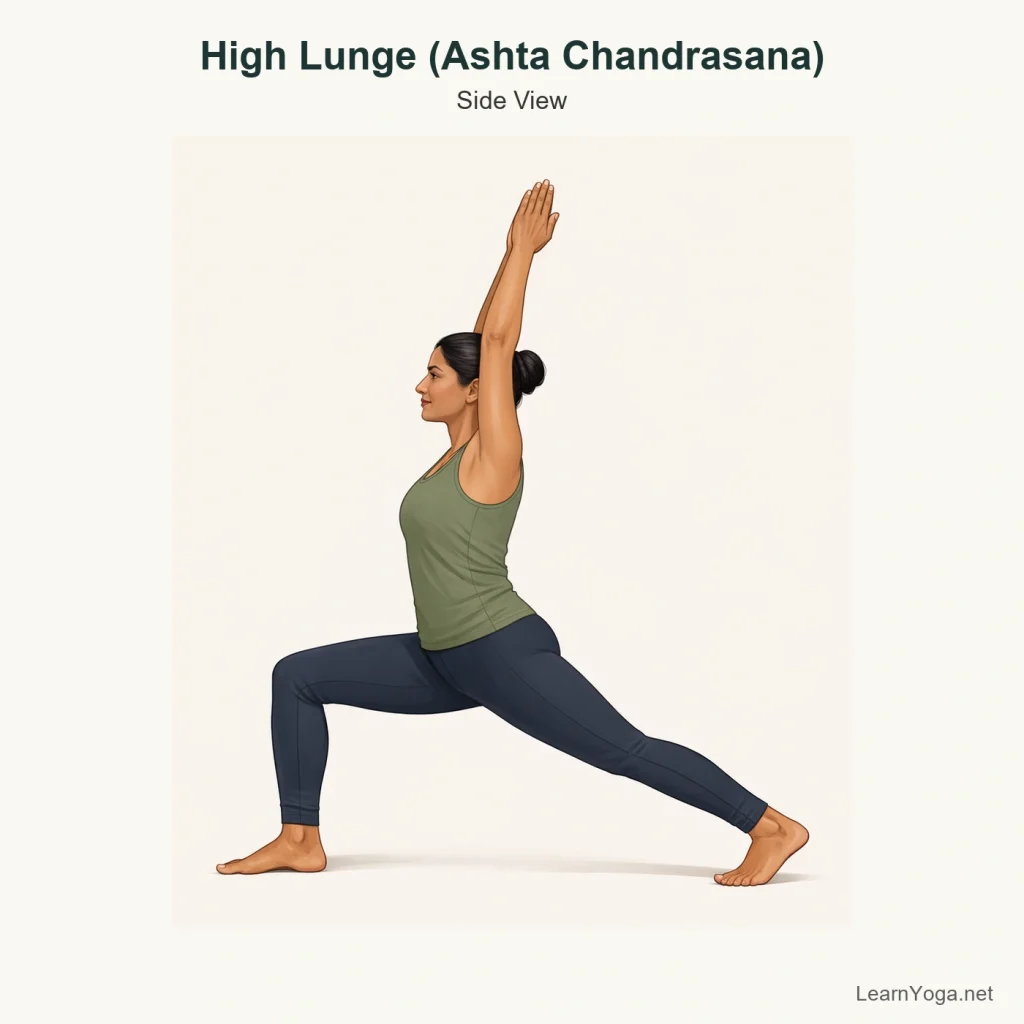
Low Lunge Twist
Lower the back knee and twist toward the front leg, using your hand on the floor or a block for support.
A good option if the standing balance demand is too high.
Common variations
Hands-at-heart Revolved Triangle
Bring the palms together at the chest instead of extending the top arm. This can make the twist feel more compact and controlled.
Revolved Triangle with inside block
Place the lower hand on a block inside the front foot rather than outside it. This usually gives more space for the spine and hamstrings.
Wall-supported Revolved Triangle
Practise with the back heel or hips lightly touching a wall to help with orientation and steadiness.
Safety and contraindications
When to avoid or get individual guidance
Avoid or reduce the range if you have an acute hamstring strain or a recent flare of back pain with twisting.
If standing twists make you dizzy, keep the gaze down or choose a simpler variation.
Move into the twist gradually, especially if your hamstrings feel tight. A long spine matters more here than a deeper turn.
Keep a soft micro-bend in the front knee if the hamstrings pull strongly or the knee starts to lock back.
If balance feels uncertain, place the lower hand on a block and keep your gaze down.
Be cautious with this pose if twisting or forward bending tends to irritate your lower back, sacroiliac area, or hamstrings.
Pause Revolved Triangle and use a shorter stance or a block when sharp pain shows up in the hamstrings, sacroiliac area, or lower back, or balance stays unreliable even with support. Get individual guidance before working into deeper versions.
Accessibility and limited mobility
This pose can be awkward for anyone who finds split-stance balance difficult. Using a wall and a high block often makes it more accessible.
If getting into a deep forward hinge is limited, shorten the stance and keep the lower hand higher rather than forcing the torso down.
For older adults or anyone who is not comfortable reaching toward the floor, Triangle Pose or Low Lunge Twist may be a more manageable way to work on similar actions.
Easier options
Use these related poses when you want a more accessible way to practise a similar movement or prepare for this pose.
No. In many bodies, reaching to the floor shortens the spine and makes the twist less clear. A block is often the better choice because it lets you keep length through the torso and steadiness in both legs.
Why do I keep losing balance in this pose?
The stance is quite narrow and the twist shifts your weight. Try shortening the distance between the feet a little, press the back heel down firmly, and keep your gaze on the floor instead of looking up. Keeping the top hand on the hip can help too.
Should my hips be completely square to the front?
Not necessarily. It is useful to aim the pelvis generally forward, but forcing it fully square can make the front hamstring or lower back grip. Work toward a balanced position where both legs stay active and the spine can stay long.
Where should I feel the pose most?
Often you will notice the front hamstring, the outer hip, the feet working for balance, and a broad twisting action through the waist and chest. If you mostly feel compression in the lower back, ease the range and lift the lower hand higher.
Is it better to look up or down?
Neither is required. Looking up increases the balance and neck demand. If that makes the pose wobbly or tight in the neck, keep the gaze down or to the side. The twist can still be strong without the upward gaze.
Reviewed for yoga instruction
Yogita
Certified Yoga Instructor with 5+ years of Teaching and Consistent Practice