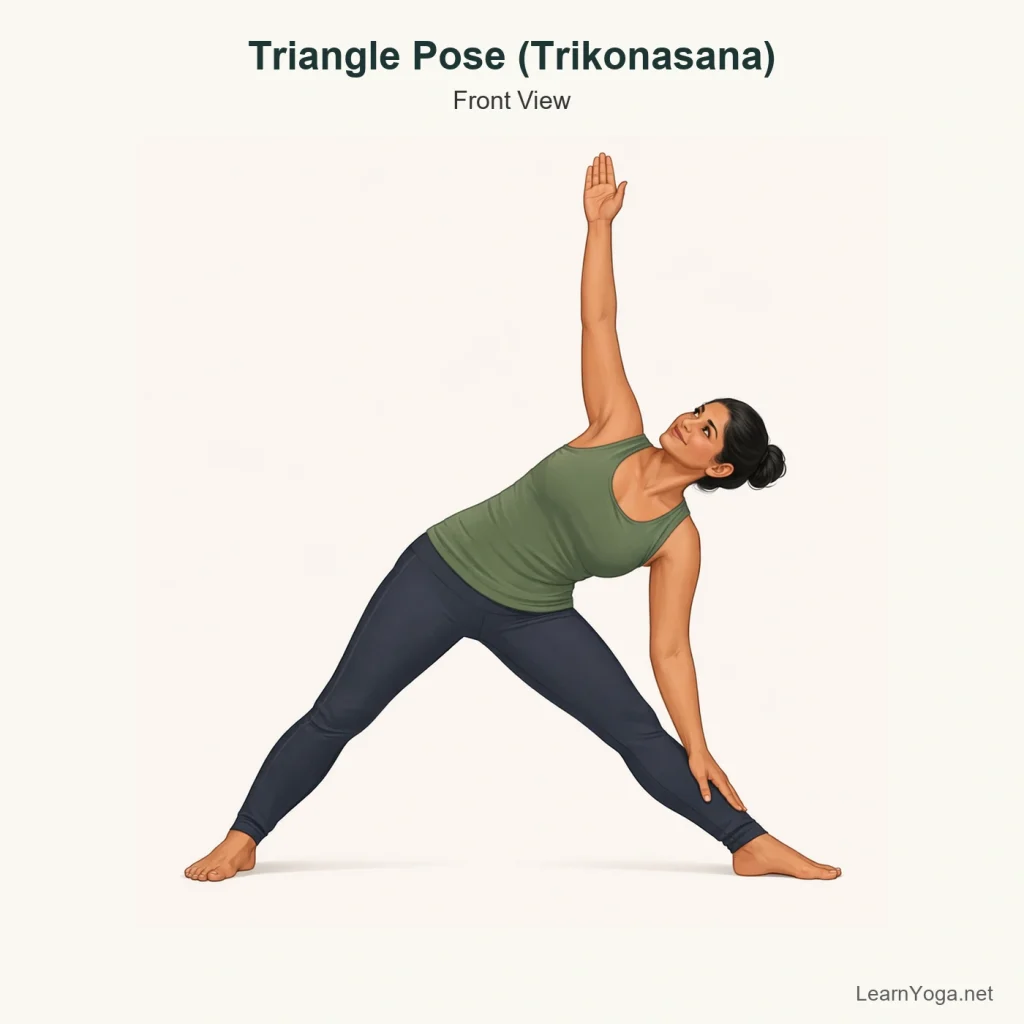
Bound Triangle Pose builds on Triangle by adding a bind around the front leg. It asks for steady legs, hamstring length, shoulder opening and enough spinal rotation to keep the chest broad rather than collapsed.
This is a strong variation of Triangle Pose, not just a deeper version of the same shape. The bind changes the job of the pose. It narrows your room to turn, so the front hamstring, outer hip and shoulders usually need more patience. For many people, the clearest version is not the deepest one. If the bind makes the chest cave or the front knee lock hard, it helps to step back to regular Triangle and rebuild the shape from there.
How to do Bound Triangle Pose
Start in Triangle Pose with your right foot forward. Keep the front leg straight without jamming the knee, and press firmly through both feet.
Place your lower hand to the inside of the right shin, ankle or floor, depending on what lets your spine stay long.
Turn your chest open on an inhale. Let the right sitting bone draw slightly under you so the pelvis does not roll backward.
Reach your top arm behind your back and bring the lower arm under the front thigh or around the shin. If your hands meet, take the bind. If they do not, pause where you are without straining.
Once bound, lengthen the spine again before trying to rotate more. Keep the front side ribs moving forward and the top shoulder drawing back.
Breathe steadily for 3 to 5 breaths. Let each inhale create space through the chest, and each exhale soften unnecessary gripping in the jaw, neck and toes.
To come out, release the bind first, place the top hand on the hip, press through the feet and rise with control. Repeat on the second side.
Yogita's tip
If the bind is there but your chest drops toward the floor, ease the bind slightly and think of turning the breastbone upward before pulling the arms tighter. The shape is usually clearer when the rotation leads and the bind follows.
Benefits
Develops more control and steadiness in the legs than regular Triangle Pose.
Challenges hamstring and inner thigh length on the front leg side.
Adds shoulder and chest opening through the binding action.
Builds awareness of how spinal length and rotation work together.
Sharpens balance and concentration because the shape is narrow and precise.
Common mistakes
Forcing the bind and losing length through the spine.
Locking the front knee back instead of keeping the leg active and lifted.
Dumping weight into the lower hand or the front foot only.
Letting the chest turn down toward the floor rather than rotating open.
Taking too short a stance, which can crowd the hips and make the pose feel stuck.
Make it work for you
Half bind with lower hand supported
Keep the lower hand on a block or shin and take only the top arm behind your back. This keeps the chest broader while you work on the leg and spinal shape.
Use a strap for the bind
Hold a strap between the hands behind the front leg instead of clasping fully. Walk the hands closer only if the breath stays smooth and the shoulders do not hunch.
Shorter range in the front hamstring
Raise the lower hand onto a block placed inside the front foot. This often gives enough height to keep the pelvis and chest more organised.
Alternatives
Triangle Pose
Practise regular Triangle with the top hand on the hip or reaching up. Focus on length through both sides of the waist and a broad chest.
Use this if the bind rounds your spine or makes balance unsteady.
Extended Side Angle Pose
Bend the front knee and place the lower forearm to the thigh or hand to a block. You can explore a bind here with less hamstring demand.
Use this if a straight front leg makes the pose too restricted.
Revolved Triangle Pose
Work with one hand on a block and the other on the hip or reaching upward, keeping the spine long.
Use this if you want a strong standing twist without the shoulder demand of the bind.
Common variations
Half Bound Triangle
The top arm wraps behind the back while the lower hand stays on the shin, ankle or a block. This keeps the chest more open and is often the most useful stepping stone.
Bound Triangle with Block
A block under the lower hand reduces the distance to the floor and helps keep the spine longer while you work toward the bind.
Prayer Bound Triangle
Some practitioners bring the lower arm around the front shin and clasp the upper wrist or fingers behind the leg, creating a firmer bind. This variation asks for even more shoulder and chest mobility.
Safety and contraindications
When to avoid or get individual guidance
Avoid or modify if you have an active hamstring strain, painful hip irritation or a shoulder issue that makes binding uncomfortable.
Skip the full bind if straight-leg standing folds tend to aggravate your lower back.
This pose places meaningful demand on the front hamstring, both hips and the shoulders in the bind.
If the front knee feels strained, soften out of the bind and return to regular Triangle or use a slight micro-bend until the leg can stay active without locking.
Use a block or a half bind if the full shape makes the chest collapse or the breath become tight.
Come out slowly if your balance feels uncertain.
Sharp pain in the front hamstring, hip, shoulder, knee, or low back during the bind, or strain that lingers after you come out, is a sign to stop and back off to Triangle or a half bind. Get individual guidance before trying the full bind again.
Accessibility and limited mobility
This pose can be awkward for anyone who finds deep hip hinging or reaching behind the leg difficult. A block under the lower hand is often more useful than trying to reach the floor.
If getting into a long standing stance feels unsteady, stay with Triangle Pose or use a wall behind you for orientation.
For older adults or anyone with limited balance, a non-bound version is usually more practical and easier to breathe in.
If reaching around the leg is restricted by shoulder range, a strap can make the shape more accessible without forcing the clasp.
Easier options
Use these related poses when you want a more accessible way to practise a similar movement or prepare for this pose.
No. The full clasp is optional. If your hands do not meet without rounding the spine or holding your breath, use a strap or stay with a half bind. The pose works well before the hands connect.
Why does this feel so much harder than regular Triangle Pose?
The bind takes away some of the space you normally use to open the chest. That means the front hamstring, the outer hip and the shoulders all have to organise more clearly at the same time. For many bodies, that is the challenging part, not just depth.
Should my front leg be completely straight?
Aim for a straight, active leg, but not a hard backward push into the knee joint. If the knee feels jammed or the pelvis rolls back, keep a very small bend and work on length through the front of the body first.
Where should I place the lower hand before taking the bind?
Place it where you can still lengthen your spine. For some people that is the shin, for others a block or the floor inside the front foot. Lower is not automatically better if it makes the chest drop.
Can I practise this if my balance is not very steady?
Yes, but it is usually better to stay with Triangle Pose or a half bind first. You can also practise near a wall for orientation. A bound shape is much easier when the legs already feel stable underneath you.
Reviewed for yoga instruction
Yogita
Certified Yoga Instructor with 5+ years of Teaching and Consistent Practice