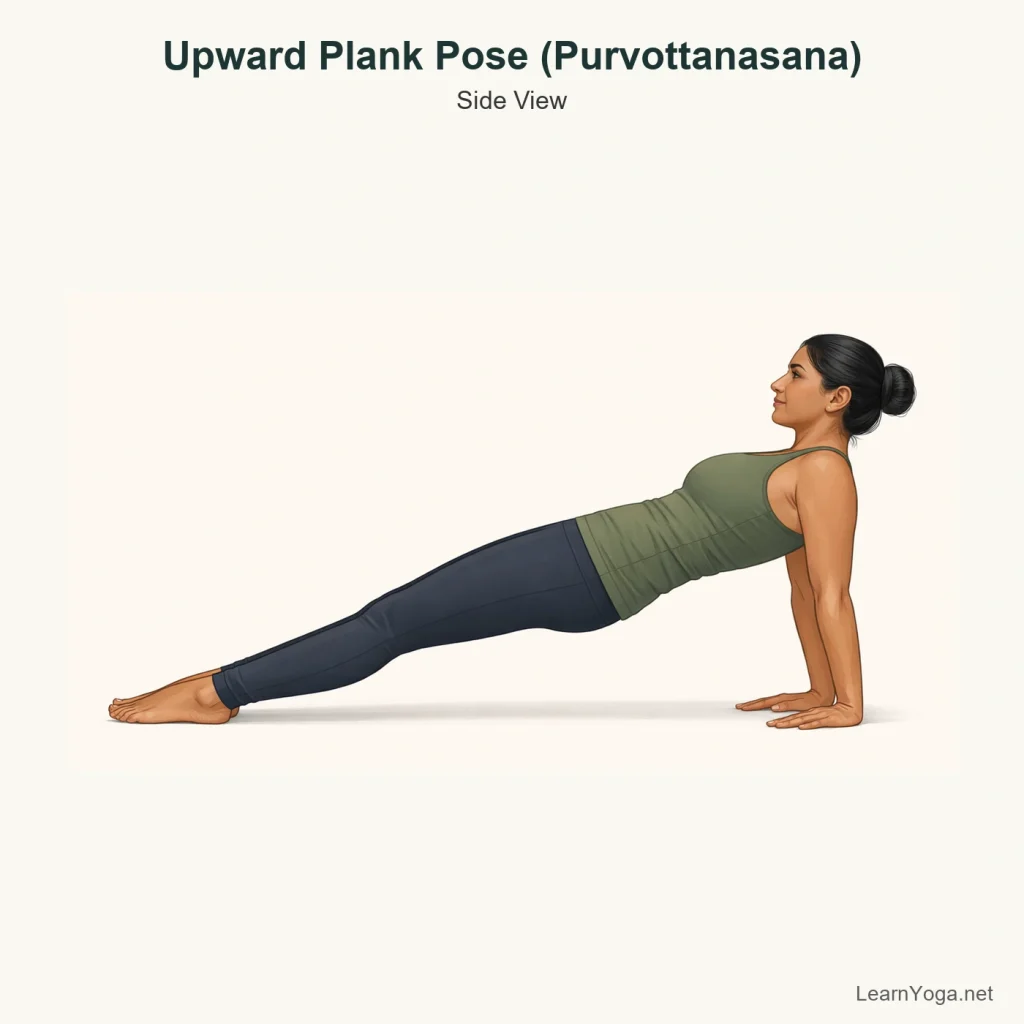
Reverse Tabletop is a simple back-body strength pose that opens the front of the shoulders and chest while asking the hips to lift. It can be useful after sitting, though the comfortable range will vary from body to body.
Reverse Tabletop starts from the floor, but the main work is not in getting into position. It is in how evenly you press through your hands and feet once you lift. For some people it feels like a strong shoulder and triceps action. For others the challenge is keeping the knees and chest from drifting apart. You do not need a very high lift. A lower, steadier version is often the more useful one.
How to do Reverse Tabletop Pose
Sit on the floor with your knees bent and feet flat, about hip-width apart.
Place your hands a little behind you with your fingers pointing toward your feet or turned slightly out if that is more comfortable for your wrists.
Set your feet firmly down and spread across the base of each hand.
On an inhale, press into your hands and feet and lift your hips.
Aim to bring your knees roughly over your ankles and your shoulders roughly over your wrists, without forcing a perfect box shape.
Let the chest broaden as the collarbones spread. Keep the back of the neck long rather than dropping the head back quickly.
Stay for 2 to 5 breaths, or take a shorter hold if your arms or wrists fatigue early.
Exhale and lower your hips back to the floor with control.
Yogita's tip
If your knees keep splaying outward as you lift, press a little more through the inner edges of your feet. That usually helps the glutes work without losing the line of the legs.
Benefits
Strengthens the back of the body, especially the glutes, arms and upper back.
Gives a clear opening sensation across the chest and front shoulders after time spent sitting or typing.
Builds awareness of shoulder extension and hip lift without needing a deep backbend.
Can help you practise pushing the floor away and organising the hands, feet and pelvis together.
Common mistakes
Placing the feet too far forward so the pose becomes mostly a hamstring strain.
Locking the elbows and collapsing into the front of the shoulders instead of pressing the floor away.
Throwing the head back, which can compress the neck.
Letting the knees turn out or feet roll to the outer edges.
Trying to lift as high as possible instead of keeping the chest broad and the breath steady.
Make it work for you
Lower lift
Lift the hips only partway and keep more weight in the feet. This reduces the load on the shoulders and wrists while you learn the shape.
Hands turned slightly out
If pointing the fingers toward the feet feels cramped, turn the hands out a little. Keep pressing evenly through the whole hand rather than dropping into the heel of the palm.
Dynamic repetitions
Instead of holding, inhale to lift and exhale to lower for 3 to 5 rounds. This often feels more manageable than staying up.
Alternatives
Supported Bridge Pose
Lie on your back with knees bent and lift into Supported Bridge with a block or firm support under the sacrum.
Use this if weight-bearing through the wrists is uncomfortable or getting the hands behind you is limited.
Bridge Pose
Lie on your back with feet flat and lift the hips while pressing the arms into the floor beside you.
Use this if you want similar hip and chest work without loading the wrists.
Staff Pose
Sit upright with your legs extended and your hands by your hips or on blocks, lifting through the chest.
Use this as a simpler seated alternative if the full lift feels too demanding on the shoulders or arms.
Common variations
Reverse Tabletop with head neutral
A steadier version with the gaze forward or slightly up, keeping the back of the neck long.
Reverse Tabletop with gentle head release
If the neck feels comfortable, the head can ease back slightly once the chest is already lifted and supported by the arms.
Dynamic Reverse Tabletop
Lift the hips on an inhale and lower on an exhale for several rounds rather than holding.
Safety and contraindications
When to avoid or get individual guidance
Recent or aggravated wrist, shoulder or neck pain may make this pose uncomfortable.
Skip the full lift if bearing weight through the hands causes sharp pain.
Keep the load moderate in the wrists and shoulders. A lower lift is fine.
If your neck is sensitive, keep your head neutral instead of dropping it back.
Press through both feet so the knees track roughly forward rather than rolling outward.
Come out of reverse tabletop if sharp pain shows up in the wrists, shoulders, or neck, or weight through the hands leaves symptoms lingering afterward. Use a lower lift or skip weight-bearing backbends for now and get individual guidance before continuing.
Accessibility and limited mobility
If getting down to the floor is difficult, Bridge Pose or Supported Bridge Pose may give a similar action with less effort in the setup.
A folded blanket under the hands can slightly change the wrist angle, though some people prefer using a different pose rather than forcing the hand position.
Older adults or anyone with reduced shoulder extension may be more comfortable keeping the lift low and the chest broad rather than aiming for a flat tabletop.
Easier options
Use these related poses when you want a more accessible way to practise a similar movement or prepare for this pose.
No. That hand position is common, but it is not the only option. If your wrists or shoulders feel pinched, turning the hands slightly out can make the pose more workable. Choose the version that lets you press evenly through the hands without sharp discomfort.
Should my hips come all the way up to a flat tabletop?
Not necessarily. A lower lift with steady breath and broad chest is often better than forcing height. If the shoulders tighten, the knees splay or the neck feels compressed, come a little lower and keep the shape more manageable.
Why do my hamstrings cramp in this pose?
That often happens when the feet are too far forward or when you try to lift suddenly. Bring the feet a little closer, press down through the whole foot and lift on a smooth inhale. You can also practise a few smaller lifts instead of one long hold.
What should I do with my head and neck?
Start with the head neutral and the gaze forward or slightly up. If your neck feels easy and supported, you may choose a gentle head release later, but it should come from an already lifted chest. Do not throw the head back to create the shape.
Reviewed for yoga instruction
Yogita
Certified Yoga Instructor with 5+ years of Teaching and Consistent Practice