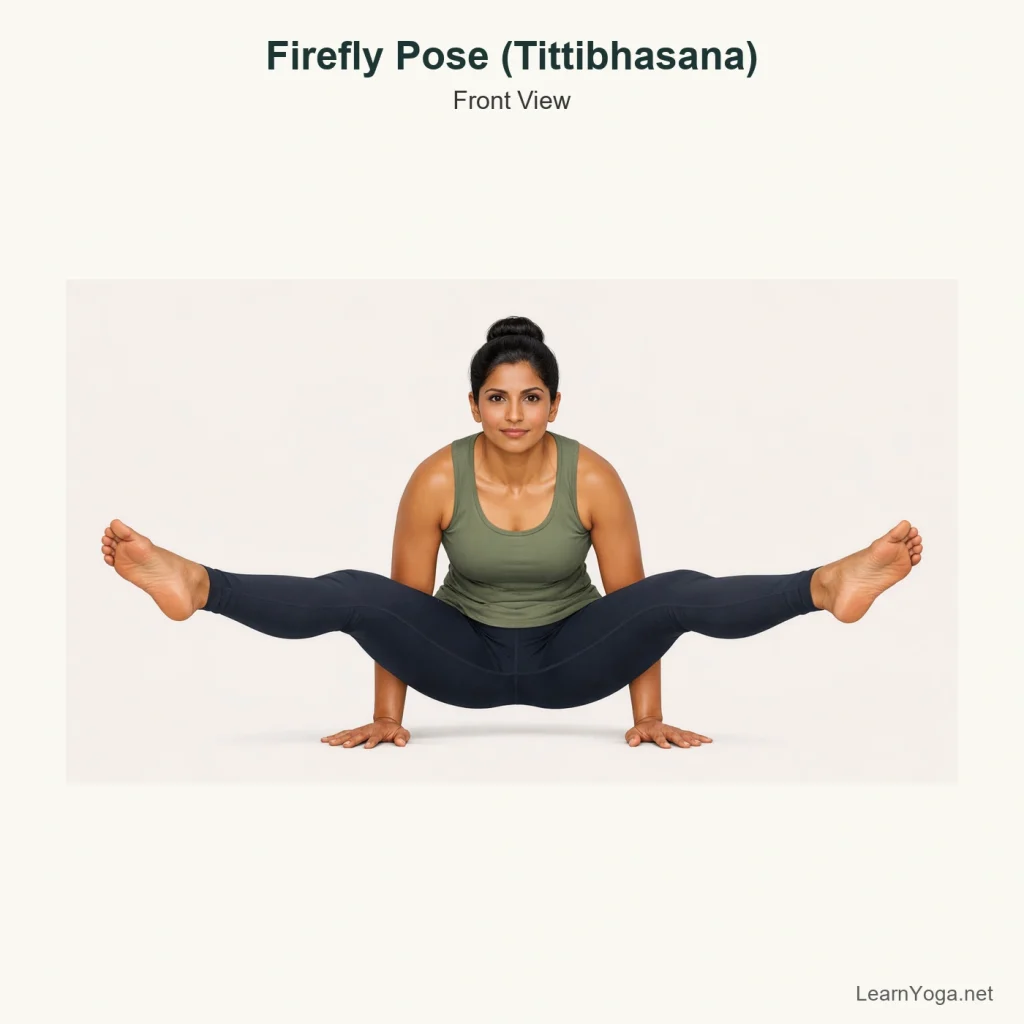
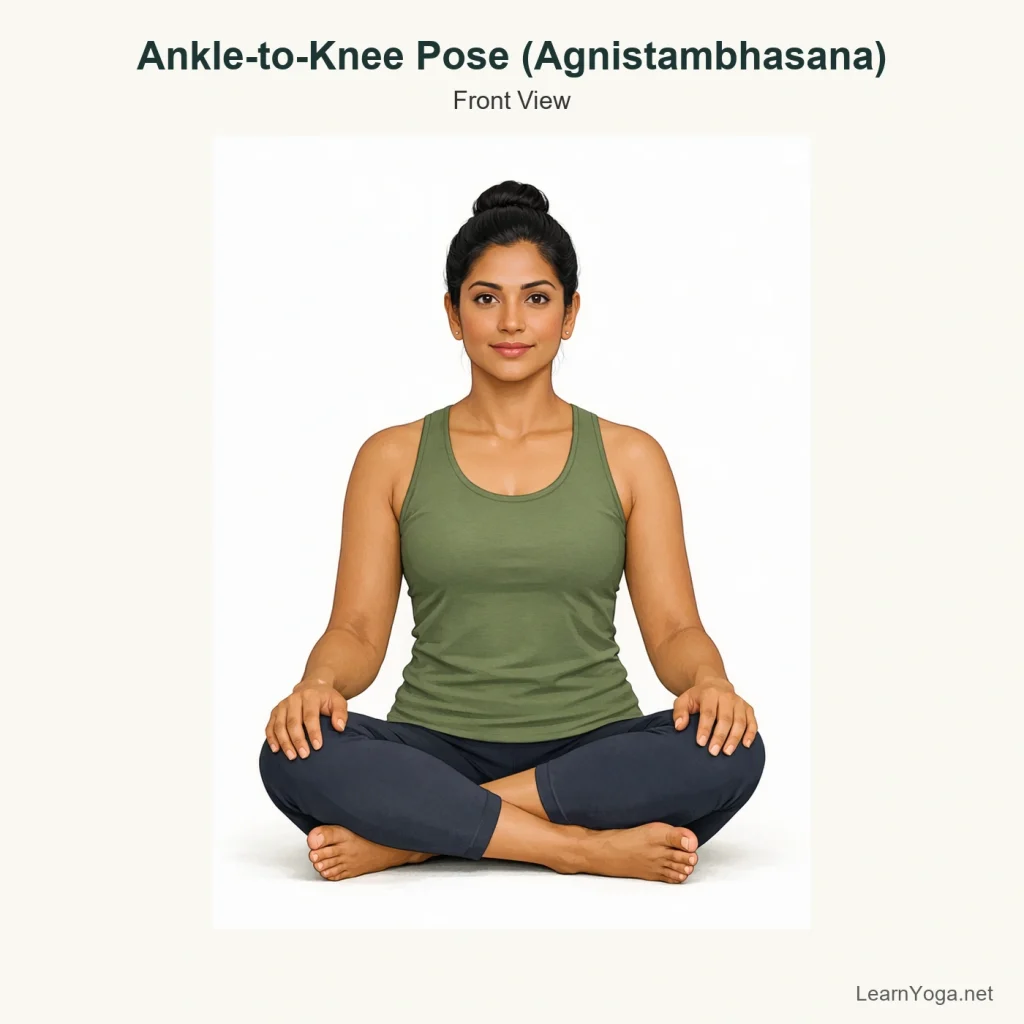
Fire Log Pose is a seated outer-hip opener with the shins stacked one over the other. The work is mostly in the hips, but the knees can complain if the hips are not ready, so it helps to set it up patiently and use support when needed.
In Fire Log Pose, the shape may look tidy from the outside, but the important part is not making a perfect stack. What matters is that the legs are organised in a way your hips can accept without strain in the knees. For some people the top shin will sit high, and that is fine. A folded blanket or block under the top leg can make the pose much more workable.
How to do Fire Log Pose
Sit on the floor with both legs extended in front of you. If your lower back rounds easily, sit on a folded blanket.
Bend one knee and bring that shin in front of you so it lies roughly parallel to the front edge of your mat.
Bend the other knee and place that shin on top, ankle over the lower knee and knee over the lower ankle as much as is comfortable.
Flex both feet gently so the ankles feel supported, and let the knees and outer hips settle without pressing them down.
Place your fingertips beside you and sit tall through the spine. Stay here, or if the shape is easy on the knees, hinge slightly forward from the hips.
Keep the jaw and shoulders soft. On each inhale, lengthen through the breastbone. On each exhale, allow the hips to release a little if they are willing.
Hold for 5 to 8 slow breaths, then lean back, lift the top leg off carefully, stretch both legs forward, and repeat on the other side.
Yogita's tip
If the top knee is floating high, support it rather than chasing the full stack. In this pose, a supported top shin usually gives the hips room to open without the knee taking the strain.
Benefits
Opens the outer hips and glutes in a clear, direct way.
Can improve comfort in other seated hip-opening poses.
Encourages an upright seated position when the pelvis is well supported.
Helps you practise staying steady with moderate sensation rather than pushing deeper.
Common mistakes
Forcing the top knee downward instead of letting the hips determine the range.
Sitting behind the sitting bones so the lower back rounds heavily.
Letting the feet go slack, which can leave the ankles feeling less supported.
Trying to make a neat shin stack even when the knees feel strained.
Folding forward too soon before the seated base feels stable.
Make it work for you
Sit on a folded blanket
Lift the hips on one or more folded blankets if the pelvis tips backward or the spine collapses. A small height often makes the leg position easier to organise.
Support under the top knee or shin
Place a block or folded blanket under the top outer leg if it hangs high in space. This reduces the pull through the knee and lets the hips relax more gradually.
Keep the front fold out
Stay upright with your hands on the floor or on blocks if leaning forward increases knee pressure or rounds your back.
Alternatives
Figure Four on the back
Lie down and cross one ankle over the opposite thigh, then draw the legs in only as far as the hips allow.
Use this if sitting upright is difficult or the stacked-shin version feels too intense on the knees.
Bound Angle Pose
Sit with the soles of the feet together and knees apart, supporting the thighs if needed.
Use this if you want a gentler hip opener with less demand on the stacked-knee position.
Easy cross-legged seat
Sit in a simple cross-legged position on blankets and change the crossing halfway through.
Use this if getting close to the Fire Log shape already creates strain.
Common variations
Upright Fire Log Pose
The classic setup with the hands on the floor or blocks and the spine upright, focusing on the seated base rather than a forward fold.
Forward-Folding Fire Log Pose
From the stacked-shin setup, hinge forward from the hips while keeping both feet active and the knees comfortable.
Supported Fire Log Pose
Practise the pose with a folded blanket under the hips and support under the top knee or shin.
Safety and contraindications
When to avoid or get individual guidance
Recent or current knee irritation
Hip pain that increases in deep external rotation
Skip the forward fold if it adds strain to the knees or lower back
This pose asks for quite a bit of hip rotation, so keep the range modest if the knees feel involved.
A strong stretch in the outer hips is normal; sharp, pinching, or twisting pain in the knee is not.
Support under the top leg is often the simplest way to make the pose safer and steadier.
Repeated sharp knee pain, deep hip pinching, or symptoms that are still there after coming out are signs to pause Fire Log Pose and avoid pushing farther into hip opening. Use more support or a simpler seat, and get individual guidance before returning to the full shape.
Accessibility and limited mobility
If getting down to the floor is awkward, choose a reclined figure four shape instead.
Older adults or anyone with limited hip rotation may find that a high seat and support under the top leg make the pose much more manageable.
If the knees do not comfortably bend into a stacked shape, use a simpler cross-legged seat or Bound Angle Pose instead of forcing the setup.
Easier options
Use these related poses when you want a more accessible way to practise a similar movement or prepare for this pose.
That is very common. The pose does not need to look like two level logs to be useful. If the top shin sits high, place support under it and focus on a steady seat rather than a perfect shape.
Should I lean forward in Fire Log Pose?
Only if the upright version feels stable and your knees stay comfortable. For many people, sitting tall is enough. A small hinge from the hips is more useful than a deep fold with a rounded back.
Where should I feel this pose most?
Usually in the outer hips and glutes, sometimes around the deep hip area. You may notice some sensation along the thighs too. You should not feel sharp pain or twisting stress in the knees.
Do I need to flex my feet?
A gentle flex often helps the ankles feel more supported and can make the leg position clearer. It does not need to be rigid. Think of the feet as awake rather than hard.
Why does one side feel much tighter than the other?
Unevenness is normal. Many people have one hip that rotates more easily. Set up each side separately, use as much support as you need, and avoid forcing the stiffer side to match the easier one.
Reviewed for yoga instruction
Yogita
Certified Yoga Instructor with 5+ years of Teaching and Consistent Practice