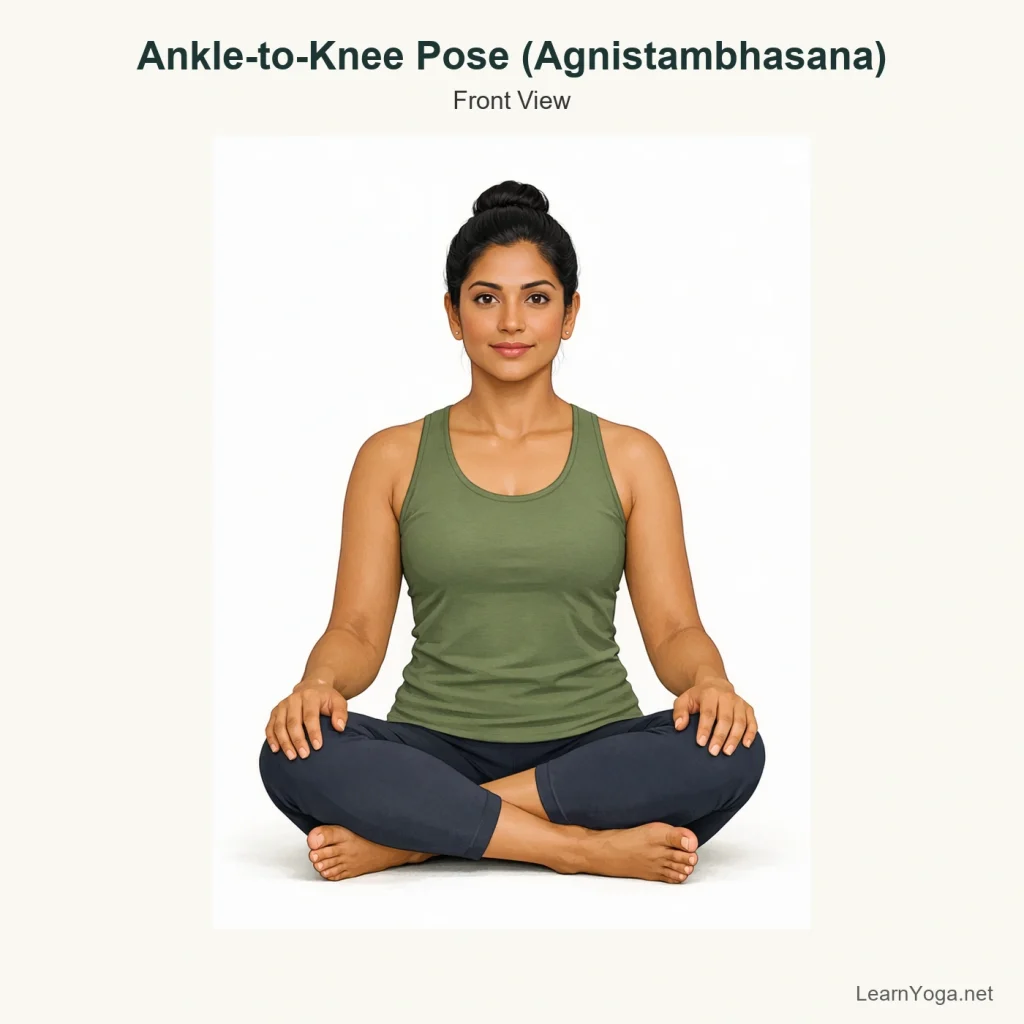
Deer Pose is a seated hip-opening shape with one shin in front and one leg folded behind. It gives you a clear way to explore rotation through the hips while staying fairly upright, and it can also become a gentle twist if that suits your body.
This pose is often used to explore internal and external rotation at the hips without asking for a very deep forward fold. The front leg usually feels the outer hip more, while the back leg may bring sensation into the front of the hip or thigh. You do not need to make a perfect right angle with either leg. A workable version is the one that lets you sit with steady breath and without strain in the knees.
How to do Deer Pose
Sit on the floor and bring both knees into a bent position, with your feet on the mat.
Let both knees drop to one side so your front shin rests roughly in front of you and your back leg folds behind you.
Place your hands on the floor or on blocks beside your hips and sit up tall. If one sitting bone lifts a lot, sit on a folded blanket.
Adjust the distance of the front heel from your pelvis until the front knee feels settled rather than forced.
Keep the chest easy and the spine long. Stay upright, or add a small turn toward the front shin if that feels natural in your back.
Breathe here for 5 to 8 slow breaths. On each inhale, lightly lift through the crown of the head. On each exhale, allow the thighs and hips to soften.
To come out, lean into your hands, bring the knees back to centre, and switch the legs to the second side.
Yogita's tip
If the back knee feels crowded, bring that foot a little farther away from the hip instead of trying to square the shape. A small change in the back leg often makes the whole pose feel much more workable.
Benefits
Explores both internal and external rotation at the hips in one seated position.
Can bring a clear stretch into the outer hip and glute area of the front leg.
May gently open the front of the hip and thigh on the back leg side.
Encourages an upright seated posture with awareness of how the pelvis is placed on the floor.
Works well as a quieter mobility pose near the end of practice or after standing work.
Common mistakes
Forcing the knees down even when the hips are not ready for that range.
Sitting heavily on one side without support, which can make the lower back feel cramped.
Pulling the front foot very close to the pelvis and creating pressure in the front knee.
Trying to twist deeply before first finding a comfortable upright seat.
Holding the breath while chasing a stronger stretch.
Make it work for you
Folded blanket under the hips
Sit on one or more folded blankets to raise the pelvis. This often reduces strain at the knees and makes it easier to sit upright.
Hands on blocks
Place blocks or firm cushions beside your hips so your hands can press down and help lengthen the spine without rounding.
Looser leg shape
Move the front heel farther forward and let both knee angles be less exact. The pose does not need sharp right angles to be useful.
Alternatives
Easy cross-legged seat
Sit in a simple cross-legged position on a folded blanket and stay upright with steady breathing.
Use this if the knee position in Deer Pose feels too strong or getting into the shape is awkward.
Figure Four Stretch
Lie on your back, cross one ankle over the opposite thigh, and draw the legs in only as far as the hips stay comfortable.
Use this if you want a similar outer-hip focus with less load on the knees and less effort getting to an upright seat.
Bound Angle Pose
Sit with the soles of the feet together and the knees open, using support under the thighs if needed.
Use this if switching the hips into different rotations feels too complex but you still want a seated hip opener.
Common variations
Upright Deer Pose
Stay tall through the spine with the hands beside the hips and keep the pose focused on seated hip rotation.
Twisted Deer Pose
Add a gentle twist toward the front shin, keeping the movement small enough that the breath stays easy and the pelvis remains grounded.
Forward-Leaning Deer Pose
Hinge slightly forward over the front shin for a stronger outer-hip sensation, only if the front knee stays comfortable.
Safety and contraindications
When to avoid or get individual guidance
Recent or irritated knee injuries may make this position unsuitable.
Skip the deeper version if hip rotation feels pinchy or forced.
Keep the sensation mainly in the hips or glutes, not as pressure inside the knees.
If sitting upright is difficult, raise the hips with support before trying to deepen the shape.
Move in and out slowly, especially when switching sides.
If you feel sharp pain in the knee or deep in the hip each time you try this shape, stop and get individual advice before continuing.
Accessibility and limited mobility
A folded blanket or low cushion under the hips can make this pose much more accessible for older adults or anyone with limited hip rotation.
If getting down to the floor or back up again is difficult, choose a supine alternative such as Figure Four Stretch.
The pose does not need to look symmetrical. Many people are noticeably different from side to side.
Easier options
Use these related poses when you want a more accessible way to practise a similar movement or prepare for this pose.
Do my front and back legs need to make exact right angles?
No. That shape is sometimes shown as a guide, but many bodies are more comfortable with a looser setup. Move the feet and knees until the pose feels steady and the knees are not being pushed.
Why do I feel this more in my knee than in my hip?
Usually that means the hip is not comfortably giving the rotation the pose is asking for. Sit up on support, bring the front heel farther away, and make the shape smaller. If the knee still feels strained, choose a gentler alternative.
Should I lean forward in Deer Pose?
You can, but you do not have to. The upright version is already useful. A forward lean tends to increase the stretch around the outer hip of the front leg, so only add it if the front knee stays easy.
Is it normal for one side to feel completely different?
Yes. Hip rotation is often uneven from side to side. Let each side have its own range instead of trying to make both shapes match.
Reviewed for yoga instruction
Yogita
Certified Yoga Instructor with 5+ years of Teaching and Consistent Practice