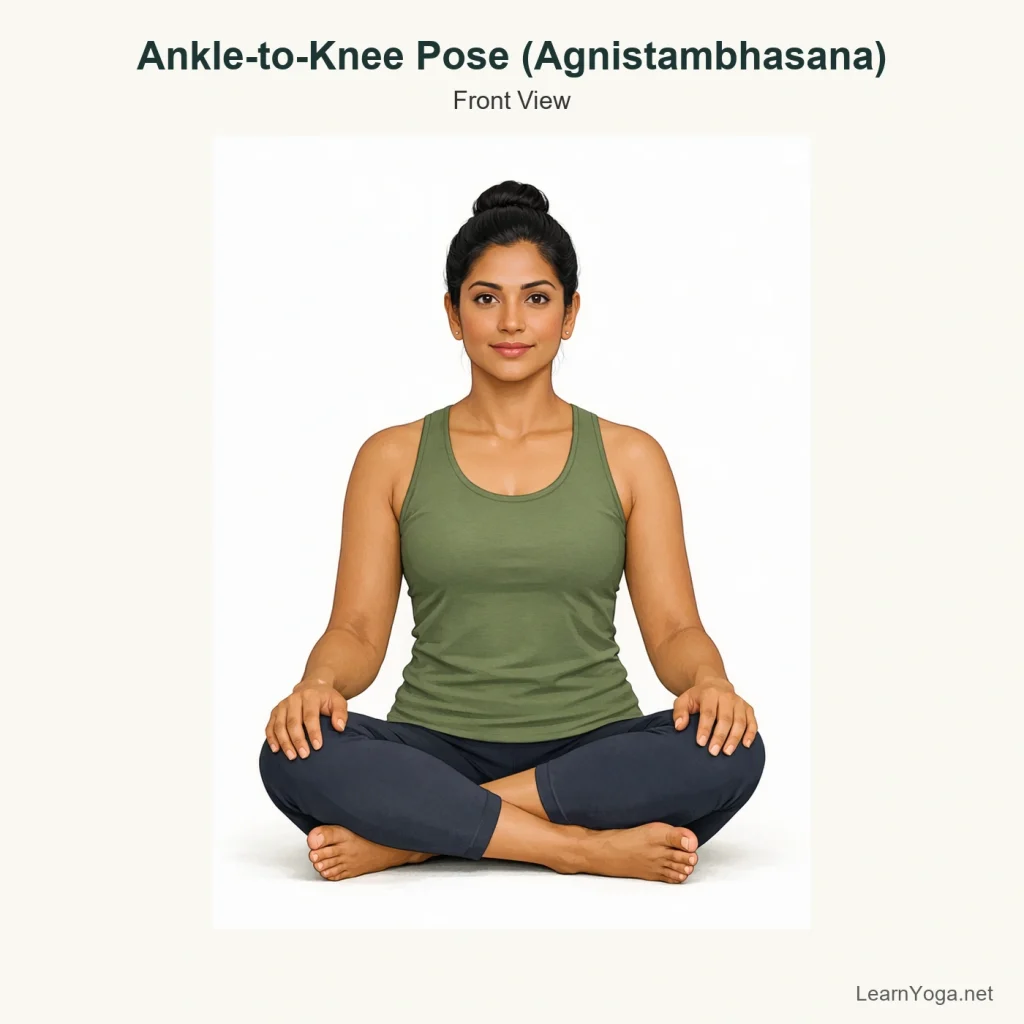
Shoelace Pose is a seated outer-hip stretch with the knees stacked one over the other. It can create a clear sensation in the glutes and outer hips, but the shape does not need to look neat or symmetrical to be useful.
Timing: Stay for 5 to 8 slow breaths on each side. · Hold for about 30 seconds per side if you prefer timing. · If the shape is strong, take 3 to 5 even breaths, then come out before you start bracing.
Shoelace Pose asks both hips to move into a fairly strong crossed-leg position, so it often feels very different from one side to the other. The main work is not in forcing the knees to stack perfectly. It is in finding a seat where the pelvis can stay reasonably grounded and the breath can remain steady. For some bodies, sitting up on support changes the pose completely.
How to do Shoelace Pose
Sit on the floor with both legs extended in front of you.
Bend one knee and draw that foot to the outside of the opposite hip.
Cross the other leg over the first so the top knee points toward the centre line and the top foot comes to the outside of the opposite hip.
If possible, let both sitting bones root down. If one or both lift a lot, sit on a folded blanket or block.
Place your hands beside your hips and lengthen upward through the spine rather than leaning back heavily.
Stay upright, or if your hips and knees are comfortable, walk your hands forward a little and fold only as far as you can keep the breath smooth.
Hold for 5 to 8 slow breaths, then press into your hands, lean back slightly and uncross the legs with care.
Repeat on the second side, changing which leg is on top.
Yogita's tip
If the top knee sits much higher than the bottom one, do not push it down with your hand. Sit on more height first. When the pelvis is less tucked under, the knees often stack more naturally without strain.
Benefits
Stretches the outer hips and glute area in a clear, contained way.
Can help you notice side-to-side differences in hip rotation.
Encourages an upright seated posture when you use enough support under the pelvis.
Works well near the end of practice when you want a quieter seated pose.
Common mistakes
Trying to force the knees into a perfect stack even when the hips are not ready for that range.
Sitting directly on the floor when the pelvis tips backward and the lower back rounds hard.
Pulling the feet too close to the hips and crowding the knees.
Folding forward just to go deeper, even though the breath becomes tight or the stretch shifts into the knees.
Make it work for you
Sit on height
Place one or more folded blankets or a block under your sitting bones. This usually makes it easier to sit upright and reduces strain at the knees.
Keep the bottom leg simpler
Extend the bottom leg straight or bend it only lightly, then cross the top leg over. This keeps some of the outer-hip work while asking less from the lower knee.
Stay upright
Keep your hands on the floor or on blocks beside you and remain vertical instead of folding forward. This is often the better choice when the hips feel full already.
Alternatives
Figure Four Stretch
Lie on your back, cross one ankle over the opposite thigh and draw the legs in gently.
Use this if sitting cross-legged bothers your knees or if getting upright on the floor is difficult.
Reclining Pigeon Pose
Lie on your back with one ankle crossed over the opposite thigh and stay there or hold behind the standing leg.
Use this when you want a similar outer-hip stretch with less pressure through the knees and less demand on seated posture.
Easy Pose
Sit in a simple cross-legged seat on support and keep the legs less tightly crossed.
Use this if Shoelace Pose feels too compact or you are working on sitting upright comfortably.
Common variations
Upright Shoelace Pose
The classic leg shape with the spine vertical and the hands beside the hips for support.
Forward-Folding Shoelace Pose
From the stacked-leg seat, hinge forward a small amount to increase the sensation in the outer hips. Only go as far as the knees and breath stay comfortable.
Supported Shoelace Pose
Practice with the sitting bones elevated on blankets or a block so the pelvis can tip more easily and the knees are less crowded.
Safety and contraindications
When to avoid or get individual guidance
Avoid or modify if you have a current knee flare-up or the crossed-leg position causes joint pain.
Take a gentler version if deep hip rotation feels pinchy in the outer hip or groin.
You should feel this mainly in the outer hips or glutes, not as sharp pressure in the knees.
Use support under the pelvis if your lower back rounds strongly or one sitting bone lifts far away from the floor.
Keep the shape smaller or simplify the bottom leg if either knee feels compressed.
Pause Shoelace Pose and switch to an easier leg setup when the knee feels sharp, caught, or compressed, or when the deep hip feels blocked instead of stretched. Get individual guidance before trying to stack the legs more deeply.
Accessibility and limited mobility
A folded blanket, bolster or block under the hips is often the difference between straining and settling in this pose.
If getting down to the floor is not practical, a reclined option such as Figure Four Stretch or Reclining Pigeon Pose is usually more accessible.
Older adults or anyone with limited hip rotation may do better with a looser cross of the legs rather than aiming for a full knee stack.
Easier options
Use these related poses when you want a more accessible way to practise a similar movement or prepare for this pose.
Do my knees need to stack exactly one on top of the other?
No. That neat stacked look depends a lot on individual hip shape and current range. If the knees are offset but your hips feel the stretch and your knees feel fine, the pose can still be doing its job.
Why do I keep leaning backward in this pose?
That usually means the pelvis is being pulled into a backward tilt by the hips. Sitting on folded blankets or a block often helps straight away. You can also move the feet slightly farther from the hips and keep the hands on the floor for support.
Should I fold forward or stay upright?
Start upright. That is enough for many people. A forward fold can increase the sensation in the outer hips, but only add it if your knees stay comfortable and you can hinge from the hips without collapsing your breath.
What if I feel this mostly in my knees?
Come out a little and change the setup. Sit higher, move the feet farther away, or straighten the bottom leg. In this pose, knee discomfort usually means the hips need a less demanding version.
Is it normal for one side to feel much tighter?
Yes, very often. Many people notice a clear difference from side to side in crossed-leg hip positions. Work within the easier, steadier range on each side rather than trying to make both sides look identical.
Reviewed for yoga instruction
Yogita
Certified Yoga Instructor with 5+ years of Teaching and Consistent Practice