Side Plank
Side Plank is a one-arm balancing pose that builds shoulder stability, side-body strength and clear whole-body organisation. It asks you to support yourself with one hand and one foot while keeping the chest open and the hips lifted.
Explore by goal
Build steadiness, coordination and body awareness with yoga poses that challenge balance in different ways. Explore accessible standing balances and more demanding options, with clear instructions and modifications to help you practise with control.

Side Plank is a one-arm balancing pose that builds shoulder stability, side-body strength and clear whole-body organisation. It asks you to support yourself with one hand and one foot while keeping the chest open and the hips lifted.

Side-Reclining Leg Lift is a side-lying balance that asks for gentle core support, leg control and a clear line through the body. It can be practised with the top knee bent or the lifted leg straight, depending on what feels steady and honest in your range.

Sage Koundinya Pose is a twisting arm balance that grows out of a deep lunge and rotation through the trunk. It asks for shoulder stability, wrist tolerance, core support and enough hip mobility to place the outer thigh high on the upper arm before you shift forward.

Scorpion Pose is a demanding inversion and backbend that asks for strong shoulder support, clear balance and careful control through the spine. It is usually learned after steady work in forearm balance or handstand variations, often with a wall.

Revolved Half Moon Pose combines single-leg balance, a standing hamstring fold and a controlled twist. It usually works best when you lower your expectations a little, use support if needed and build the shape from length first, then rotation.

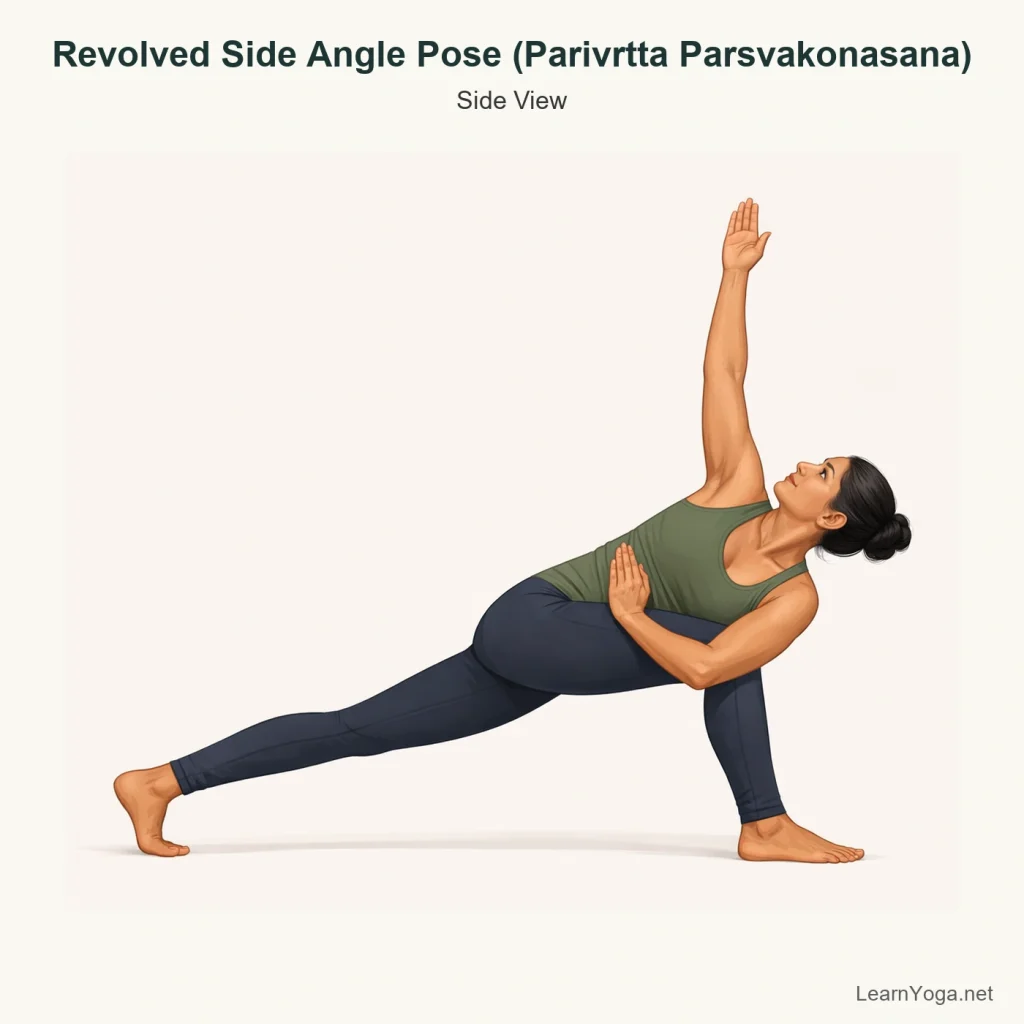
Revolved Side Angle Pose is a standing twist that asks for steady legs, a long spine and controlled rotation. It can be practised in a smaller, more workable shape with the back knee lowered or the bottom hand lifted onto a block.

Revolved Triangle is a standing twist with a narrow base, so it asks for steadiness as much as flexibility. It can build awareness through the feet, legs, spine and breath, but it usually works better when the range is moderate rather than forced.

Palm Tree Pose is a simple standing stretch that reaches the arms overhead and lengthens the whole body upward. It is often used near the start of practice to wake up the feet, spine and shoulders without a lot of load.

Mountain Pose is a simple standing shape that teaches how to organise your weight, legs, pelvis and spine with attention. It often looks easy from the outside, but small changes in the feet and ribs can make the whole pose feel steadier and lighter.

Noose Pose is a deep squat with a twist and a bind. It asks for ankle and knee mobility, steady feet and enough spinal lift that the twist does not collapse into the lower back.