Eagle Pose is a standing balance with the legs crossed and the arms wrapped. It asks for steady attention through the feet, hips and shoulders without needing a big range of motion.
This shape can feel compact quite quickly. That is normal. The work is less about how tightly you wrap and more about keeping enough space to stand, breathe and organise yourself clearly. Some bodies will hook the foot or bring the palms together easily, while others will stay with a lighter version.
How to do Eagle Pose
Start in Mountain Pose with your gaze steady on one point in front of you.
Bend both knees a little and shift your weight into your left foot.
Lift your right leg and cross the right thigh over the left thigh.
Either keep the right toes on the floor like a kickstand, place the right toes on a block, or if it is comfortable hook the right foot behind the left calf.
Bring your arms forward at shoulder height and cross the left arm over the right if the right leg is on top.
Bend the elbows and wrap the forearms so the backs of the hands, palms or fingertips meet. Stop at the version that lets your shoulders stay broad.
Lift the elbows roughly in line with the shoulders while letting the shoulders soften down away from the ears.
Sit a little deeper into the standing leg only as far as you can keep the chest upright and the balance steady.
Take 3 to 5 smooth breaths. On each inhale, grow a little taller through the crown of the head. On each exhale, settle the hips and draw the forearms gently away from the face.
To come out, unwind the arms and legs slowly and return to Mountain Pose before changing sides.
Yogita's tip
If the wrapped foot keeps pulling you off centre, press down more clearly through the standing big-toe mound and outer heel. That usually gives the ankle something solid to organise around.
Benefits
Builds balance and concentration in a compact standing shape
Strengthens the standing leg and helps you notice how the foot, ankle and hip work together
Gives the upper back and outer shoulders a contained stretch
Practises coordinating arms and legs across the midline of the body
Can be a useful pause between larger standing poses because it asks for steadiness rather than speed
Common mistakes
Leaning the chest too far forward and turning the pose into a fold
Gripping the shoulders up toward the ears while wrapping the arms
Forcing the foot to hook behind the calf when balance is already shaky
Locking the standing knee instead of keeping a soft, workable bend
Twisting the pelvis strongly to one side rather than staying mostly centred over the standing foot
Make it work for you
Toes-down Eagle
Cross the top leg over but keep the toes of that foot lightly on the floor for balance instead of wrapping the foot behind the calf.
Open-arm Eagle
Cross the arms but hold opposite shoulders or place the backs of the hands together if full arm wrapping feels crowded in the shoulders or upper back.
Wall support
Stand beside a wall and lightly touch it with one hand or with the hip to reduce the balance demand while you work on the leg and arm position.
Alternatives
Eagle Arms Stretch in a chair
Sit upright on a chair with both feet on the floor and wrap only the arms. Lift the elbows gently and breathe into the space across the upper back.
Use this if standing balance is not available today or getting up and down from the floor is difficult.
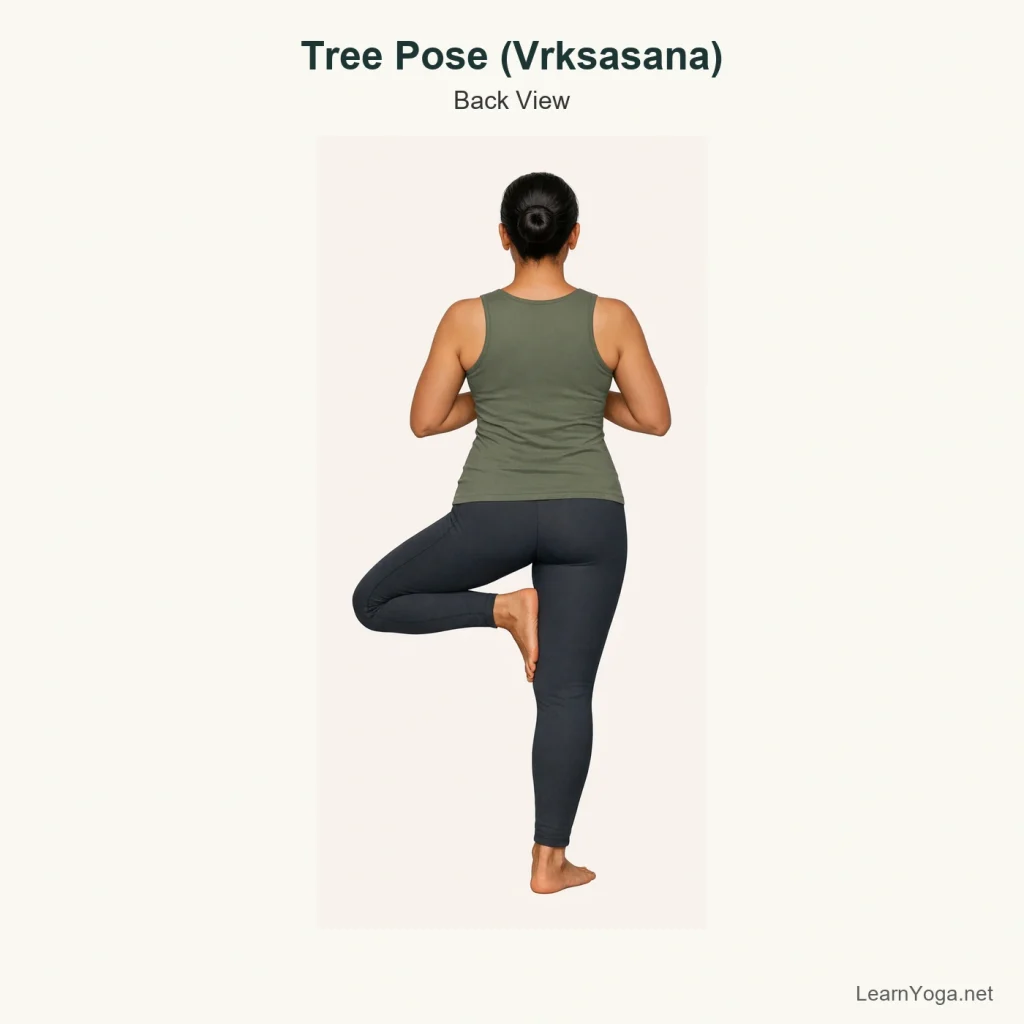
Tree Pose
Practise Tree Pose with one foot grounded and the hands at the chest or overhead.
Use this if you want a standing balance with less knee bend and no leg wrap.
Chair Pose with Eagle Arms
Keep both feet on the floor in Chair Pose and wrap only the arms.
Use this if the leg crossing bothers the knees but you still want the shoulder and upper-back work.
Common variations
Full Eagle Wrap
The top foot hooks behind the standing calf and the palms press together while the torso stays upright.
Kickstand Eagle
The thighs cross but the toes of the top foot stay on the floor for extra balance support.
Eagle Arms Only
The legs stay parallel while only the arms wrap, making the pose more accessible for many knees and ankles.
Safety and contraindications
When to avoid or get individual guidance
Recent ankle sprain or unstable balance
Knee pain with crossing and bending
Shoulder irritation that worsens with arm wrapping
Keep the standing knee tracking in a direction that feels natural over the foot rather than forcing it to twist inward.
If balancing feels uncertain, use a wall or keep the top toes on the floor.
Ease off the arm wrap if the shoulders feel pinched or if your neck starts tightening.
Pause Eagle Pose and uncross or lessen the wrap when the standing knee hurts sharply, the ankle feels wobbly or gives way, or the shoulder stays painful even in a simpler version. Get individual guidance before spending longer in the pose.
Accessibility and limited mobility
Practising with your back or side near a wall can make the balance much more manageable.
If deep knee bending is uncomfortable, stay higher in the pose and cross lightly rather than sitting down deeply.
A chair version with Eagle Arms can work well for older adults, anyone recovering confidence with balance, or anyone who finds standing on one leg tiring.
If shoulder range is limited, choose hands to shoulders or backs of hands touching rather than insisting on palms together.
Easier options
Use these related poses when you want a more accessible way to practise a similar movement or prepare for this pose.
You do not need to. Many people practise Eagle Pose very well with the top toes resting on the floor or hovering without the hook. The key is staying steady in the standing foot and keeping the pelvis reasonably centred.
Which arm goes on top in Eagle Pose?
Usually the arm opposite the top leg crosses in front. If the right leg is on top, the left arm crosses over the right. This tends to organise the shape more evenly, but if you are only practising Eagle Arms as a shoulder stretch, you can work both sides separately.
Why do I wobble so much as soon as I cross the legs?
Crossing the legs narrows your base and shifts your weight. Try less depth in the standing knee, keep the top toes on the floor, and fix your gaze on one still point. A wall beside you can make the learning much easier.
Should my elbows lift as high as possible?
Not necessarily. Lift them only until you feel the upper back broaden without the shoulders bunching toward the ears. If the neck feels crowded, lower the elbows a little and create more space between the forearms and the face.
Reviewed for yoga instruction
Yogita
Certified Yoga Instructor with 5+ years of Teaching and Consistent Practice