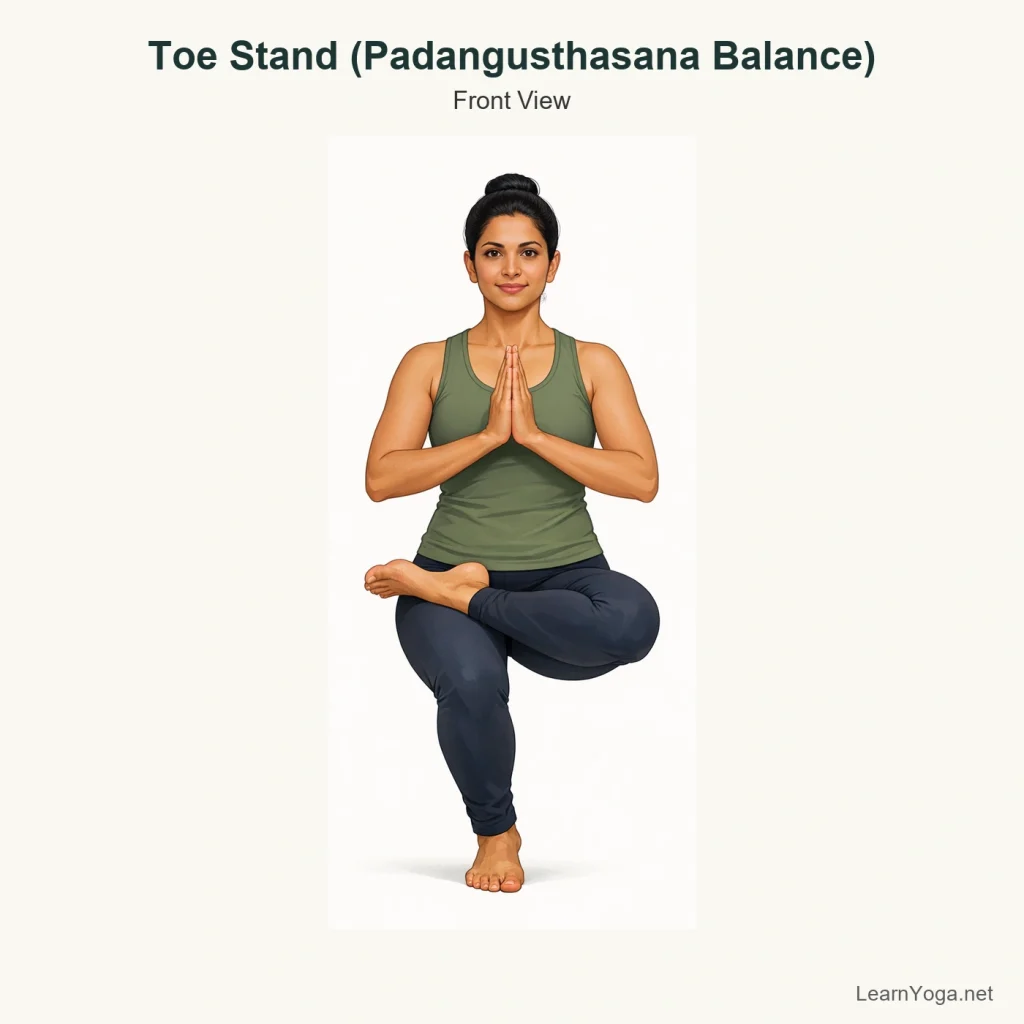
Toe Stand is a compact one-leg balance done from a figure-four setup. It asks for ankle stability, control through the standing leg and enough hip mobility to lower without collapsing into the knee.
This pose is small, but it is not simple. You balance on the ball of one foot while the other ankle crosses over the thigh, then lower into a tight squat shape. For many people the challenge is not getting down, but staying organised once they are there. Move slowly, keep the standing heel lifted, and do not force the depth. A higher version is still the pose.
How to do Toe Stand
Begin in Mountain Pose with your weight steady in one foot.
Lift the other foot and place that ankle across the standing thigh just above the knee, coming into a figure-four shape.
Bring your hands to your hips or prayer at your chest and bend the standing knee.
Lower the hips gradually as the standing heel lifts, so you balance on the ball of the standing foot.
Keep the crossed foot gently flexed and let the standing knee track in the same direction as the toes.
Stay higher if needed, or lower until the sitting bones hover near the standing heel.
Lengthen the spine on an inhale and soften the jaw and belly on each exhale.
To come out, lean the chest slightly forward, press through the standing foot, and rise carefully back to the figure-four balance before releasing to stand.
Repeat on the second side.
Yogita's tip
Most people balance better when the crossed foot stays clearly flexed. That small action helps protect the lifted knee and usually makes the outer hip work more honestly.
Benefits
Builds balance on the ball of one foot.
Strengthens the ankle and lower leg of the standing side.
Trains control in a deep single-leg squat range.
Asks the hips to work in both mobility and stability at the same time.
Sharpens concentration because the shape is compact and precise.
Common mistakes
Dropping down too quickly and losing the balance before the foot and ankle can organise.
Letting the standing knee collapse inward instead of following the line of the toes.
Rounding the chest heavily, which makes the pose feel cramped and unstable.
Relaxing the crossed foot completely and putting extra pressure into the lifted knee.
Trying to sit all the way down even when a higher position is steadier and cleaner.
Make it work for you
Wall support
Stand beside a wall and keep fingertips on it as you lower. Use just enough pressure to steady yourself rather than leaning your weight into the hand.
Higher toe stand
Lower only part of the way and hold there. Keeping more height often gives the standing ankle and knee time to adjust.
Hands down for balance
If you can safely reach, place fingertips on the floor in front of you while balancing on the toes. This reduces the demand on balance while you learn the shape.
Alternatives
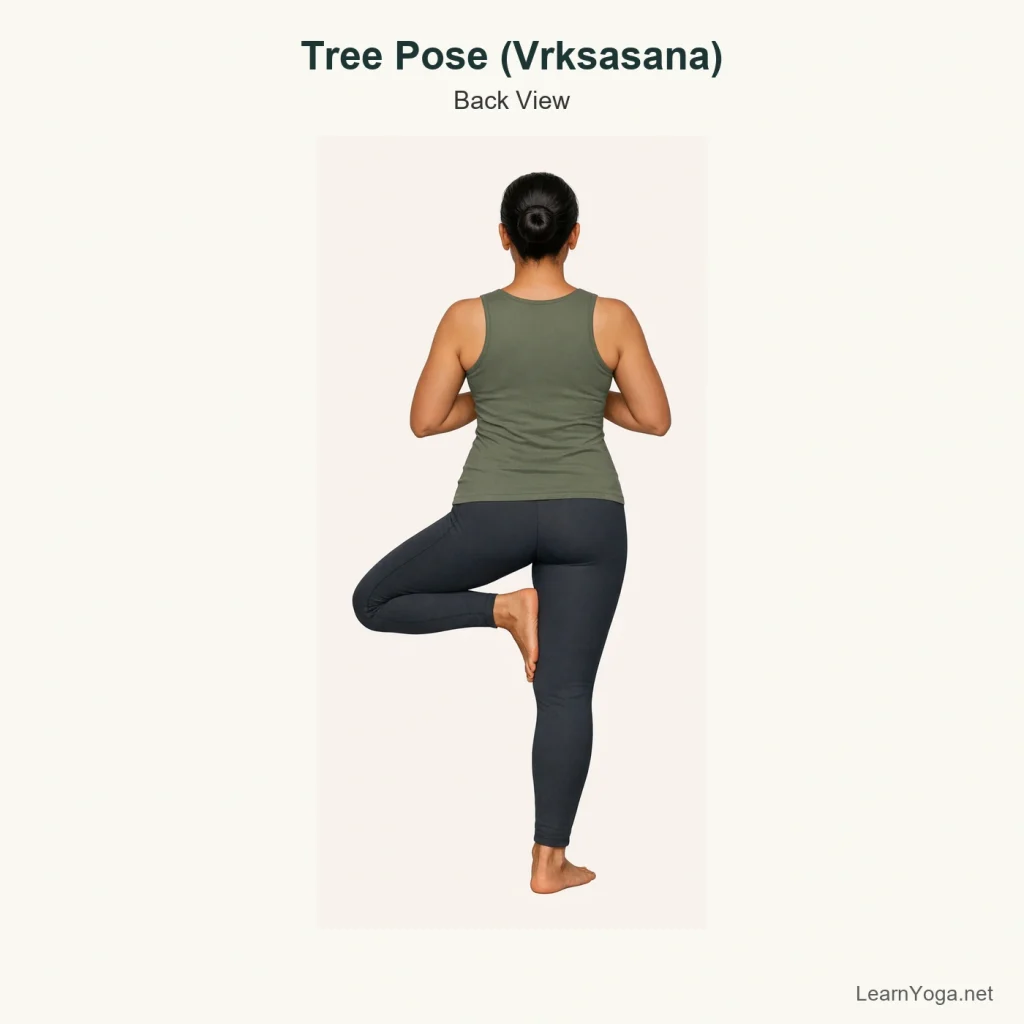
Tree Pose
Practise balancing upright with one foot placed to the inner leg and keep the hands on a wall if needed.
Use this if the deep squat range or toe balance is too demanding.
Chair Pose
Bend both knees evenly and sit the hips back without lifting the heels.
Use this if you want leg strength work without the one-leg balance.
Figure Four Stretch
Lie on your back, cross one ankle over the opposite thigh, and draw the legs in only as far as the hips allow comfortably.
Use this if the hip shape is the main goal and standing balance is not appropriate today.
Common variations
Prayer Toe Stand
The hands come together at the chest once balance is steady, making the pose more upright and a little more demanding.
Toe Stand with floor support
The fingertips stay on the floor in front of the body to reduce the balance challenge while keeping the same leg shape.
Half Toe Stand
The standing knee bends and the heel lifts, but the hips do not lower into the full squat depth.
Safety and contraindications
When to avoid or get individual guidance
Recent or current ankle, knee or foot irritation that makes single-leg balance uncomfortable.
Skip this pose if you are likely to fall when lowering into a squat on the toes.
Move slowly into and out of the pose, especially if balance is unpredictable.
Keep the crossed foot active so the lifted knee is not hanging loosely.
If the standing knee or ankle feels pinched or unstable, come up and choose a higher version or another balance pose.
Pause Toe Stand and choose a higher balance variation when the standing ankle, knee, or crossed hip gives sharp pain, or the lowering phase feels too wobbly to control safely. Get individual guidance before working on the full pose again.
Accessibility and limited mobility
This pose can be awkward for anyone who finds it hard to get low and rise again without using the hands. A wall or a sturdy chair nearby can make practice more manageable.
If ankle mobility is limited, the lifted-heel balance may feel more like a strain than useful work. A higher version usually works better than pushing for the full depth.
For older adults or anyone with reduced confidence in balance, upright options such as Tree Pose may be more practical than attempting the full squat on the toes.
Easier options
Use these related poses when you want a more accessible way to practise a similar movement or prepare for this pose.
Do I need to lower all the way down for it to count as Toe Stand?
No. A higher version is often more useful, especially while you are learning. If you can keep the standing foot steady, the crossed foot active, and the knee tracking well, you are doing meaningful work even without full depth.
Why do I lose balance as soon as my standing heel lifts?
The shift onto the ball of the foot changes the balance point quite a lot. Try lowering more slowly, lean the chest a touch forward, and use a wall or fingertips on the floor until the ankle learns the position.
What should the crossed foot be doing?
Keep it gently flexed rather than limp. That usually helps the outer hip engage and stops the lifted knee from feeling loose or compressed.
Is it normal for one side to feel much less stable?
Yes. Many people have one ankle that balances more easily or one hip that opens more comfortably. Work both sides, but do not force them to feel identical. A wall-supported version on the tighter or shakier side is completely fine.
Can I practise this if deep squats are uncomfortable for me?
You can try a partial version, but if the squat range itself feels strained, choose Tree Pose or a reclined Figure Four Stretch instead. Those options keep some of the same themes without asking for the same depth or balance.
Reviewed for yoga instruction
Yogita
Certified Yoga Instructor with 5+ years of Teaching and Consistent Practice