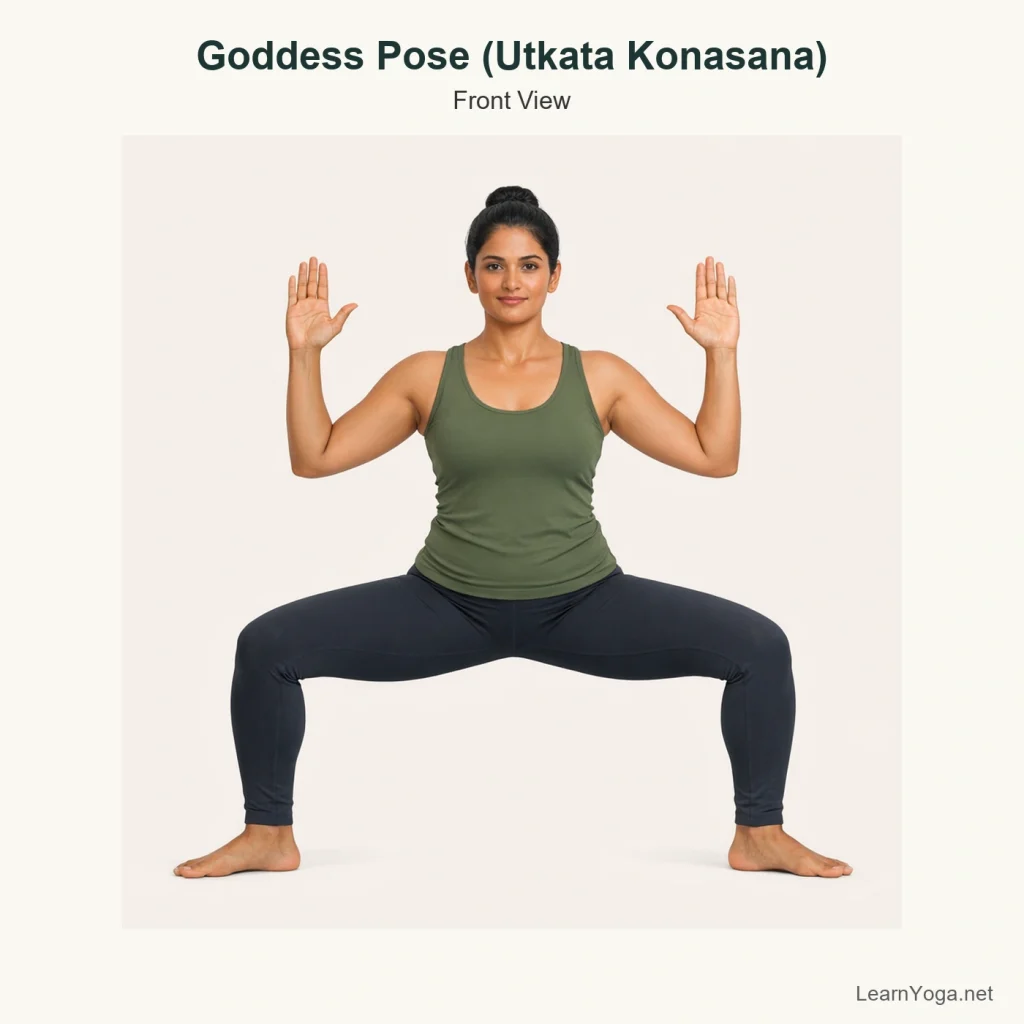
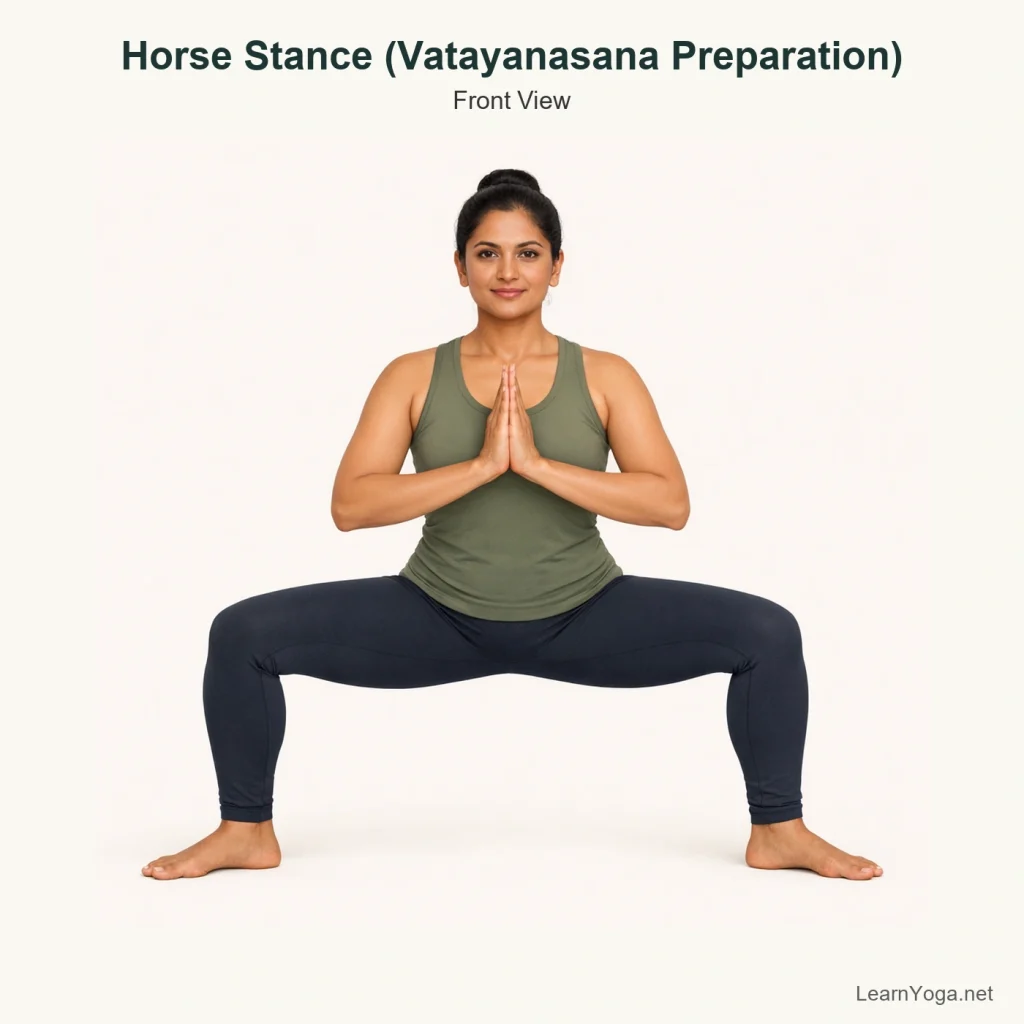
Prayer Squat is a wide squat with the hands together at the chest. It can gently open the hips and ankles while asking you to organise the spine and feet so the shape feels steady rather than collapsed.
This pose is often used to explore a deep squat, but it does not need to be very deep to be useful. For many people, the main work is in the ankles and hips, not in getting lower. Keep the feet placed in a way that lets the knees track comfortably, and let your version of the pose match your current range.
How to do Prayer Squat
Stand with the feet a little wider than hip-width, with the toes turned out as much as you need for your knees to bend comfortably.
Bring the palms together at the chest and lengthen up through the crown of the head before you start to lower.
Bend the knees and send the hips down and slightly back, as if lowering into a squat between the legs.
Press the feet evenly into the floor, especially the heels if they can stay down, and let the knees follow the line of the toes.
Use the elbows lightly inside the knees only if that helps you create space in the hips without straining.
Keep the chest broad and the spine long rather than rounding heavily forward.
Stay for 3 to 8 breaths. On each inhale, find a little lift through the sternum. On each exhale, allow the hips to settle only as far as the joints feel comfortable.
To come out, press through the feet, lift the hips, and return to standing with control.
Yogita's tip
If you keep falling backward, the issue is often not hip tightness alone. Try widening your stance a little and turning the toes out slightly more so the pelvis has somewhere to go.
Benefits
Builds familiarity with squatting mechanics in the hips, knees and ankles.
Can improve awareness of how the feet and knees line up under load.
Encourages a more upright spine than a collapsed squat when practised with support from the hands at the chest.
Works well as a preparation for other standing poses that need hip and ankle mobility.
Common mistakes
Forcing the squat lower after the heels have lifted and balance has become shaky.
Letting the knees collapse inward instead of tracking in the same general direction as the toes.
Rounding the back and dropping the chest between the thighs.
Using the elbows to push hard into the knees instead of letting the hips open gradually.
Taking the feet too narrow for the body's current ankle and hip range.
Make it work for you
Heels Elevated Prayer Squat
Place a folded blanket or wedge under the heels. This reduces the ankle demand and often lets the spine stay more upright.
Supported Prayer Squat at a Wall
Stand facing a wall and lightly hold it as you lower into the squat. Use the support to keep weight balanced through the feet rather than gripping with the toes.
Higher Squat
Pause well above your deepest range, with the thighs higher than the knees if needed. Keep the chest lifted and breathe there without trying to sink lower.
Alternatives
Chair Squat Hold
Stand in front of a chair and bend the knees until the hips lightly touch the seat, then rise again or hover just above it.
Useful if getting low is uncomfortable or getting back up from the floor-level squat feels difficult.
Wide Seated Hip Opening
Sit on a folded blanket with the legs comfortably wide and the hands at the chest or on the floor for support while you practise upright posture.
Useful when knees or ankles do not tolerate the loaded squat position.
Common variations
Prayer Squat with Heels Lifted
A higher variation where the heels lift and the body balances more on the balls of the feet. This changes the ankle demand and is not the best choice if balance feels uncertain.
Prayer Squat with Elbows Inside Knees
The elbows press lightly inside the knees while the palms stay together, helping some people create a little more space through the inner thighs.
Wide Prayer Squat
The feet step a bit wider apart to make room for the pelvis and reduce the feeling of being blocked at the front of the ankles.
Safety and contraindications
When to avoid or get individual guidance
Recent aggravation of knee, ankle or hip pain may make this pose uncomfortable.
Use caution if deep squatting affects your balance.
Move gradually, especially if your ankles, knees or hips feel stiff in deep bending.
Do not force the heels to stay down if that creates strain; use support under the heels or stay higher.
If the knees feel pinchy, adjust the stance width or toe angle and reduce the depth.
If you feel sharp pain in the front of the ankle, inside the knee, or deep in the hip each time you try to squat, stop and get individual advice before continuing with deeper versions.
Accessibility and limited mobility
If lowering deeply is difficult, practise a higher version with a chair behind you so you know where the hips are going.
A folded blanket under the heels can make the pose more accessible for people with limited ankle dorsiflexion.
For older adults or anyone who feels unsteady close to the floor, wall support usually makes this pose more manageable and easier to exit safely.
If getting up from a deep squat is the hardest part, keep the pose brief and higher rather than staying low for a long hold.
Easier options
Use these related poses when you want a more accessible way to practise a similar movement or prepare for this pose.
Not necessarily. Some bodies can squat with the heels grounded quite easily, and some cannot without compensation. If the heels lift and you lose stability, place support under them or stay in a higher squat.
How wide should I place my feet?
Choose a stance that lets your knees bend comfortably and your pelvis lower between the legs. If you feel blocked at the ankles or crowded in the hips, step the feet a little wider and turn the toes out slightly more.
What should I do if my knees feel uncomfortable?
Come up a little, check that the knees are tracking in the same direction as the toes, and avoid pushing them wider with force. A higher squat or heel support often helps. If discomfort stays sharp or localised, leave the pose.
Is Prayer Squat the same as Garland Pose?
They are closely related, and names are sometimes used differently. In practice, Prayer Squat usually refers to the squat shape with the hands at the chest, while Garland Pose often describes a deeper yogic squat variation.
How long should I hold the pose?
A short hold is often enough. Try 3 to 5 steady breaths at first. If the shape feels stable and easy to breathe in, you can stay a little longer without forcing the depth.
Reviewed for yoga instruction
Yogita
Certified Yoga Instructor with 5+ years of Teaching and Consistent Practice