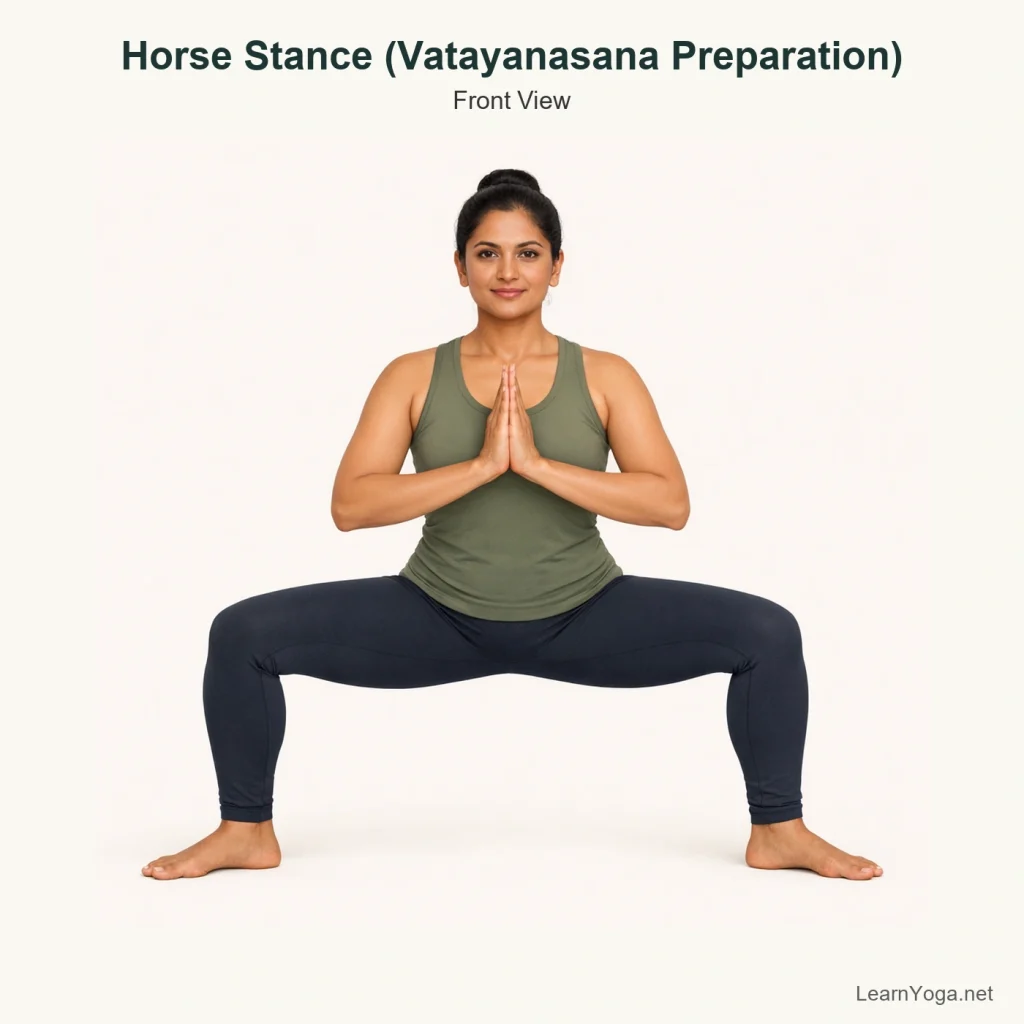
Horse Stance is a wide standing squat with the toes turned out and the knees bending over the feet. It is a simple way to work the legs, wake up the hips and practise staying upright while the lower body does the work.
This pose asks for width in the stance and a clear bend through both knees, but it does not need to be very low. For many people, a medium depth is the most useful place to start. The main job is to keep the knees tracking in the same direction as the toes while the chest stays lifted and the feet stay grounded.
How to do Horse Stance
Stand tall and step your feet wide apart, wider than your hips but not so wide that you feel pulled into a split stance.
Turn your toes out on a gentle diagonal. The exact angle can vary, but choose a position where your knees can bend comfortably in the same direction as your feet.
Place your hands on your hips or bring your palms together at your chest.
Inhale to lengthen through the spine and lift the crown of the head.
Exhale and bend both knees, lowering into a wide squat only as far as you can keep your heels grounded and your knees tracking over the middle toes.
Press evenly through both feet, especially the base of the big toe, little toe and heel.
Keep the pelvis fairly neutral rather than tucking strongly under or tipping the seat back. Let the tailbone drop naturally as the lower belly lightly supports you.
Stay for 3 to 5 slow breaths. On each inhale, grow a little taller through the chest. On each exhale, soften the thighs without collapsing inward.
To come out, press firmly into the feet and straighten the legs on an inhale. Step the feet back together with control.
Yogita's tip
If the knees keep drifting inward, do not think about pushing them wide as hard as possible. Instead, press the outer edges of the feet down and let the thighs follow the line of the toes. That usually creates a steadier stance with less strain.
Benefits
Builds practical strength in the thighs and glutes.
Opens the inner hips in a controlled, weight-bearing way.
Helps you practise knee tracking and even pressure through both feet.
Encourages an upright torso while the legs work.
Can be useful as a warm-up before wider standing poses and side lunges.
Common mistakes
Turning the feet out so far that the knees cannot follow the same line.
Dropping very low before the legs and hips are ready for it.
Letting the knees collapse toward each other.
Shifting most of the weight into the inner edges of the feet or the heels only.
Leaning the chest too far forward instead of stacking it more or less over the pelvis.
Holding the breath once the legs start working.
Make it work for you
Higher stance
Keep the same wide setup but bend the knees less. A smaller squat is often the best place to learn the shape without losing knee alignment.
Hands on thighs
Place your hands lightly on the tops of the thighs for feedback and support, without pushing the knees aggressively outward.
Wall support
Stand with your back lightly touching a wall or practise near a wall for balance. This can help you keep the chest upright while you find your foot position.
Alternatives
Chair-supported wide squat
Stand behind a chair and hold the backrest while you bend the knees into a smaller wide squat, then rise again.
Use this if balance feels uncertain or if you want less load while practising the leg action.
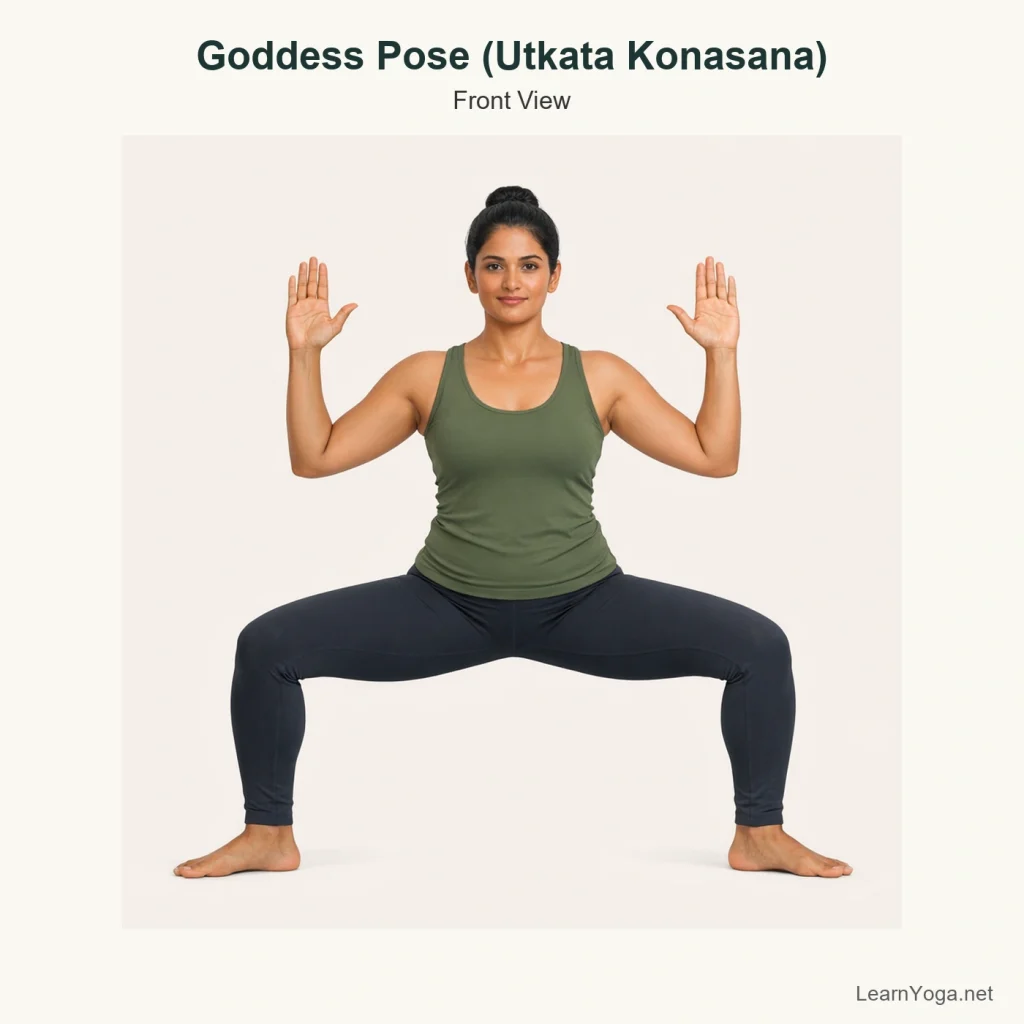
Goddess Pose
Take a similar wide stance but keep the pose more active through the arms and torso, or stay at a moderate depth rather than sinking low.
Use this if you want a closely related catalogue pose with the same basic lower-body pattern.
Mountain Pose
Stand with the feet under the hips and practise bending and straightening the knees a little while keeping the feet grounded.
Use this if a wide stance or turned-out feet bother the hips or knees today.
Common variations
Prayer hands Horse Stance
The palms press together at the chest to help the torso stay centred and upright.
Dynamic Horse Stance
You lower into the stance on an exhale and rise slightly on an inhale for several rounds instead of holding still.
Wide Horse Stance hold
A slightly wider version with a shallower bend can emphasise grounding through the feet and inner thigh length.
Safety and contraindications
When to avoid or get individual guidance
Recent flare-up of knee pain may make this pose uncomfortable.
If wide turned-out standing positions usually irritate your hips, use a smaller stance or choose a simpler alternative.
Keep the knees bending in the same direction as the toes.
Choose a depth where the heels stay grounded and the joints feel steady.
If the front of the hips or the inner knees feel pinched, come up slightly and reduce the turnout of the feet.
Pause Horse Stance if sharp pain shows up in the knee, hip, or groin, or the legs cannot take weight comfortably in the squat. Choose a shallower stance, and get individual guidance before working on deeper wide-leg versions.
Accessibility and limited mobility
This pose can be practised at a higher level; it does not need to become a deep squat to be useful.
If getting low is difficult, use a chair, countertop or wall for support so the legs can work without as much balance demand.
Older adults or anyone with limited hip range may find a narrower stance and a smaller turnout more comfortable than a very wide setup.
If standing for long feels tiring, try short holds of 1 to 2 breaths, then straighten the legs and repeat.
Easier options
Use these related poses when you want a more accessible way to practise a similar movement or prepare for this pose.
Only go as low as you can keep the feet grounded, the knees steady and the chest fairly upright. For many bodies, a medium bend is more useful than a very deep squat.
Why do my knees drift inward when I bend?
This often happens when the stance is too wide, the feet are turned out too much, or the outer hips are not quite engaged. Try narrowing the stance a little, reducing the turnout and pressing evenly through the whole foot.
What should my pelvis do in this pose?
Aim for a natural, balanced position rather than a strong tuck or an exaggerated arch. If the lower back feels compressed, come up slightly and let the tailbone drop without forcing it.
Can I move in and out of the pose instead of holding it?
Yes. Dynamic repetitions work well here. Inhale to rise a little, exhale to bend the knees again, and repeat for 3 to 5 rounds if that feels better than staying still.
Is it normal for my ankles to feel like they are working?
Yes, some ankle effort is normal because the pose asks you to stabilise in a wide stance. It should feel like work, not strain. If the ankles wobble or feel pinchy, take a narrower stance or use chair support.
Reviewed for yoga instruction
Yogita
Certified Yoga Instructor with 5+ years of Teaching and Consistent Practice