Side Plank
Side Plank is a one-arm balancing pose that builds shoulder stability, side-body strength and clear whole-body organisation. It asks you to support yourself with one hand and one foot while keeping the chest open and the hips lifted.
Pose Explorer
Search all published poses or narrow the library by level, goal, body area, pose type, position or energy.

Side Plank is a one-arm balancing pose that builds shoulder stability, side-body strength and clear whole-body organisation. It asks you to support yourself with one hand and one foot while keeping the chest open and the hips lifted.

Side Crow is a compact arm balance with a twist. It asks for wrist loading, a rounded upper back, clear core support and a forward shift of weight more than a big jump upward.

Shoulder Stand is a supported inversion where the body lifts vertically from the shoulders rather than balancing on the head or neck. It asks for organised upper back support, steady core work and enough shoulder mobility to keep the throat and neck spacious.

Shoelace Pose is a seated outer-hip stretch with the knees stacked one over the other. It can create a clear sensation in the glutes and outer hips, but the shape does not need to look neat or symmetrical to be useful.

Seated Forward Fold is a simple-looking pose that asks for patience more than force. A small bend in the knees and a clear lift through the front of the spine often make the fold more useful and more comfortable.

Scorpion Pose is a demanding inversion and backbend that asks for strong shoulder support, clear balance and careful control through the spine. It is usually learned after steady work in forearm balance or handstand variations, often with a wall.

Scale Pose is a compact seated arm balance that asks for strong pressing through the hands, a rounded lift through the trunk and enough hip mobility to keep the legs tucked in. It is usually approached from Lotus Pose, though not every body will find that version comfortable or appropriate.

Sage Koundinya Pose is a twisting arm balance that grows out of a deep lunge and rotation through the trunk. It asks for shoulder stability, wrist tolerance, core support and enough hip mobility to place the outer thigh high on the upper arm before you shift forward.

Revolved Triangle is a standing twist with a narrow base, so it asks for steadiness as much as flexibility. It can build awareness through the feet, legs, spine and breath, but it usually works better when the range is moderate rather than forced.

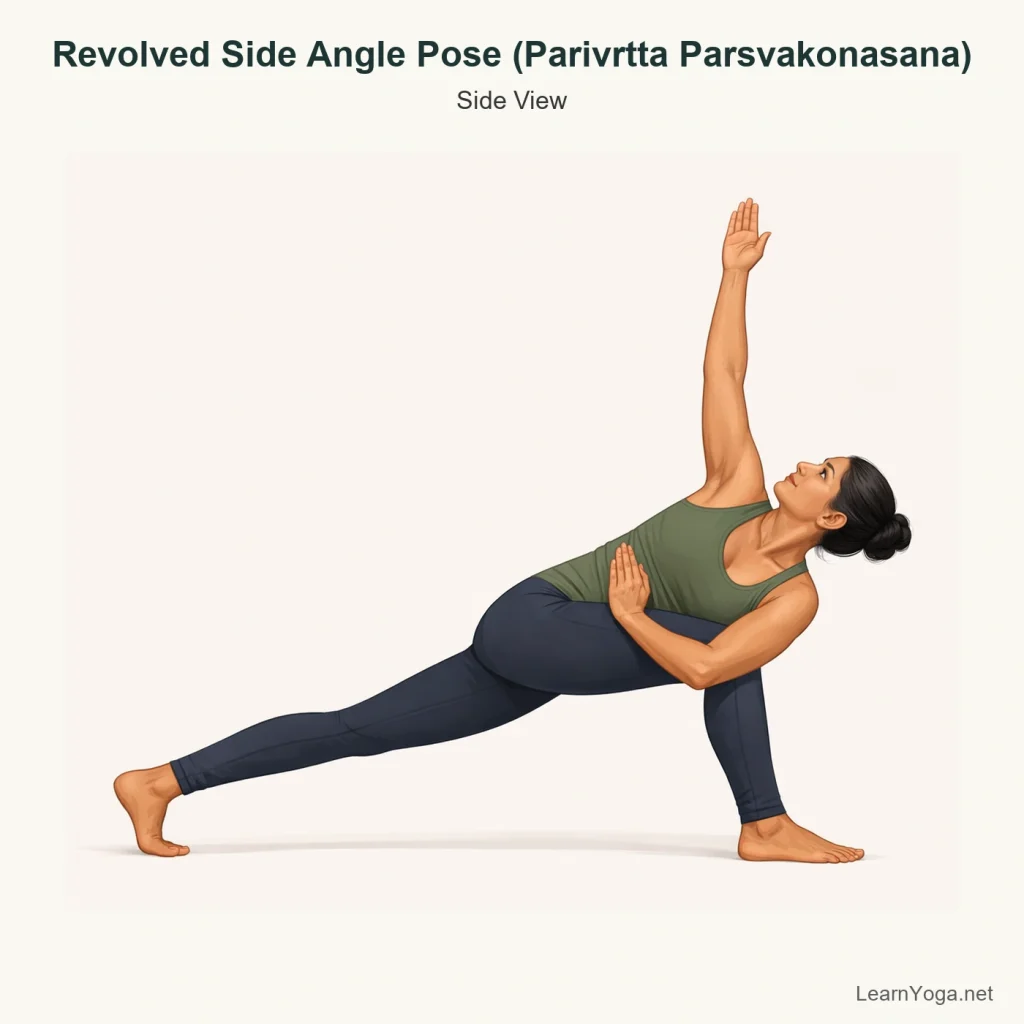
Revolved Side Angle Pose is a standing twist that asks for steady legs, a long spine and controlled rotation. It can be practised in a smaller, more workable shape with the back knee lowered or the bottom hand lifted onto a block.