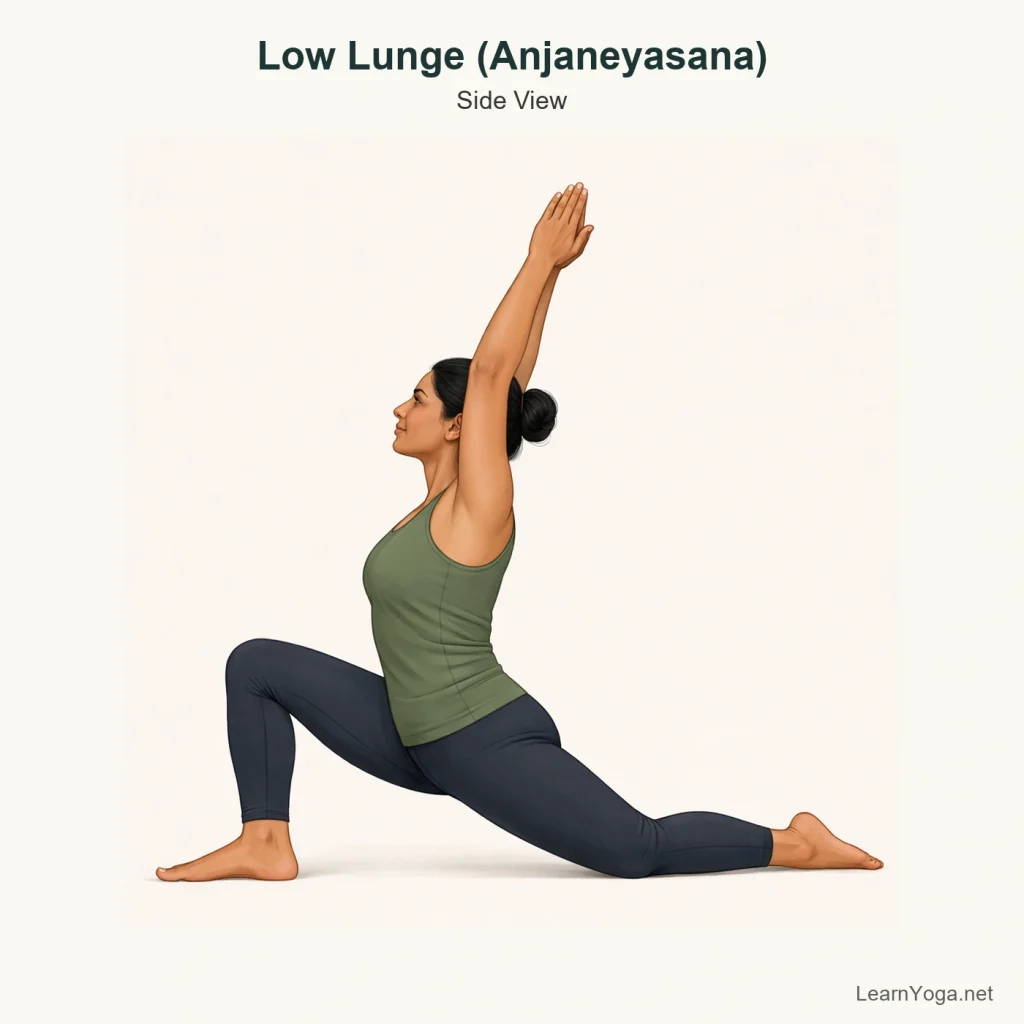
Kneeling Quad Stretch is a low lunge variation that brings a clearer stretch to the front thigh of the back leg. It can be done upright or with the hand holding the back foot, and it usually works best when you keep the pelvis fairly level instead of pushing forward aggressively.
This pose asks for two things at once: steadiness in the lunge and enough softness in the front thigh to bend the back knee comfortably. Some bodies will take the foot easily; others will need a strap, wall, or a smaller range. There is no need to force the shape.
How to do Kneeling Quad Stretch
Start in a low lunge with your right foot forward and your left knee down. Place padding under the back knee if you want more comfort.
Bring your hands to your front thigh and lift your torso upright. Let your pelvis stack over the back knee rather than lunging far forward.
Bend your left knee and draw the heel toward the seat. Reach the left hand back to hold the foot or ankle, or loop a strap around the foot if your hand does not reach easily.
Keep the front knee roughly above the ankle and the chest upright. Gently draw the lower front ribs in so the stretch stays more in the front of the back thigh than in the lower back.
Stay for 3 to 5 slow breaths, or around 20 to 40 seconds. Use each inhale to grow a little taller and each exhale to soften the back thigh without yanking the foot closer.
Release the back foot slowly, place the hand down, and step out of the lunge. Repeat on the second side.
Yogita's tip
If the stretch disappears as soon as you catch the foot, check whether your pelvis has drifted forward. Bringing your hips a touch back over the kneeling knee often makes the front thigh work clearer and keeps the lower back quieter.
Benefits
Lengthens the front of the back thigh in a controlled kneeling position.
Explores knee bending together with hip extension, which can be useful preparation for lunges and backbends.
Builds balance and postural control while the torso stays upright.
Can help you notice whether you are moving from the hip and thigh or simply pushing into the lower back.
Common mistakes
Driving the pelvis too far forward and turning the pose into a lower-back compression.
Letting the front knee slide well past the ankle without need.
Pulling hard on the back foot instead of easing into the stretch gradually.
Twisting the torso to reach the foot rather than keeping the chest mostly forward.
Ignoring discomfort at the kneeling knee when extra padding or a different version would help.
Make it work for you
Use a strap around the back foot
Loop a strap around the back foot and hold the strap with the same-side hand or both hands. This reduces the need to reach deeply back while still allowing the knee to bend.
Hand on front thigh
Keep one or both hands on the front thigh and simply bend the back knee a little without holding the foot. This is a good place to stay if balance or range is limited.
Wall support
Practise beside a wall and place one hand on it for balance while the other hand reaches for the foot or strap.
Alternatives
Prone Quad Stretch
Lie on your belly and bend one knee, reaching back for the foot or using a strap.
Use this if balancing in a lunge feels unsteady or if you want a simpler way to isolate the front thigh.
Reclining Hero Pose
Take a supported reclined version with props under the back if available, staying in a small range.
Use this if you want a two-leg front-thigh stretch without the balance demand, and only if kneeling is already comfortable for your knees.
Low Lunge
Stay in a regular low lunge with the back knee down and torso upright, without bending the back knee.
Use this if holding the foot strains the knee or lower back.
Common variations
Supported strap variation
From a low lunge, a strap loops around the back foot so the torso can stay more upright while the back knee bends.
Wall-assisted variation
One hand rests on a wall for balance while the other hand or a strap works with the back foot.
Deep lunge variation
The front knee bends a little more as the back foot is held, increasing the intensity through the front of the back hip and thigh.
Safety and contraindications
When to avoid or get individual guidance
Recent or current knee irritation may make the kneeling position or deep knee bend unsuitable.
Skip the foot hold and choose a milder version if the front of the thigh cramps or the lower back feels compressed.
Use padding under the back knee if kneeling is tender.
Keep the stretch moderate at the front of the thigh; there is no need to pull the foot all the way in.
If the lower back feels pinched, come more upright and ease the pelvis back slightly.
Come out of the stretch if there is sharp pain in the kneeling knee, the bent knee, or the low back. Choose a milder quad stretch or get individual guidance before trying this version again.
Accessibility and limited mobility
Place a folded blanket or extra mat under the kneeling knee if the floor feels hard.
If getting down to the floor is difficult, use a chair or wall for support during the transition into and out of the lunge.
If reaching the foot is not realistic today, use a strap or stay with a smaller knee bend rather than forcing the shoulder and spine to compensate.
Older adults or anyone with limited balance may find the wall-supported version more workable than the free-standing version.
Easier options
Use these related poses when you want a more accessible way to practise a similar movement or prepare for this pose.
Use a strap around the foot, or keep the back knee bent without holding the foot at all. You can still get a useful stretch in a smaller version.
Should I push my hips forward to feel more stretch?
Usually only a little. If you drive the hips far forward, the sensation often shifts into the lower back. Keep the torso tall and let the front of the back thigh lengthen without forcing the pelvis ahead.
Why do I feel this in my lower back instead of my thigh?
That often happens when the ribs flare and the pelvis moves too far forward. Come a little more upright, draw the lower ribs in gently, and reduce how strongly you pull the foot.
Is it normal for the kneeling knee to feel pressure?
Some pressure from the floor is common, but it should not feel sharp. Add more padding, shorten the hold, or switch to Prone Quad Stretch if kneeling is not comfortable.
How long should I stay in the pose?
A practical starting point is 3 to 5 slow breaths on each side. If you are using support and the shape feels steady, you might stay for up to 40 seconds.
Reviewed for yoga instruction
Yogita
Certified Yoga Instructor with 5+ years of Teaching and Consistent Practice