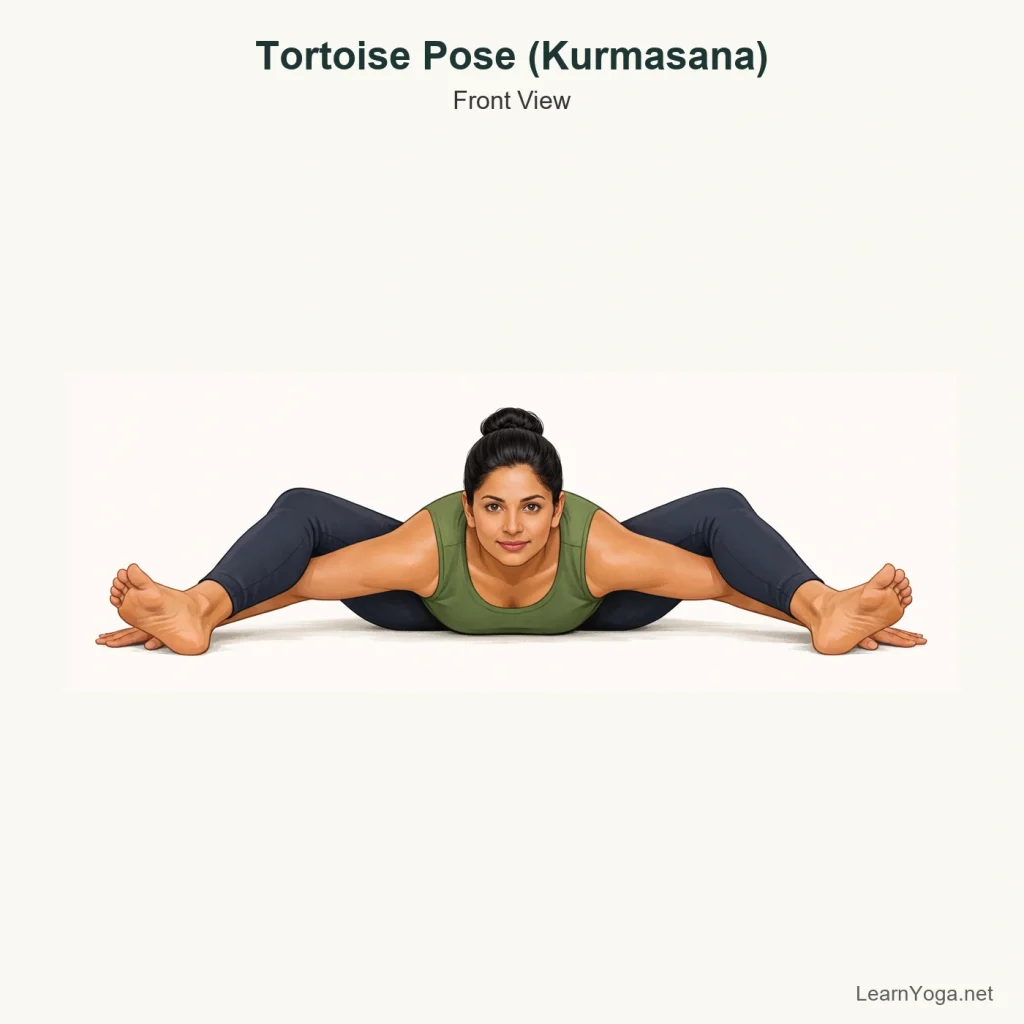
Tortoise Pose is a deep seated forward bend with the arms threaded under the legs. It asks for plenty of hip opening and hamstring length, but it works better when you enter gradually and keep the spine long rather than forcing your way down.
Tortoise Pose can look like a shape you simply fold into, but the setup does most of the work. The legs need enough width, the knees usually need some softness, and the arms slide under only as far as the shoulders can stay comfortable. For many bodies, a lighter version is more useful than the full expression.
How to do Tortoise Pose
Sit on the floor with your legs a little wider than hip-width apart and your knees bent.
Lift through the chest and tip the pelvis slightly forward so you are not rounding straight away.
Slide one arm at a time under the knees, turning the palms down or slightly out as feels natural.
Ease the legs straighter only as much as the backs of the legs allow without yanking on the lower back.
Walk the heels forward a little and let the chest move between the thighs rather than collapsing heavily toward the floor.
Keep the neck easy and the jaw soft. Breathe in to create a little length through the front of the body, and breathe out to settle without pushing.
Stay for 3 to 6 breaths, or less if the breath becomes strained.
To come out, bend the knees more, slide the arms back out and lift the chest slowly.
Yogita's tip
If the arms keep getting stuck at the elbows, bend the knees more than you think you need. In this pose, softer knees often give the shoulders enough space and stop the fold from turning into a tug on the hamstrings.
Benefits
Gives a strong stretch through the backs of the legs and outer hips.
Practises folding from the hips with more patience and control.
Can help you notice the difference between a long spine and a collapsed spine in deep forward bends.
Brings the shoulders into extension as the arms move under the legs.
Encourages a quieter, steadier breath in a compact shape.
Common mistakes
Trying to straighten the legs too soon and ending up pulled backward on the sitting bones.
Forcing the chest down and rounding hard through the lower back.
Jamming the shoulders under the knees instead of creating space with bent knees first.
Holding the breath to get deeper into the shape.
Letting the feet turn completely passive so the legs lose support.
Make it work for you
Bent-Knee Tortoise
Keep both knees clearly bent and focus on sliding the arms under the legs while staying lifted through the chest. This often makes the pose more workable and reduces strain at the hamstrings.
Seat on a Folded Blanket
Sit on a folded blanket or low cushion to help the pelvis tip forward. This can make it easier to hinge from the hips instead of rounding straight into the back.
Higher Chest Version
Rather than lowering deeply, pause with the chest only partway forward and keep the elbows slightly bent. Use the inhale to lengthen and the exhale to soften without dropping.
Alternatives
Head-to-Knee Pose
Practise one side at a time with one leg extended and the other bent. Keep the fold moderate and the spine long.
Use this if both hamstrings together feel too restrictive or the full pose rounds your back immediately.
Bound Angle Pose
Sit upright with the soles of the feet together and knees apart, staying tall or folding only a little.
Choose this if the under-leg shoulder position is too intense or uncomfortable.
Wide-Angle Seated Forward Fold
Open the legs comfortably wide and fold forward with the hands on the floor in front of you, without threading the arms underneath.
This is useful if you want a similar hip and hamstring action with less demand on the shoulders.
Common variations
Bent-Knee Kurmasana
A more accessible version with the knees bent and the torso supported more by the thighs than by leg straightness.
Wider-Leg Kurmasana
Practised with the feet a little wider apart to create more room for the shoulders and chest.
Upright Entry Variation
The arms thread under the legs, but the torso stays noticeably lifted instead of folding deeply.
Safety and contraindications
When to avoid or get individual guidance
Avoid or modify if you have a current hamstring strain, irritated lower back, or shoulder pain that worsens when the arms move behind you.
Skip the full pose if straight-leg seated forward bends are already painful for you.
Move in gradually. The main demand is usually at the hamstrings, inner hips and lower back, with some load on the shoulders as the arms thread underneath.
Keep some bend in the knees if the pelvis cannot tip forward easily.
If you feel sharp pulling at the hamstring attachments, pinching in the front of the hip, or strain in the lower back, back out and choose a lighter version.
Pause Kurmasana and switch to an easier forward fold when sharp pain shows up in the hamstrings, inner hips, shoulders, or lower back. Symptoms that continue after you come out are a good reason to get individual guidance before practising the full pose again.
Accessibility and limited mobility
This pose can be awkward for anyone who finds it hard to get down to the floor or back up again. Set up near a wall or sturdy support if standing up afterward is the harder part.
Older adults or people with limited hamstring range may find a folded blanket under the seat and a clearly bent-knee version more realistic than the classical shape.
If shoulder extension is limited, choose a forward bend without threading the arms under the legs.
Easier options
Use these related poses when you want a more accessible way to practise a similar movement or prepare for this pose.
Do my legs need to be fully straight in Tortoise Pose?
No. Many people practise this pose more comfortably with bent knees. If straightening the legs pulls your pelvis backward or rounds your lower back sharply, keep the bend and work on space in the hips and chest first.
What if I cannot get my arms very far under my legs?
That is common. Widen the legs a little, bend the knees more, and enter one arm at a time without forcing. You can stop with the upper arms partly under the knees and still get useful work from the pose.
Where should I feel the pose most?
Usually in the backs of the legs, the outer or inner hips depending on your shape, and around the shoulders as the arms thread underneath. It should not feel like sharp pulling in the lower back or a pinching catch in the hips.
Should I try to bring my chest or head to the floor?
Not as the main goal. It is usually more helpful to think about length through the front of the body and a steady breath. For some bodies, the torso will stay quite lifted, and that can still be appropriate.
When should I practise Tortoise Pose in a session?
It usually fits better after you are warm and have already done some seated hip opening or forward bends. It is rarely the first deep fold of practice.
Reviewed for yoga instruction
Yogita
Certified Yoga Instructor with 5+ years of Teaching and Consistent Practice