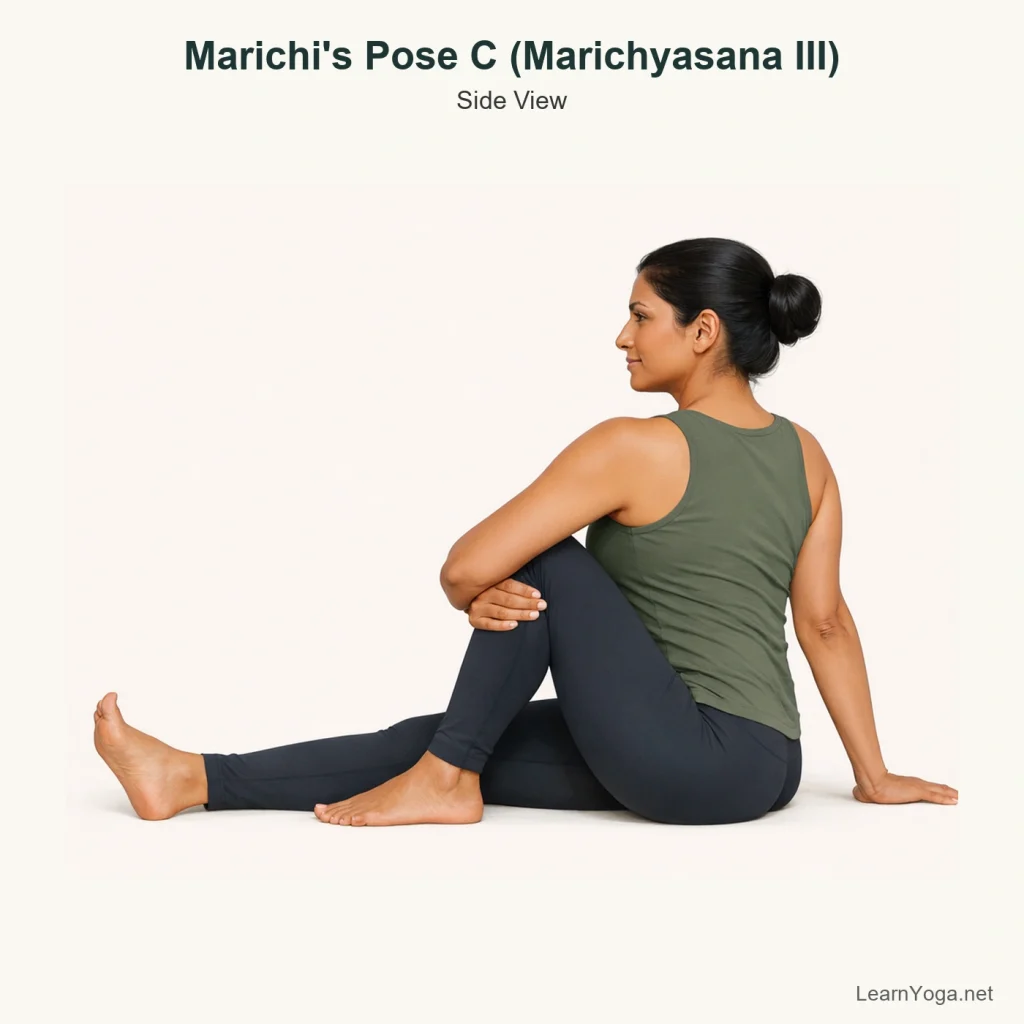
Marichi's Pose C is a seated twist with one knee bent and the other leg extended. It asks for a steady base, an upright spine and a measured turn rather than a strong pull with the arms.
This pose can be quite clear and useful when you keep it simple. The bent knee helps you organise the twist, but the shape is usually better when you sit tall first and turn only as far as your breath stays easy. Some bodies will bind or hook the arm more deeply, while others will be more comfortable holding the shin or hugging the knee.
How to do Marichi’s Pose C
Sit in Staff Pose with both legs extended. Bend your right knee and place the right foot on the floor close to the sitting bone, keeping the left leg long and active.
Press the extended leg down gently and sit evenly on both sitting bones. If your lower back rounds, sit on a folded blanket.
Inhale and lengthen up through the crown of the head. Exhale and begin to turn to the right from the belly, ribs and chest.
Bring your left upper arm or elbow to the outside of the right knee, or simply hug the knee with the left arm if that feels steadier.
Place your right fingertips on the floor just behind your pelvis without leaning heavily into that hand. Keep the chest broad and the spine tall.
Stay for 3 to 5 smooth breaths. Each inhale creates a little more height; each exhale may allow a small, comfortable turn.
To come out, inhale to lengthen, exhale and slowly unwind to centre. Extend the right leg, pause in Staff Pose, then repeat on the other side.
Yogita's tip
If the extended-leg foot goes slack, the twist often collapses backward. Flex that foot gently and press the back of the thigh toward the floor to give the spine something firm to rise from.
Benefits
Practises spinal rotation with attention to posture rather than speed.
Helps you notice the difference between turning from the ribs and pulling from the shoulders.
Gives the outer hip and back body a moderate, workable effort while one leg stays active.
Can improve awareness of sitting evenly instead of tipping to one side in seated poses.
Common mistakes
Rounding back and dropping the chest in order to twist farther.
Pulling strongly with the arm and forcing the turn.
Letting the extended leg roll out and become passive.
Sitting mostly on one hip instead of grounding both sitting bones as evenly as possible.
Placing the back hand too close, which can jam the shoulder and push the chest forward.
Make it work for you
Sit on a folded blanket
Raise the hips on one or two folded blankets if the pelvis tips backward or the extended leg makes the spine round. This usually makes the twist cleaner and more comfortable.
Hug the bent knee
Instead of hooking the elbow outside the knee, wrap the opposite arm around the bent shin and use that contact to guide a smaller twist.
Keep the bent foot farther away
Place the bent foot a little farther from the pelvis if the knee feels cramped. You will lose some leverage, but the setup is often more manageable.
Alternatives
Bharadvaja's Twist
Choose a gentler seated twist with both hips supported and less leverage from the arm.
Use this if the straight-leg setup or the bent knee in Marichi's Pose C feels awkward.
Easy seated twist
Sit in a simple cross-legged seat and twist toward one side with one hand behind you and the other on the opposite knee.
Use this if getting the extended leg and bent-knee position organised is distracting or uncomfortable.
Supine twist
Lie on your back and take a gentle reclining twist with knees bent.
Use this if sitting upright is tiring or if you want spinal rotation with less demand on the hips and knees.
Common variations
Open-arm Marichi's Twist
The opposite arm hugs the bent knee instead of crossing outside it, creating a smaller and often steadier twist.
Bound variation
A deeper version sometimes includes wrapping the arm around the bent leg and taking a bind. This suits only bodies that can keep the spine long without strain.
Blanket-supported variation
The hips are lifted on a folded blanket to help the pelvis tip forward and reduce rounding in the lower back.
Safety and contraindications
When to avoid or get individual guidance
Avoid or reduce the pose if you have a current knee flare-up that makes deep bending uncomfortable.
Take a smaller twist or choose an alternative if seated rotation irritates your lower back.
Keep the twist moderate if your lower back feels compressed when you turn.
If the bent knee feels strained, move the foot slightly farther away or choose a simpler seated twist.
Turn gradually and let the breath set the pace rather than forcing the shape.
Pause Marichyasana III and avoid deeper seated twists when the bent knee gives sharp pain, the low back feels pinched as you turn, or tingling lingers after you unwind. Get individual guidance before trying to take the twist further.
Accessibility and limited mobility
If sitting on the floor is difficult, practise a gentle seated twist on a firm chair instead.
A folded blanket under the hips can make a big difference for older adults or anyone with limited hip mobility.
If fully straightening one leg is not comfortable, keep a soft bend in that knee while still reaching the heel forward.
Easier options
Use these related poses when you want a more accessible way to practise a similar movement or prepare for this pose.
No. That leverage can deepen the twist, but it is not required. If placing the elbow outside the knee rounds your back or makes you strain, simply hug the knee and focus on sitting tall.
Why do I keep leaning back in this pose?
Usually the pelvis is tipping backward, often because the hips or hamstrings are asking for more room. Sit on a folded blanket and make the twist smaller. That often helps you stack the spine more easily.
Should the straight leg stay completely flat on the floor?
As much as is comfortable, yes, but it does not need to be rigid. Keep the leg active, reach through the heel and gently flex the foot. If the knee needs to soften a little so the spine can lift, that is a reasonable adjustment.
Where should I look during the twist?
Let the gaze follow the chest only if the neck feels easy. You can look to the side or even forward. The main action is in the torso, not in cranking the head around.
Reviewed for yoga instruction
Yogita
Certified Yoga Instructor with 5+ years of Teaching and Consistent Practice