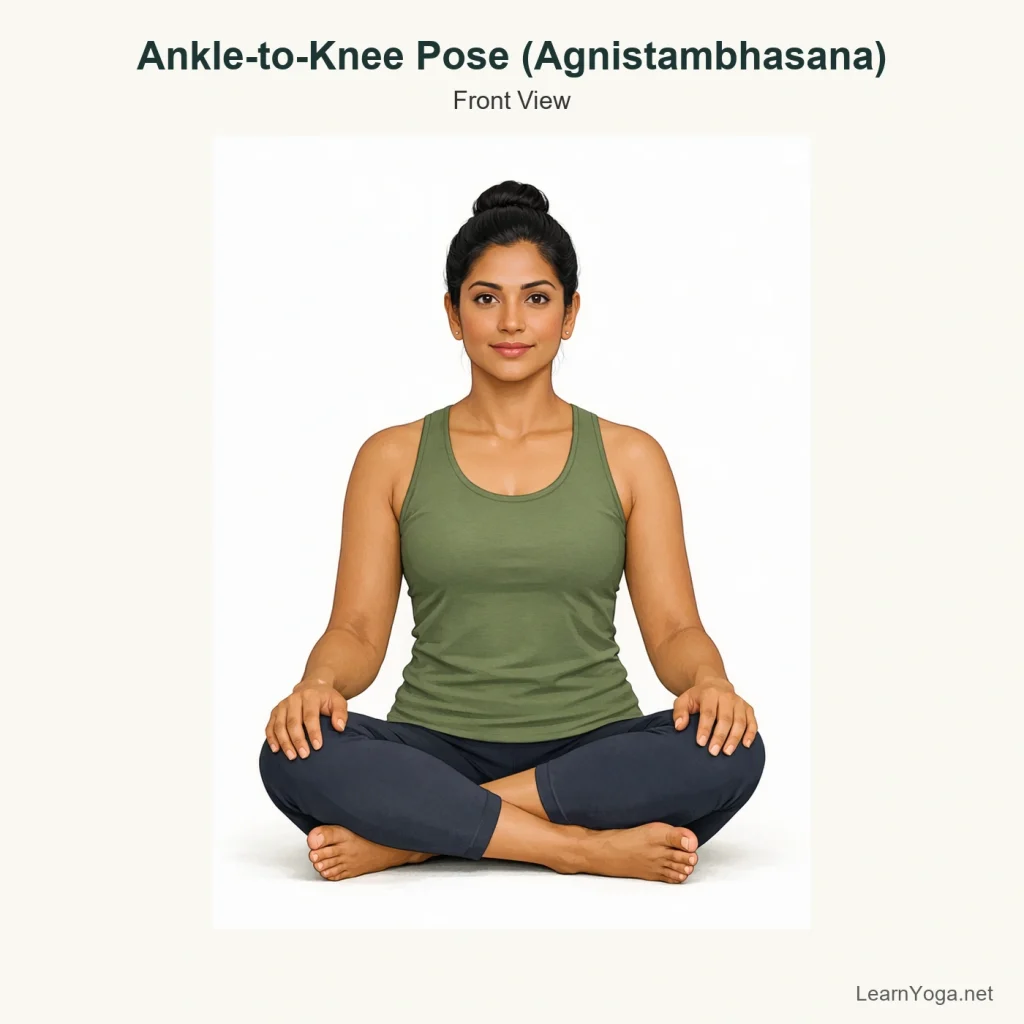
Half Lotus Pose is a seated hip-opening posture with one foot placed high on the opposite thigh and the other leg folded underneath or in front. It asks for comfortable external rotation at the hip, while the knee and ankle need to stay quiet and well supported.
Half Lotus can be a steady meditation seat for some people, but it is not a shape to force. The pose depends much more on hip range than on pulling the foot into place. If the knee feels strained, the setup is too deep for today. A careful version should feel organised through the legs, easy enough to breathe in, and stable through the pelvis and spine.
How to do Half Lotus Pose
Sit on the floor in Staff Pose with both legs extended. If your lower back rounds or your knees feel pulled, sit on a folded blanket or cushion.
Bend your right knee and cradle the right leg with both hands, one hand at the ankle and one under the knee, so you move the leg without twisting the knee.
Guide the right foot toward the top of the left thigh, placing it as high as is comfortable. Keep the sole angled slightly upward and the ankle active, as if gently flexing the foot.
Fold the left leg in, either tucking the left foot under the opposite knee or crossing it more simply in front if that is steadier for you.
Settle both sitting bones as evenly as you can. Place your hands on your thighs or knees and lengthen up through the centre of the chest without hardening the ribs.
Stay for 5 to 10 slow breaths. On each inhale, grow a little taller. On each exhale, let the hips soften while keeping the lifted foot supported and the top knee free from pressure.
To come out, lean back slightly, lift the top foot off the thigh with your hands, and extend the legs forward before changing sides.
Yogita's tip
Before placing the foot on the opposite thigh, draw the shin in toward your chest first. That usually shows whether the hip is ready; if the knee already feels pulled in that stage, the full setup is not the best choice today.
Benefits
Encourages external rotation at the hip in a more moderate way than Full Lotus.
Can help you practise upright seated posture with less effort when the legs are well supported.
Builds awareness of the difference between movement coming from the hip and strain showing up at the knee.
Works as a preparation for deeper seated shapes such as Full Lotus for people whose bodies are suited to that progression.
Common mistakes
Pulling the foot into place with the hands instead of checking whether the hip is opening enough.
Letting the lifted foot go slack, which can leave the ankle feeling compressed.
Pressing the top knee down toward the floor.
Sitting behind the sitting bones so the lower back rounds and the chest collapses.
Ignoring a pinching or twisting feeling at the knee because the pose looks almost in place.
Make it work for you
Sit on height
Place one or more folded blankets under the sitting bones. This often gives the pelvis a slight forward tilt and reduces strain through the knees.
Support the top knee
If the lifted knee hangs in space, slide a folded blanket or block underneath it so the leg does not have to hold itself up.
Lower the bottom leg demand
Instead of folding the lower leg tightly in, extend it forward or keep it in a loose cross-legged shape while the top foot rests on the opposite thigh.
Alternatives
Easy Pose
Sit cross-legged with both feet underneath the opposite knees and rest your hands on your thighs.
Use this if placing one foot on the thigh creates knee tension or if you want a simpler meditation seat.
Bound Angle Pose
Bring the soles of the feet together and let the knees open out to the sides, with support under the thighs if needed.
Use this if you want a hip-opening seat without the same rotation demand at one knee.
Figure Four Stretch
Lie on your back, cross one ankle over the opposite thigh, and stay there or draw the legs in gently.
Use this when sitting on the floor is awkward or when you want a clearer hip stretch with less load through the knee.
Common variations
Half Lotus with extended lower leg
The top foot comes onto the opposite thigh while the lower leg stays straight in front. This reduces compression around the lower knee and can make the pelvis easier to level.
Half Lotus forward fold
From the upright seat, hinge forward slightly from the hips while keeping the spine long. This is only useful if the knee and ankle already feel settled in the basic shape.
Supported Half Lotus seat
The pose is done on folded blankets with extra support under the lifted knee, turning it into a steadier sitting posture rather than a strong stretch.
Safety and contraindications
When to avoid or get individual guidance
Avoid or modify if you have current knee pain, a recent knee injury, or ankle pain with deep folding.
Skip the pose if hip rotation is very limited and the foot has to be forced into place.
This pose mainly asks for hip rotation. If you feel the sensation strongly in the knee, come out and choose a simpler seat.
Keep the lifted foot active so the ankle is not hanging heavily on the thigh.
Use your hands to place and remove the foot carefully rather than dragging it in or out.
Support under the sitting bones or under the lifted knee can make the shape significantly safer and steadier.
If Half Lotus repeatedly causes sharp knee pain, catching in the joint, or ankle pain that lingers after you come out, pause and get individual advice before practising deeper lotus variations.
Accessibility and limited mobility
Many people are more comfortable with the pelvis raised on a firm cushion or folded blankets.
If getting down to the floor is difficult, a seated alternative such as Easy Pose on a chair or Figure Four Stretch on the back may be more manageable.
Older adults or anyone with limited hip rotation often do better with simpler cross-legged seats rather than trying to place the foot high on the thigh.
If one hip has much less range than the other, it may be enough to practise only the easier side in Half Lotus and use an alternative on the second side.
Easier options
Use these related poses when you want a more accessible way to practise a similar movement or prepare for this pose.
Usually you will notice work or stretch around the outer hip of the lifted leg, along with a steady upright seat. You should not feel twisting, pinching or pressure in the knee. If the knee is the main sensation, back out and choose a simpler version.
Does the foot have to sit very high on the thigh?
No. Higher is not automatically better. The foot only needs to go where it can rest without forcing the knee. For some bodies that will be quite high; for others, a lower or modified position is the better choice.
Why does one side feel much easier than the other?
Uneven hips are very common. One side may rotate more easily, or the ankle and knee may tolerate the shape differently. Practise both sides with patience, but do not try to make the tighter side copy the easier side by force.
Can I meditate in Half Lotus if I cannot stay long comfortably?
You can, but only if the shape stays quiet and steady. If you start fidgeting, leaning back, or feeling numbness in the legs, a higher seat or a simpler cross-legged position will usually work better for meditation.
Is Half Lotus always a preparation for Full Lotus?
Not necessarily. It can be a complete pose on its own. Some practitioners use it as a step toward Full Lotus, but many people are better served by keeping Half Lotus as their deepest version.
Reviewed for yoga instruction
Yogita
Certified Yoga Instructor with 5+ years of Teaching and Consistent Practice