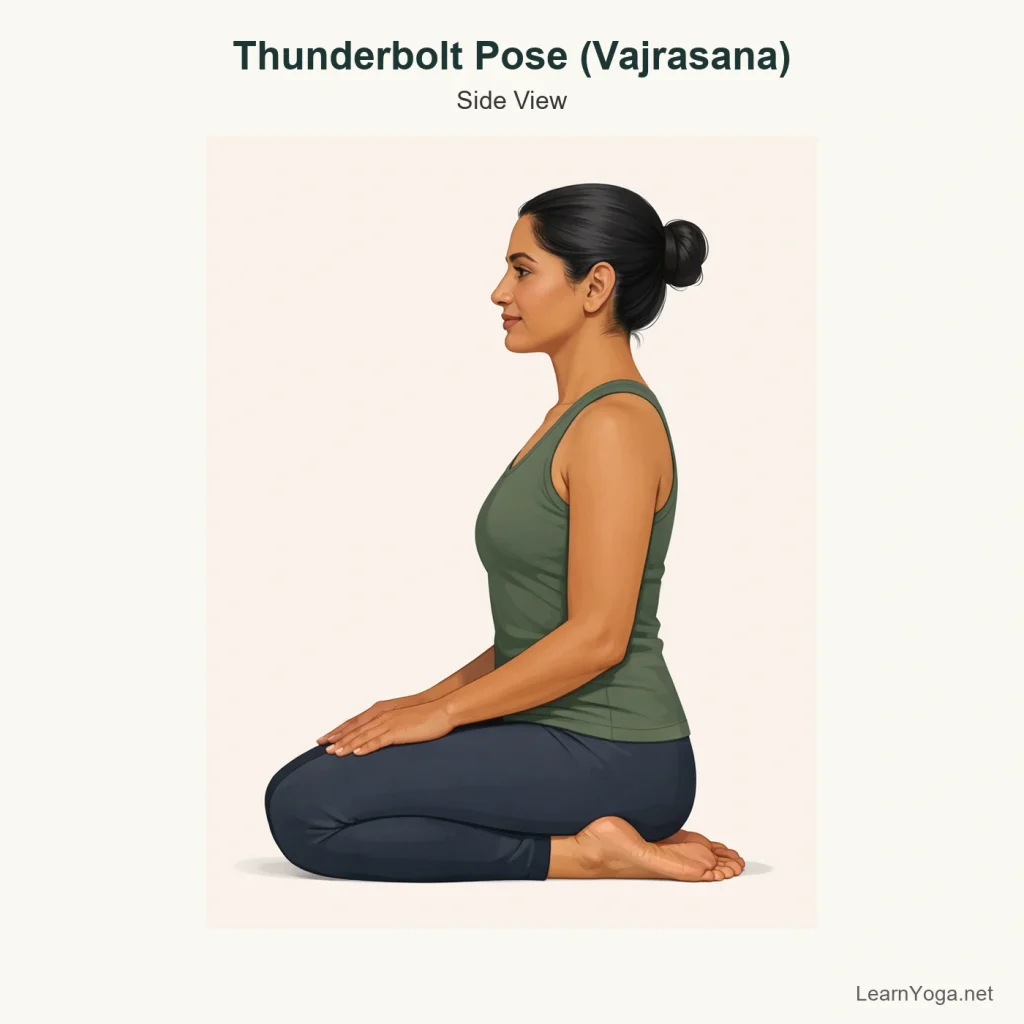
Reclining Hero Pose is a deep kneeling backbend done from Hero Pose, with the thighs lengthening strongly and the front body opening as you lean back. The most useful version is often supported and only as deep as your knees, ankles and lower back can accept comfortably.
This pose asks for quite a lot from the knees, fronts of the ankles and quadriceps, so it helps to treat it as a gradual recline rather than a goal shape. Some bodies rest back only onto the hands or elbows, while others can lower to the floor or a bolster. There is no need to force the final position.
How to do Reclining Hero Pose
Begin in Hero Pose with your knees pointing forward and your feet alongside your hips. If sitting between the feet is already uncomfortable, come out and choose a different pose.
Press the tops of the feet into the floor and let the toes point straight back as much as is natural for you. Keep the knees roughly hip-width or a little closer if that feels steadier, without forcing them together.
Place your hands behind you on the floor and lean back slowly. Pause here if this is already enough across the thighs or ankles.
If it feels comfortable, lower one forearm and then the other. Keep the knees grounded and notice whether they begin to lift or spread sharply apart.
You may stay on the elbows, or lower your back onto the floor or a support. Let the lower ribs stay fairly contained rather than pushing the belly high and dropping heavily into the lower back.
Rest your arms by your sides or place the hands on the belly or lower ribs. Take 5 to 8 slow breaths, especially easing the throat, jaw and front thighs on each exhale.
To come out, bring the elbows under you if you reclined fully, press into your forearms and hands, and rise slowly one stage at a time back to upright.
Yogita's tip
If the knees feel acceptable but the lower back suddenly takes over, come a little higher and draw the front ribs softer. In this pose, less depth often gives a clearer stretch through the thighs.
Benefits
Lengthens the fronts of the thighs and can bring a strong opening through the quadriceps.
Mobilises the ankles and the front of the feet in a kneeling position.
Gives gentle opening across the chest and front body when the recline is supported well.
Can help you notice whether you are moving from the thighs and hips or collapsing into the lower back.
Common mistakes
Leaning back too quickly instead of lowering in stages.
Forcing the seat to the floor even when Hero Pose itself is not comfortable.
Letting the knees lift or splay wide as you recline.
Dropping heavily into the lower back to reach a deeper shape.
Ignoring strong pressure in the knees or sharp sensation across the fronts of the ankles.
Make it work for you
Recline onto hands or elbows only
Stop at the first stage where you still have steady breath and no sharp knee discomfort. Staying higher often gives plenty of sensation in the thighs.
Bolster or pillows behind the back
Place a bolster, stacked pillows or folded blankets lengthwise behind you and recline onto that support instead of the floor. This reduces the depth and usually makes the pose more manageable.
Blanket under shins or ankles
If the fronts of the ankles feel compressed, place a folded blanket under the shins or just above the ankles to soften the angle.
Alternatives
Hero Pose
Stay upright in Hero Pose with the hands beside the hips or on the thighs.
Use this if the kneeling base is enough and the recline feels too strong.
Half Camel Pose
Come into Half Camel Pose for a more upright front-body opening with less knee flexion than a full recline.
Use this if you want a backbend shape without lying back.
Supported Bridge Pose
Lie on your back and place a block or bolster under the sacrum for a supported chest and hip-front opening.
Use this if getting into deep kneeling is not comfortable for your knees or ankles.
Common variations
Supported Reclining Hero Pose
The back rests on a bolster, stacked blankets or cushions, reducing the depth of the recline.
Elbows-Supported Reclining Hero
The pose is held on the forearms rather than lowering all the way down, which gives a clear thigh stretch with more control.
Arms Overhead Reclining Hero
Once the recline is steady, the arms reach overhead to change the sensation through the ribs and shoulders.
Safety and contraindications
When to avoid or get individual guidance
Avoid or modify if you have a current knee, ankle or top-of-foot injury.
Skip the full recline if deep knee bending or lying back causes discomfort in your lower back.
This pose places deep bend through the knees and a strong stretch across the quadriceps and fronts of the ankles.
Move into it gradually and stop if you feel sharp pain, pinching in the knees, or strong compression in the lower back.
Using props is not a lesser version here. Support often makes the pose safer and more useful.
Come out of Reclining Hero Pose and avoid deeper versions when sharp knee pain, strong ankle or top-of-foot pain, or back pain continues after you sit up. Get individual guidance before repeating deep kneeling backbends.
Accessibility and limited mobility
This pose can be difficult for people with limited knee bending, stiff ankles or anyone who finds floor transitions challenging.
A higher support behind the back often makes the pose more accessible than trying to lie flat.
Older adults may prefer Supported Bridge Pose or a supported chest opener instead of a deep kneeling recline.
If getting down to the floor or back up is the main issue, choose an alternative that starts from lying down rather than kneeling.
Easier options
Use these related poses when you want a more accessible way to practise a similar movement or prepare for this pose.
Do I need to lie all the way back to be doing the pose properly?
No. Many people get the main effect of the pose while staying on the hands or elbows, or by resting on a bolster. If your breath stays easier and the knees feel steadier there, that is the better version for your body.
What should I feel in Reclining Hero Pose?
Usually there is a strong stretch through the fronts of the thighs and some sensation across the ankles and the front body. What you do not want is sharp pain in the knees, pinching in the low back, or a feeling that you have to brace hard to stay there.
My knees lift off the floor when I lean back. Is that a problem?
It is a sign that the pose may be asking for more range than is comfortable right now. Try staying higher, add support behind you, or return to upright Hero Pose. The shape is usually more useful when the knees can stay grounded without strain.
Can I keep my knees a little apart?
Yes, if that gives you a steadier and more comfortable base. Some people feel better with the knees closer together, others need a little space. Keep the position reasonable and avoid forcing the knees into a width that creates pressure.
Which counter pose works best after this one?
A simple choice is Child's Pose or Knees-to-Chest Pose. After a deep thigh stretch and recline, most people prefer something that rounds or neutralises the spine and gives the knees a chance to straighten.
Reviewed for yoga instruction
Yogita
Certified Yoga Instructor with 5+ years of Teaching and Consistent Practice