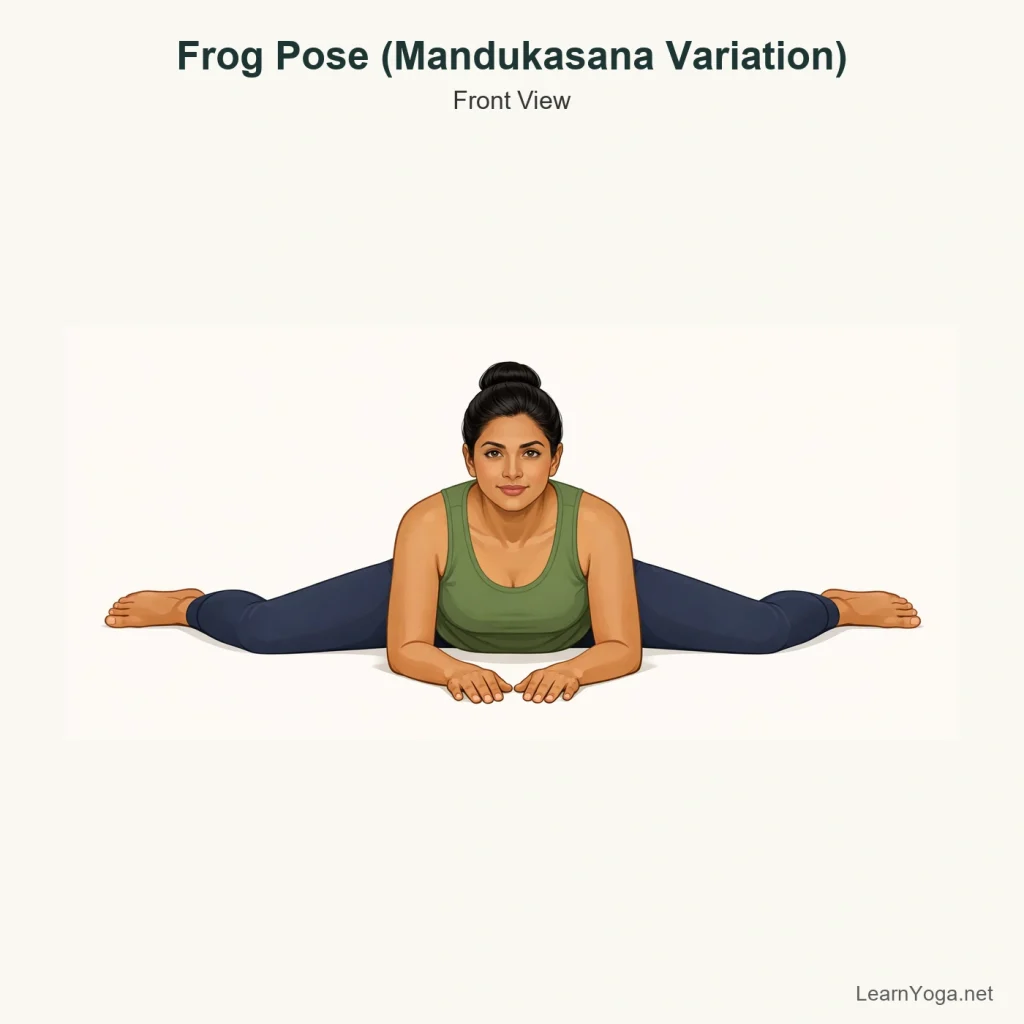
Frog Pose is a deep floor-based hip opener that widens the knees and lengthens through the inner thighs. It can be useful for exploring hip mobility, but it needs patience and enough support under the knees, ankles and torso.
Frog Pose asks for a wide-knee position with the shins on the floor, so the sensation tends to land strongly in the inner thighs and around the hips quite quickly. It is not a pose to force. A smaller version often gives a clearer stretch than pushing the knees as wide as possible. Keep the setup practical, move in slowly and treat support as part of the pose rather than a backup plan.
How to do Frog Pose
Start on hands and knees with a folded blanket under both knees if the floor feels hard.
Walk your knees apart a little at a time. Keep your ankles roughly in line with your knees and let the inner edges of the feet rest on the floor, or flex the feet if that feels steadier for your knees.
Pause with your hands under your shoulders and notice whether the sensation stays in the inner thighs and hips rather than turning sharp at the knees.
If it feels manageable, lower to your forearms or place a bolster, stacked blankets or blocks under your chest so you do not have to hang in the pose.
Lengthen slightly from the crown of the head forward and let the lower belly stay easy. Try not to drive the lower back into a hard arch.
Stay for 5 to 10 slow breaths, or up to about 90 seconds if you can breathe evenly and keep your face, jaw and throat soft.
To come out, press into your hands, lift your chest, and slowly walk your knees back toward each other before sitting back or resting on your belly.
Yogita's tip
If the stretch feels lost and the lower back takes over, bring your knees slightly closer together first. For many people that makes the inner-thigh work clearer and the pose more sustainable.
Benefits
Explores hip abduction in a sustained, floor-based position.
Lengthens the inner thighs and groin area for many bodies.
Can help you practise staying steady with strong sensation without rushing deeper.
Offers a different hip-opening shape from lunge-based poses or seated folds.
Common mistakes
Sliding the knees too wide too fast and losing steady breath.
Dropping the belly heavily and compressing the lower back.
Forcing the ankles or feet into a position that makes the knees feel strained.
Holding the pose without enough support under the chest or knees.
Staying because the shape looks right even though the sensation feels sharp or pinchy.
Make it work for you
Blanket under the knees
Place one or more folded blankets under your knees to reduce pressure on the kneecaps and make it easier to stay without bracing.
Bolster under the chest
Rest your forearms or chest on a bolster, block stack or folded blankets so the torso is supported and the hips do not have to carry all the weight.
Smaller frog
Keep the knees only moderately apart and stay higher on your hands. This often gives a clearer, safer version than pushing into the deepest range.
Alternatives
Bound Angle Pose
Sit upright with the soles of the feet together and knees apart, supporting the outer thighs if needed.
Use this if getting to a wide-knee floor position is difficult or if your knees do not tolerate Frog Pose well.
Reclining Bound Angle
Lie back with the soles of the feet together and knees supported by blocks or blankets.
Use this for a gentler groin-opening shape with much less knee load and less demand on the hands.
Wide-Knee Child's Pose
Take the knees wide but keep the hips moving back toward the heels, with support under the chest if needed.
Use this if you want some inner-thigh opening in a more familiar and easier-to-exit shape.
Common variations
Forearm Frog
A lower version with the forearms on the floor or on support, usually increasing the stretch through the inner thighs.
Supported Frog
A gentler version with bolsters or blankets under the chest and sometimes under the pelvis to reduce intensity.
Rocking Frog
A dynamic variation where you slowly shift a little forward and back to explore changing sensation rather than holding still.
Safety and contraindications
When to avoid or get individual guidance
Recent or current knee irritation
Groin strain or inner-thigh strain
Hip pain that increases with wide-knee positions
Frog Pose places meaningful load on the knees and a deep stretch through the inner thighs and hips, so move in gradually.
Use padding under the knees and enough support under the torso to avoid dropping your weight into the joints.
Back off if the sensation shifts from broad stretch to sharp knee pain or strong pinching in the groin or hip.
A smaller range is still the pose.
Stop if you feel sharp pain at the knee joint, a pulling sensation that feels too strong in the groin, or pinching deep in the hip that does not ease when you narrow the stance. Get individual guidance before trying the pose again.
Accessibility and limited mobility
This pose can be awkward for anyone who finds kneeling, crawling or getting down to the floor difficult. A seated option such as Bound Angle Pose may be more practical.
Older adults or anyone with sensitive knees often do better with generous padding and a smaller range, or by choosing a reclined alternative instead.
If hip range is limited, support under the chest usually makes the pose feel clearer and easier to exit.
Easier options
Use these related poses when you want a more accessible way to practise a similar movement or prepare for this pose.
Either can work. Some people prefer the inner edges of the feet resting on the floor, while others feel steadier with the feet flexed. Choose the version that keeps the knees feeling more supported and the sensation centred in the inner thighs.
How wide do my knees need to go?
Only as wide as you can keep a smooth breath and clear, even sensation. Wider is not automatically better here. A moderate stance often gives a more useful stretch and is much easier to leave without strain.
Why do I feel this more in my knees than my hips?
That usually means the setup needs adjusting. Try bringing the knees closer together, adding more padding, supporting your chest, or changing the foot position. If the knees still take the load, choose a gentler alternative such as Reclining Bound Angle.
Do I need to lower all the way to my forearms?
No. Staying on your hands is a perfectly valid version. Lowering the torso can increase the sensation, but only go down if you can keep the front of the body supported and the lower back reasonably neutral.
Reviewed for yoga instruction
Yogita
Certified Yoga Instructor with 5+ years of Teaching and Consistent Practice