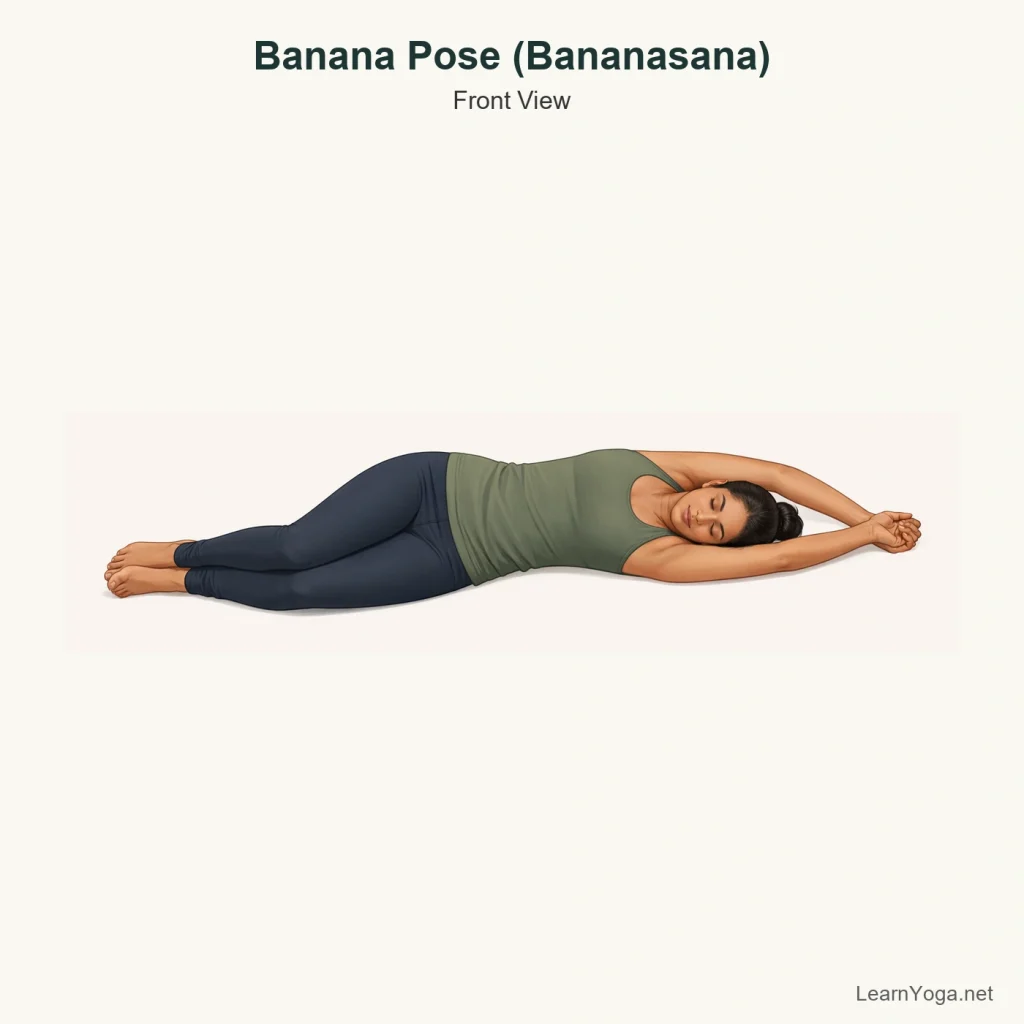
Banana Pose is a quiet side bend done on your back. It gives you a simple way to lengthen through one whole side of the body without needing balance or much effort.
This pose is often more comfortable than side bending in standing because the floor supports you. The shape is simple, but it works best when you do not force the reach. Think of it as making a soft crescent with your body. Some people feel more sensation through the outer hip and ribs, others through the shoulder or waist. A smaller shape is still the pose.
How to do Banana Pose
Lie on your back with both legs long. If your lower back feels tight, bend your knees for a moment and settle the back of the pelvis on the floor.
Walk both feet a little to the right side of your mat.
Slide your hips slightly to the right as well, keeping both sides of the waist long rather than sharply collapsing one side.
Reach both arms overhead and walk your hands to the right, making a gentle banana shape from your heels to your fingertips.
If it is comfortable, cross your left ankle over your right ankle to deepen the stretch along the left side body. If that feels too strong, keep the feet uncrossed.
Let the back of your head rest easily. Soften your jaw, ribs and belly, and breathe into the left side waist and rib cage for 5 to 8 slow breaths.
To come out, uncross the ankles if needed, bring your arms and legs back through centre, pause, and then repeat on the second side.
Yogita's tip
If the pose feels pinchy near the lower ribs or shoulder, make the curve smaller. Usually a gentle sideways drift of the arms and legs feels better than trying to pull yourself into a dramatic crescent.
Benefits
Lengthens the side body, especially around the outer waist and ribs.
Gives a gentle stretch through the shoulder line when the arms are overhead.
Can create more space through the outer hip and flank after lots of sitting.
Offers a calm, low-effort shape for the end of practice or a quiet pause during the day.
Common mistakes
Pulling the arms and legs so far to the side that the breath becomes tight.
Forcing the ankles to cross when that makes the low back or outer hip feel strained.
Letting one shoulder lift and tense toward the ear instead of softening the upper chest.
Holding the pose without returning to centre between sides.
Make it work for you
Bent-Knee Banana
Keep both knees bent with your feet on the floor while you move your upper body into the side bend. This usually reduces pulling across the low back and hips.
One Arm Overhead
If both arms overhead feel too intense, keep the lower arm by your side and only reach the top arm overhead into the side bend.
Head Support
Place a thin folded blanket under the head if the chin lifts a lot or the neck feels uncomfortable on the floor.
Alternatives
Swaying Palm Tree Pose
Practise a gentle standing side bend with feet grounded and one arm overhead at a time.
Use this if lying down is not practical or getting to the floor is difficult.
Banana Pose with Knees Bent
Make a smaller crescent shape with both feet on the floor and skip the ankle cross.
Use this if straight legs pull on the low back or hamstrings.
Constructive Rest Pose
Lie on your back with knees bent and feet on the floor, arms resting by your sides.
Use this if you want a quieter rest without the side bend.
Common variations
Ankles Crossed Banana Pose
Cross the outer ankle over the inner ankle to increase the stretch along one side of the body.
Bent-Knee Banana Pose
Keep both knees bent and feet grounded while the upper body moves into the crescent shape.
Single-Arm Banana Pose
Reach only one arm overhead while the other arm stays down by your side for a milder shoulder demand.
Safety and contraindications
When to avoid or get individual guidance
Skip or reduce the pose if lying flat on your back is not comfortable for you right now.
Use a smaller version if overhead arm position irritates the shoulders.
Keep the shape mild enough that your breath stays easy.
If reaching both arms overhead bothers your shoulders or neck, lower one arm or both.
Come out if you feel sharp or pinching pain in the shoulder, low back or outer hip.
If a gentle version still causes sharp pain in the shoulder, side ribs, low back or hip, stop and get individual guidance before trying it again.
Accessibility and limited mobility
This pose can suit many older adults because it does not require balance, but getting down to the floor and back up may still be the main barrier.
If lying flat is uncomfortable, place a folded blanket under the head or bend the knees.
A smaller side bend is often more useful than a strong stretch, especially if shoulder range is limited.
Easier options
Use these related poses when you want a more accessible way to practise a similar movement or prepare for this pose.
Only if it feels comfortable. Crossing the outer ankle over the inner one can increase the side stretch, but it is not required. If your low back, outer hip or knees feel strained, keep the feet separate.
What if my shoulders do not like my arms overhead?
Try one arm overhead and keep the other arm by your side, or rest both arms lower in a wide V shape. The pose can still work well without forcing a full overhead reach.
Why do I feel this more in my hip than my ribs?
That is common. Depending on your proportions and daily habits, the stretch may show up more in the outer hip, waist, shoulder or rib cage. As long as the sensation is broad and manageable rather than sharp, that is fine.
How long should I stay in the pose?
For a simple practice, stay for 5 to 8 slow breaths on each side. If you are using it as a resting pose, you might stay 1 to 2 minutes per side, as long as the breath remains easy.
Reviewed for yoga instruction
Yogita
Certified Yoga Instructor with 5+ years of Teaching and Consistent Practice