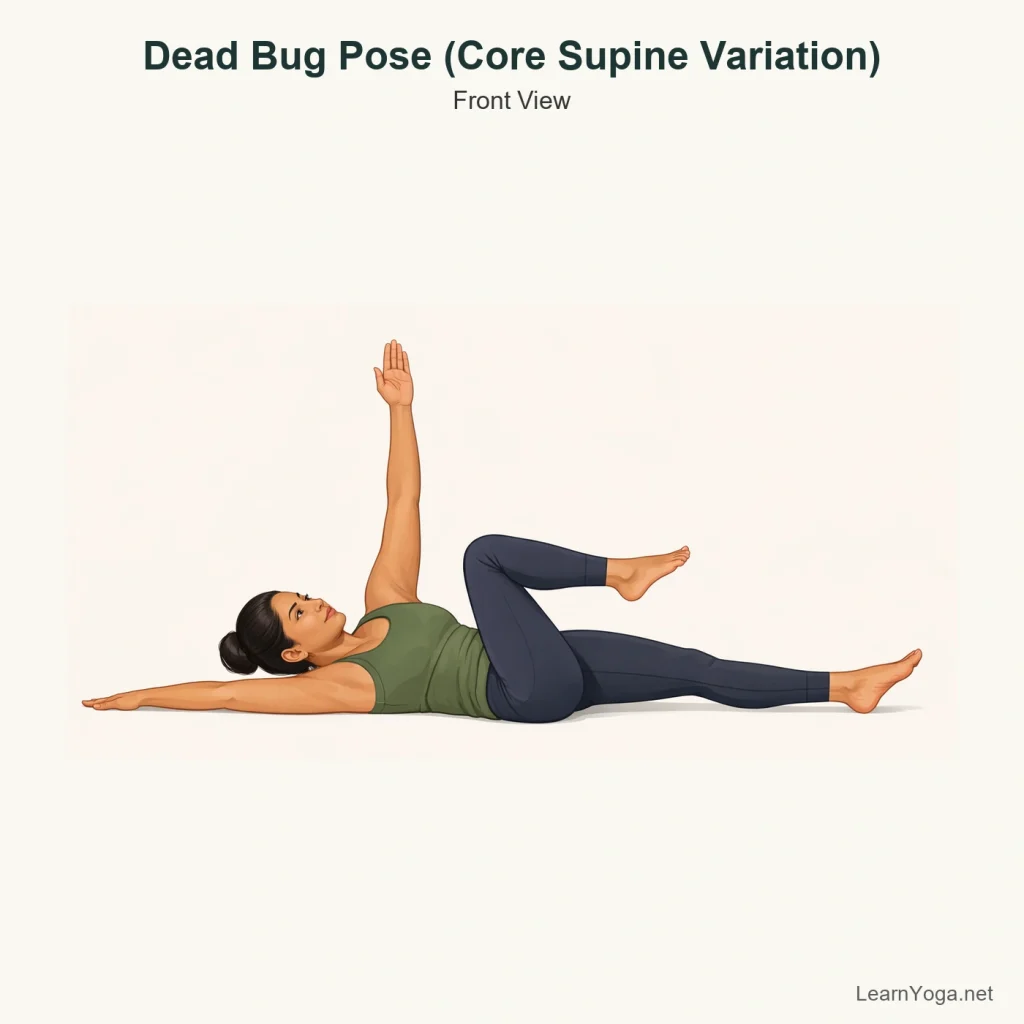
Revolved Abdomen Pose is a reclining twist where both legs move across the body while the shoulders stay grounded as comfortably as possible. It is a simple way to explore spinal rotation and gentle core control without needing to balance.
Beginnersupinetwistcorehipslower-backspineCalming
Typical hold: 3 to 6 breaths per side
Timing: 3 slow breaths per side · 5 breaths per side · 20 to 30 seconds per side
This supine twist can be done in a small range or a fuller one. The work is not in getting the knees to the floor. It is in moving with enough control that the breath stays steady and the front of the body does not harden. Some people prefer the knees bent; others are more comfortable with the legs a little farther away from the chest. Let the twist suit your back and hips rather than trying to copy a fixed shape.
How to do Revolved Abdomen Pose
Lie on your back with your arms out to the sides or in a cactus shape, palms facing up if that feels easier on your shoulders.
Draw both knees in over your hips so your thighs are roughly upright and your shins are parallel to the floor.
Take a quiet inhale in the centre and feel the back of your ribs on the mat.
As you exhale, lower both knees to the right in a slow arc. Let the movement come from the waist and ribs as well as the hips.
Keep the left shoulder heavy enough to stay broad on the floor if possible, but do not strain to pin it down.
Turn your head to the left only if your neck feels comfortable there. Otherwise keep your gaze up.
Stay for 3 to 6 breaths. With each inhale, soften the belly and widen the back ribs. With each exhale, let the legs rest a little more heavily without pushing.
Inhale back through centre using your abdominal muscles, pause for a breath, then repeat on the second side.
Yogita's tip
If the knees feel much heavier than your waist can comfortably control, slide them slightly farther away from your chest. That usually makes the twist feel broader and less compressed in the low back.
Benefits
Explores gentle rotation through the spine in a supported position.
Can help you notice the difference between moving the legs and actually twisting from the ribs and waist.
Gives the abdominal muscles some light work as you return to centre with control.
May feel settling at the end of practice because the floor supports the body.
Common mistakes
Dropping the knees too far and then feeling the top shoulder lift sharply away from the floor.
Pulling the knees tightly into the chest, which can make the low back feel crowded.
Forcing the head to turn away from the knees even when the neck feels strained.
Using momentum to swing from side to side instead of moving steadily with the breath.
Make it work for you
Knees Bent and Lowered on Support
Place a folded blanket, bolster, or block under the outer knees so the legs can rest before they reach the floor. This often makes the twist easier to breathe in.
Feet on the Floor Twist
Keep both feet on the mat with knees bent and together, then let the knees tip side to side a smaller amount. This reduces the lever of the legs and is often friendlier for the low back.
Arms Narrower
If a wide T shape bothers the shoulders, place the arms lower than shoulder height or rest the hands on the belly and side ribs instead.
Alternatives
One-Knee Supine Twist
Keep one foot on the floor and guide only one knee across the body while the other leg stays planted or extended.
Use this if twisting both legs together feels too heavy on the low back or hard to control.
Constructive Rest Pose
Lie on your back with knees bent and feet on the floor, letting the pelvis and ribs settle evenly.
Use this if you want a quieter resting position instead of a twist.
Common variations
Straight-Leg Revolved Abdomen Pose
Both legs extend more fully as they move across the body, which increases the lever and usually makes the pose stronger through the core and outer hips.
Bent-Knee Version with Wide Arms
The classic beginner-friendly shape with knees bent to about 90 degrees and arms extended for support.
Head Neutral Variation
The knees move to one side while the head stays facing the ceiling, which is often more comfortable for the neck.
Safety and contraindications
When to avoid or get individual guidance
Avoid or reduce the range if twisting aggravates a recent low back, hip, or neck irritation.
Skip the fuller version after a fresh abdominal strain.
Keep the twist in a comfortable range, especially if your low back feels stiff today.
Support the knees if they hover and the pose feels pulled or jerky.
Let the head stay neutral if turning the neck adds strain.
If this pose regularly brings sharp pain, radiating symptoms, or a strong pinching feeling in the low back or neck, stop and get individual advice before repeating the deeper twist.
Accessibility and limited mobility
This pose works well for many people who prefer to practise on the floor without bearing weight through the wrists or knees.
If getting down to the floor is difficult, choose a simpler reclined position such as Constructive Rest Pose instead of forcing the transition.
Older adults or anyone with limited spinal rotation may be more comfortable with the feet on the floor version and support under the knees.
If shoulder range is limited, the arms do not need to form a straight line. Place them lower or rest one hand on the belly.
Easier options
Use these related poses when you want a more accessible way to practise a similar movement or prepare for this pose.
No. Let the knees stop wherever your shoulders, waist, and breath still feel manageable. Resting the legs on a prop is often more useful than trying to reach the floor.
Why does my top shoulder lift up?
Usually the legs have gone farther than your ribs can comfortably rotate. Bring the knees a little closer to centre or place support under them. Think of widening across the collarbones rather than forcing the shoulder down.
Should I keep my knees stacked over each other?
That is a helpful starting point, but it does not need to be exact. If one knee slides slightly forward and the twist feels easier in your low back, that is fine.
Is it better to practise this slowly or hold it still?
Both can work. Moving side to side with the breath can feel gentle and rhythmic, while staying for several breaths gives the body time to settle. Choose the version that lets you stay relaxed and controlled.
Reviewed for yoga instruction
Yogita
Certified Yoga Instructor with 5+ years of Teaching and Consistent Practice