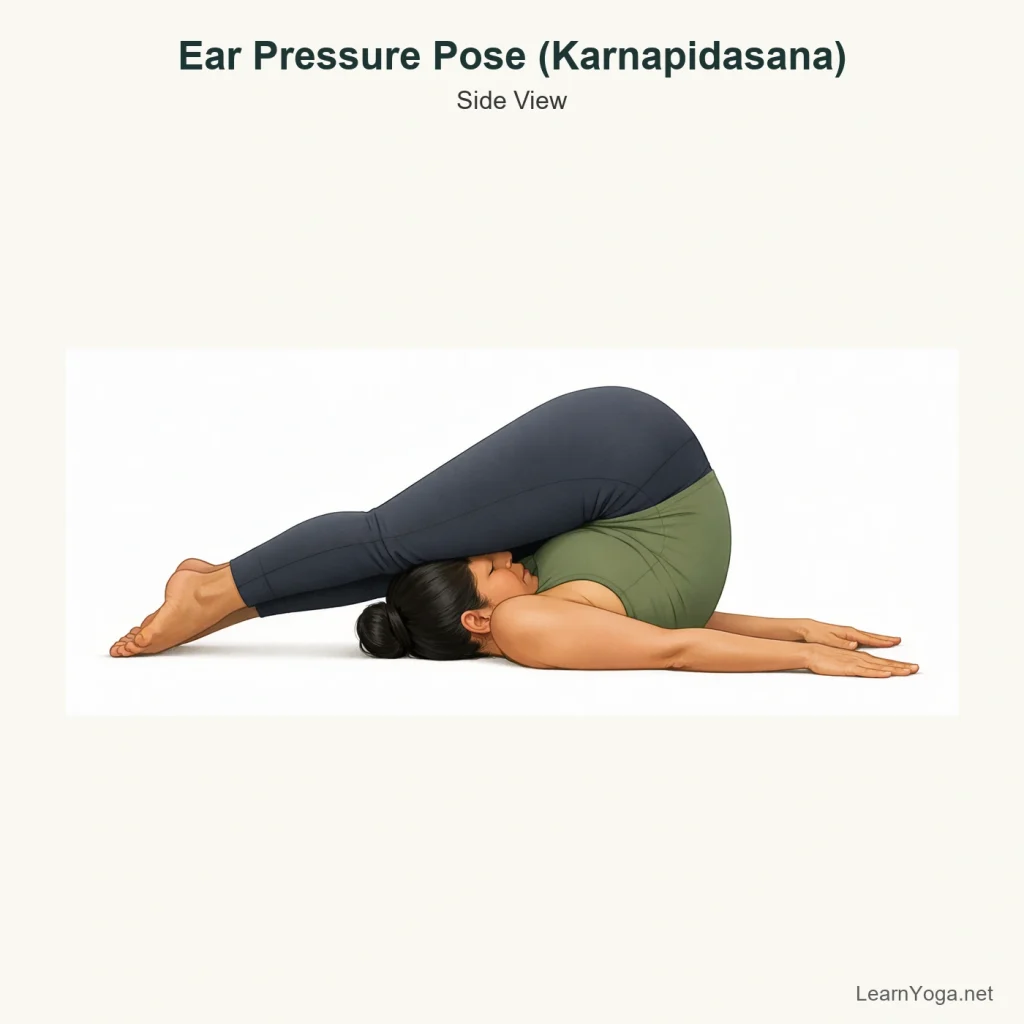
Plow Pose is an inverted forward-fold shape where the legs move overhead while the shoulders and upper arms support the base. It asks for controlled entry and exit, and it works best when the back of the body lengthens without forcing the feet to the floor.
In Plow Pose, the dramatic part is where the feet go, but the more useful place to pay attention is the base underneath you. A steady version usually comes from broad shoulders, a quiet neck and a slow rollover rather than from trying to reach the toes down. For some bodies the feet touch the floor easily. For others they do not, and that is completely fine.
How to do Plow Pose
Lie on your back with your arms alongside you, palms down. Settle the back of the head on the mat and keep the neck in a neutral position.
Bend your knees and draw them toward your chest. Press the arms and palms into the floor.
On an exhale, roll the pelvis up and bring your thighs toward your torso. Move slowly so the lift comes from control, not momentum.
Support your back with your hands if needed, or keep the arms long on the floor if that feels steadier for you.
Continue taking the legs overhead. If your feet comfortably reach the floor behind you, let them land lightly. If they do not, keep the knees bent or rest the feet on a support such as a chair seat or stacked blocks.
Keep the weight on the shoulders and upper arms rather than turning the head. Let the back of the neck stay long and the throat soft.
Stay for 3 to 8 breaths. Breathe into the back ribs and keep the face, jaw and eyes relaxed.
To come out, bend your knees slightly, support your back with your hands if helpful, and slowly roll down one section of the spine at a time until the pelvis returns to the floor.
Yogita's tip
If the feet are hovering and the pose feels compressed, do not chase the floor with your toes. Bend the knees a little more and lift the thighs toward the ceiling first. That usually gives the spine more space and takes some push out of the neck.
Benefits
Lengthens the back body, especially along the spine and backs of the legs.
Builds awareness of controlled spinal rolling and overhead positioning.
Can help you practise staying steady and unhurried in an inverted shape.
Encourages work through the shoulders and upper back to support the pose.
Common mistakes
Using momentum to throw the legs overhead instead of lifting with control.
Forcing the feet to the floor and ending up compressed through the neck or breath.
Turning the head while in the pose.
Letting the elbows splay wide if the hands are supporting the back.
Holding the breath or tightening the jaw and throat.
Make it work for you
Feet on a chair
Place a sturdy chair behind your head before you begin. When you roll over, rest your feet on the chair seat instead of reaching for the floor. This reduces the depth and usually makes the pose easier to breathe in.
Bent-knee Plow
Keep the knees softly bent and the thighs closer to your torso. Focus on a broad upper back and steady shoulders rather than straight legs.
Hands supporting the back
Bring your hands to the back ribs or pelvis to help hold the lift. Keep the elbows no wider than shoulder width if possible.
Alternatives
Legs Up the Wall Pose
Lie with your legs resting up a wall and your pelvis a comfortable distance away from it.
Use this if you want a quiet inverted shape without loading the neck or taking the legs fully overhead.
Supported Bridge Pose
Lift the pelvis and place a block or firm support under the sacrum, then let the chest stay open and the neck neutral.
Use this if rolling into Plow feels too strong on the neck, shoulders or spine.
Knees-to-Chest Pose
Hug the knees in while keeping the head and shoulders relaxed on the floor.
Use this if you want a gentler curled shape without the overhead range.
Common variations
Supported Plow
The feet rest on a chair, blocks or another support behind the head so the pose is less deep and easier to organise.
Bent-Knee Plow
The knees stay bent to reduce pull through the backs of the legs and make the rollover more manageable.
Hands-Supported Plow
The hands hold the back to help maintain lift through the pelvis and reduce the feeling of dropping into the neck.
Safety and contraindications
When to avoid or get individual guidance
Avoid this pose if you currently have a neck injury or significant neck irritation.
Skip it if rolling onto the shoulders causes sharp pain or strong pressure in the neck.
Keep the head still once you are in the pose. Do not turn to look sideways.
If the breath feels strained or the neck feels compressed, come out and use a supported version.
Move into and out of the pose slowly rather than swinging the legs overhead.
Sharp or increasing neck pain, tingling that travels into the arm or hand, or pressure that does not settle after you come out means it is best to pause Halasana and get individual guidance before trying it again.
Accessibility and limited mobility
This pose can be awkward if getting up and down from the floor is difficult. A wall-based option such as Legs Up the Wall may be more practical.
Older adults or anyone with limited neck or shoulder range may prefer a supported version with the feet on a chair rather than taking the feet to the floor.
If the hamstrings tighten strongly when the legs go overhead, keep the knees bent instead of forcing the legs straighter.
Easier options
Use these related poses when you want a more accessible way to practise a similar movement or prepare for this pose.
No. That is not the main goal. If your feet hover, or only reach a chair or blocks, you can still practise the pose well. The more important signs are a steady breath, broad shoulders and no feeling of being jammed into the neck.
Should I keep my hands on my back or on the floor?
Either can work. Hands on the back usually help if you need more lift and control. Arms on the floor can feel simpler if your feet are already well supported. Choose the version that lets your neck stay quiet and your breathing stay easy.
Why does this pose feel heavy in my neck?
Usually that happens when the legs are being forced too far overhead or the upper back is not lifting enough. Try a supported version with the feet on a chair, keep the knees more bent, and come out if the pressure does not improve quickly.
How long should I stay in Plow Pose?
A short hold is enough for many people. Start with 3 slow breaths. If the pose stays comfortable and your breath remains smooth, you might stay for 5 to 8 breaths. There is no need to hold longer if the shape becomes strained.
What is a good alternative if Plow Pose feels too intense?
Legs Up the Wall is a very practical substitute. It gives you an inverted rest without the same neck and spinal demand. Supported Bridge is another good option if you want some lift through the pelvis without taking the legs overhead.
Reviewed for yoga instruction
Yogita
Certified Yoga Instructor with 5+ years of Teaching and Consistent Practice