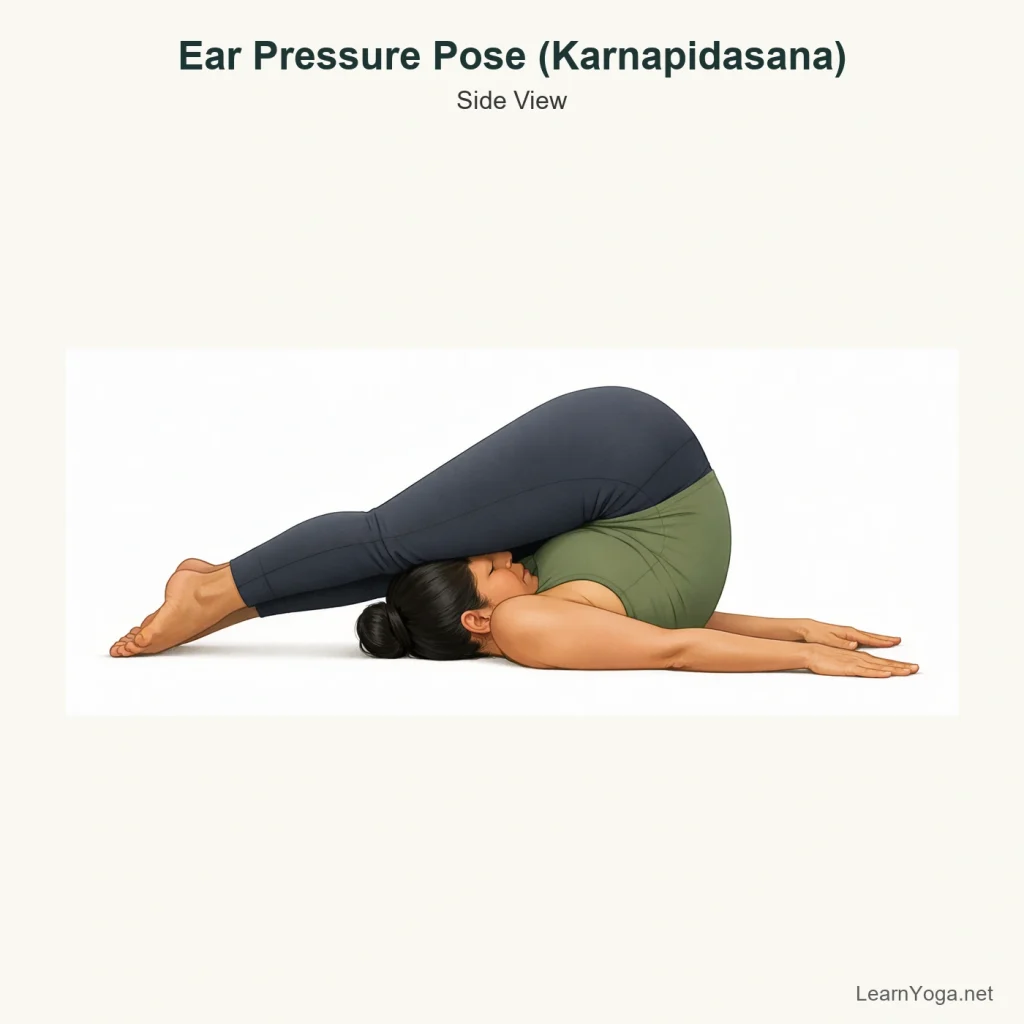
Ear Pressure Pose is a compact inversion usually entered from Plow Pose, with the knees bending toward the ears. It asks for controlled spinal flexion and a stable shoulder base more than extra force.
This pose can look folded and quiet from the outside, but the important work is in how you organise the base. The shoulders stay broad, the back body rounds evenly, and the neck should not feel jammed. The knees may reach the floor beside the ears, or they may hover. Both are valid if your breath stays steady and you can come out with control.
How to do Ear Pressure Pose
Begin in Plow Pose with your shoulders grounded and your hands either supporting your back or resting on the floor.
Take a smooth exhale and bend both knees, drawing them toward the sides of your head.
Let the knees move in the direction of the ears without pulling them down with force. Your feet can stay light.
Keep the weight on the backs of the shoulders rather than rolling onto the neck. Soften the jaw and throat.
If it feels steady, release the hands to the floor behind you or keep them on the back for support.
Stay for 3 to 5 breaths, allowing the back ribs to widen on each inhale and the front body to soften on each exhale.
To come out, place the hands back to the floor or support the back, then slowly return through Plow Pose before rolling down one vertebra at a time.
Yogita's tip
If the knees are close to the ears but the pose still feels tense, look at your throat. A slightly softer throat and jaw often makes the whole shape feel less compressed without changing the position much.
Benefits
Practises controlled spinal flexion from an inverted position.
Can help you explore a more compact shape after Plow Pose without needing to force the legs straight.
Encourages awareness of the shoulder base and how to keep weight off the neck as much as possible.
Offers a quiet, inward-focused hold that can slow the pace of practice near the end of a sequence.
Common mistakes
Rolling too far onto the neck instead of staying grounded through the shoulders.
Forcing the knees down beside the ears and losing steady breath.
Entering too quickly from Plow Pose without enough control through the centre of the body.
Holding the breath once the shape becomes compact.
Trying to straighten or tidy the legs instead of allowing an honest bend in the knees.
Make it work for you
Supported hands on back
Keep your hands on your back rather than releasing them to the floor. This usually gives more control while you bend the knees toward the ears.
Hovering knees
Let the knees stop wherever they naturally reach, even if they do not touch the floor. Focus on steady breathing and a broad upper back.
Alternatives
Plow Pose
Stay in Plow Pose instead of bending the knees more deeply.
Use this if Ear Pressure Pose feels too compact in the neck, back or breath.
Legs Up the Wall
Rest with your legs up the wall and your pelvis on the floor or lightly supported.
Use this if you want a gentler inversion without neck loading.
Supported Bridge Pose
Place a block or firm support under the sacrum and rest there with the chest open.
Use this if getting into or out of deep inverted spinal flexion is not comfortable.
Common variations
Hands supporting the back
A steadier version where the hands stay at the back ribs or pelvis while the knees bend in.
Knees hovering near the ears
A lighter version where the knees move toward the ears but do not need to reach the floor.
Safety and contraindications
When to avoid or get individual guidance
Avoid if you currently have a neck injury or neck pain.
Skip this pose if inverted spinal flexion is not comfortable for you today.
Use a simpler option if your breath feels cramped once you fold in.
Keep the weight centred on the shoulders, not directly on the neck.
Do not force the knees down beside the ears if the breath becomes restricted.
Come out slowly, especially if you feel pressure in the throat or upper spine.
Stop right away for sharp neck pain, pressure in the throat or upper spine that does not settle after coming out, or tingling down the arms. Choose a simpler inversion and get individual guidance before trying Karnapidasana again.
Accessibility and limited mobility
This pose is not a good fit for many beginners, especially if getting into or out of inversions feels awkward or rushed.
Older adults or anyone with limited neck, shoulder or spinal flexion may find a gentler option such as Legs Up the Wall more workable.
If getting down to the floor or rolling the spine up and down is difficult, choose a supported supine alternative rather than trying to force the transition.
Easier options
Use these related poses when you want a more accessible way to practise a similar movement or prepare for this pose.
Do my knees need to touch the floor beside my ears?
No. For many people they will hover, and that is completely fine. The more useful markers are a steady breath, a broad shoulder base and the feeling that you can leave the pose slowly.
Should my hands stay on my back or reach to the floor?
Either can work. Keeping the hands on the back usually gives more support and makes the transition calmer. Releasing the hands to the floor asks for a bit more stability through the shoulders and trunk.
Why does this pose feel cramped in my throat?
That often happens when too much weight has rolled toward the neck or when the knees are being pulled in too aggressively. Ease out slightly, return toward Plow Pose, and rebuild the shape with less force.
Can I practise Ear Pressure Pose without doing Shoulder Stand first?
It is usually learned from Plow Pose or after Shoulder Stand because those shapes help you organise the base. If you do not already feel steady there, a gentler inversion is often the better choice.
Reviewed for yoga instruction
Yogita
Certified Yoga Instructor with 5+ years of Teaching and Consistent Practice